Oil prices fall after US waives Iran sanctions and peace talks in Switzerland progress – business live
US waives sanctions on Iran for 60 days after first talks in Switzerland to negotiate peace deal; communications line opened to ensure safe passage through strait of HormuzNissan has stopped work on a fully electric version of its top-selling model Qashqai in Sunderland as part of a cost-cutting drive, Reuters
Julia Kollewe
June 23, 2026
0 Comments
Nissan has stopped work on a fully electric version of its top-selling model Qashqai in Sunderland as part of a cost-cutting drive, Reuters reported.
The move comes as traditional rivals and new Chinese entrants flood Europe with affordable alternatives.
The carmaker has since embarked on a major global restructuring, however, and is in talks with the UK government about securing financial support for an updated roadmap for the factory, expected in coming months, Reuters reported last week.
Nissan makes the electric compact Leaf at the plant and in April unveiled an electric crossover SUV Juke to be built there.
Development of the electric Qashqai was halted quietly early last year. Even if Nissan resumes work on it, it would not come to market until the early 2030s.
In a statement, Nissan did not address its plans for a fully electric Qashqai, but said it remained committed to expanding its “electrified” line-up, which includes hybrid models.
The company added that the European market had experienced “significant volatility” in EV demand and that it was pursuing a “balanced” electrification strategy.
Nissan said earlier this year it would halt plans to build two electric SUVs at its Canton, Mississippi, plant and instead focus on hybrid models. Globally, the firm has said it will cut the number of its models to 45 from 56.
The company sells the Qashqai as a petrol and hybrid vehicle, and the model accounted for about 45% of its total sales of 330,000 cars in Europe in 2025.
Any new government funding for Nissan is expected to be tied to a commitment to produce new models or variants and protect jobs at Sunderland, which employs about 6,000 workers in England’s industrial northeast.
Nissan said this month it had signed a pact with Chery to examine manufacturing the Chinese carmaker’s vehicles using one of the two lines at Sunderland.
Britain is also consulting carmakers over plans to water down rules that require them to hit EV sales targets or face punitive fines.
Ticket reseller StubHub UK has been fined almost £900,000 and ordered to make payments to more than 50,000 fans for not showing the full price of tickets at the time of booking, an illegal practice known as “drip pricing”.
The UK competition watchdog, which launched an investigation into the sales practices of eight firms including rival reseller Viagogo UK last year, said that StubHub must issue refunds exceeding £590,000 to customers.
The Competition and Markets Authority (CMA) said that the average refund for the 51,350 customers it identified who had a “hidden fee” added at the end of the online ticket buying process is about £10.33 for each transaction.
The CMA also fined StubHub £889,200 for infringing consumer protection law. Emma Cochrane, executive director of consumer protection, said
Hitting customers with hidden fees is illegal. It’s not fair to draw people in with what looks like a good deal, only for them to find the real price is higher when they get to the checkout due to extra charges that can’t be avoided.
The CMA investigated the experience of fans buying tickets for gigs and sports events on StubHub and found that between 6 April and 7 December last year some were required to be mandatory costs such as delivery and service fees.
These fees were added at the final stage of the checkout process, and not included in the total price from the start, which broke consumer law.
The competition watchdog said that the almost £900,000 penalty includes a 40% reduction because StubHub admitted breaking the law and chose to settle the case. Cochrane said:
Our message to businesses is simple: be transparent on costs or risk CMA action. Going to a live gig or sports game is an event many people save for – and our action today means thousands of fans will get back money taken unfairly through hidden fees.
Great Britain’s grid operator has played down the risks of blackouts this winter, despite European gas storage levels dropping below the level seen during the 2022 energy crisis, my colleagues Mark Sweney and Jillian Ambrose report.
The National Energy System Operator (Neso) expects Britain’s electricity supply over winter to outstrip demand by almost 8.8%, with supplies expected to reach an almost five-year high.
Neso said that surplus supply levels dropped to as low as almost 6% the winter following Russia’s invasion of Ukraine four years ago, while this year is expected to almost match 2025’s 9% level, which marked a five year high.
However, Neso’s report noted that across the European Union gas storage levels are at a four-year low, 7% below the level recorded at the same time in 2022.
Gas plants are regularly used to bolster power supplies in the colder months when freezing temperatures drive demand for energy higher, or when wind and solar power is in short supply.
European gas storage reached 41% of capacity on 3 June, thirteen percentage points lower than the 10-year average, eight percentage points lower than last year, and seven percentage points below 2022 levels. Neso said in its report:
This means injection rates for the remainder of the summer must be high to meet regulatory targets by the start of winter.
The company, which was acquired by the government from National Grid two years ago, instructs which of the available power plants, batteries and renewable projects such as wind and solar power will generate on a daily basis to maintain a balance between supply and demand.
Deborah Petterson, director of whole energy system resilience at Neso, said:
This has been a year of turbulence in energy markets and geopolitical uncertainty. However, Great Britain’s electricity system has a strong track record of reliability. Sufficient electricity margins [are] expected throughout winter. Households and businesses can be confident that electricity supplies remain secure.
The expected buffer also means that power supply levels will be maintained even if the conflict in the Middle East were to result in gas supply shortages to power plants in Great Britain.
Last year, about 14% of the UK gas supply came from imports – the UK relied on gas imports sourced from countries including the US and Qatar – but this is expected to rise sharply to a quarter by 2030, and almost half by 2035.
Great Britain’s gas use fell by 4% on average last winter, compared to the winter before, according to National Gas, which owns and operates the country’s gas pipeline network.
But the operator warned that while even as the country’s gas use declines “rapid swings in demand are coming more common due to the role gas power plants play in ramping up generation when renewable energy output drops, “placing greater stress on the system at times of highest need”.
Glenn Bryn-Jacobsen, a director at National Gas, said:
Operating conditions are becoming increasingly dynamic, with the system no longer characterised by steady demand patterns but by sharp swings driven by weather and renewable output.”
Its annual winter review showed that on the coldest day of last winter, 5 January, gas plants ramped up over ten-fold from around 2.3 gigawatts the previous day to 26.1GW, due to a slump in wind power.
This represented the largest swing in gasfired generation ever recorded over a 36hour period, according to National Gas figures. The daily peak for winter gas demand was also the second highest recorded in five years, it said. Bryn-Jacobsen said:
While this demonstrates the strength of the current system, it also underscores the increasing complexity of operating and balancing the network.
Good morning, and welcome to our rolling coverage of business, the financial markets and the world economy.
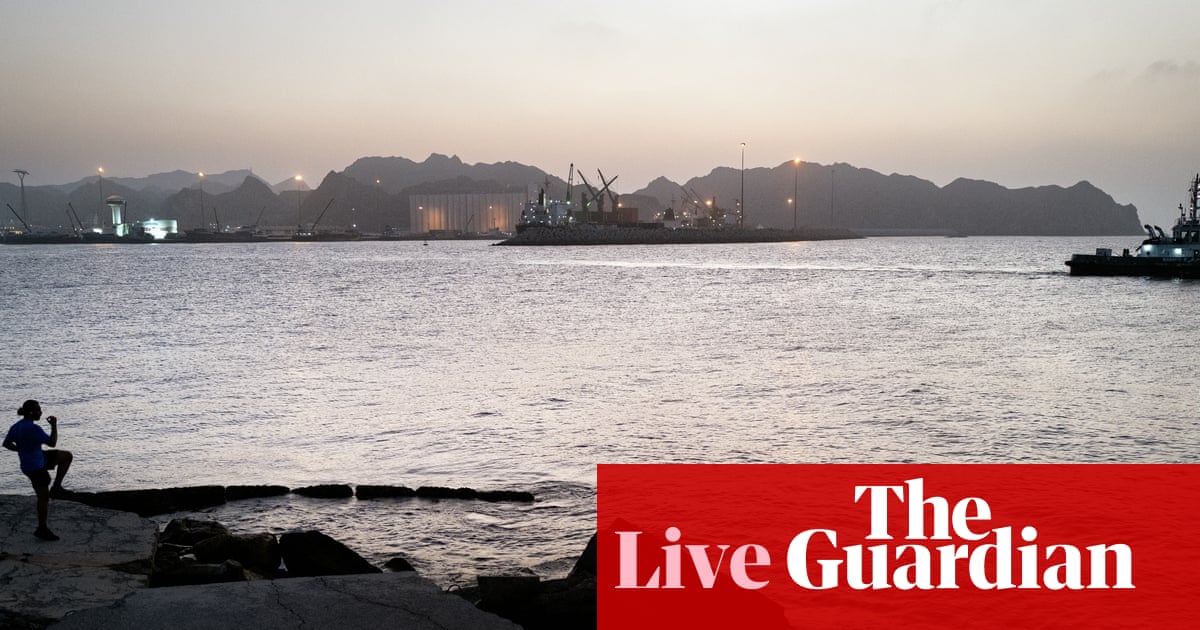
Crude oil has fallen, after the United States waived sanctions on Iran for 60 days from Monday after the first talks to negotiate a permanent peace deal.
US vice president JD Vance said talks with Iranian officials in Switzerland had laid a “good foundation for a successful final deal” to end the war.
Brent crude fell 1.4%, more than $1, to $76.83 a barrel in early London trading, taking it closer to the $72 a barrel level seen before the US and Israel launched missile attacks on Tehran on 28 February.
The US and Iran agreed a roadmap towards a permanent agreement, building on the interim deal signed last week, within 60 days in the Qatari-owned mountain resort of Bürgenstock, according to mediators Pakistan and Qatar.
They also agreed on a mechanism to end fighting in Lebanon between US ally Israel and Iran-aligned Hezbollah, and opened a communications line to help ensure safe passage for commercial ships through the strait of Hormuz.
The US Treasury announced a waiver until 21 August on sanctions, allowing Tehran to sell oil and related products.
Asian shares fell sharply, however, and European and US stock futures are pointing to a lower open later, as amid mounting expectations that the Federal Reserve may take a more aggressive approach to tackle inflation later this year. Japan’s Nikkei tumbled 3.3% while South Korea’s Kospi plunged 9.3% and Hong Hong’s Hang Seng dropped 1.9%.
A full decade has passed since the Brexit referendum. Today marks the 10-year anniversary of the UK’s fateful vote to leave the European Union.
The Agenda
8.15am BST-9am BST: France, Germany, eurozone S&P Global PMI surveys (flash ) for June
9.30am BST: UK S&P Global PMIs flash for June
11am BST: CBI Industrial trends survey
1.15pm BST: US ADP jobs change weekly report
2.45pm BST: US S&P Global PMIs flash for June
6.30pm BST: Bank of England policymaker Swati Dhingra panel discussion at King’s College London: Brexit ten years on




 Julia Kollewe