

Ex-Prime Minister Nikola Gruevski was acquitted of abusing his position over construction of a lavish party headquarters, nicknamed the ‘White Palace’.
 Sinisa Jakov Marusic



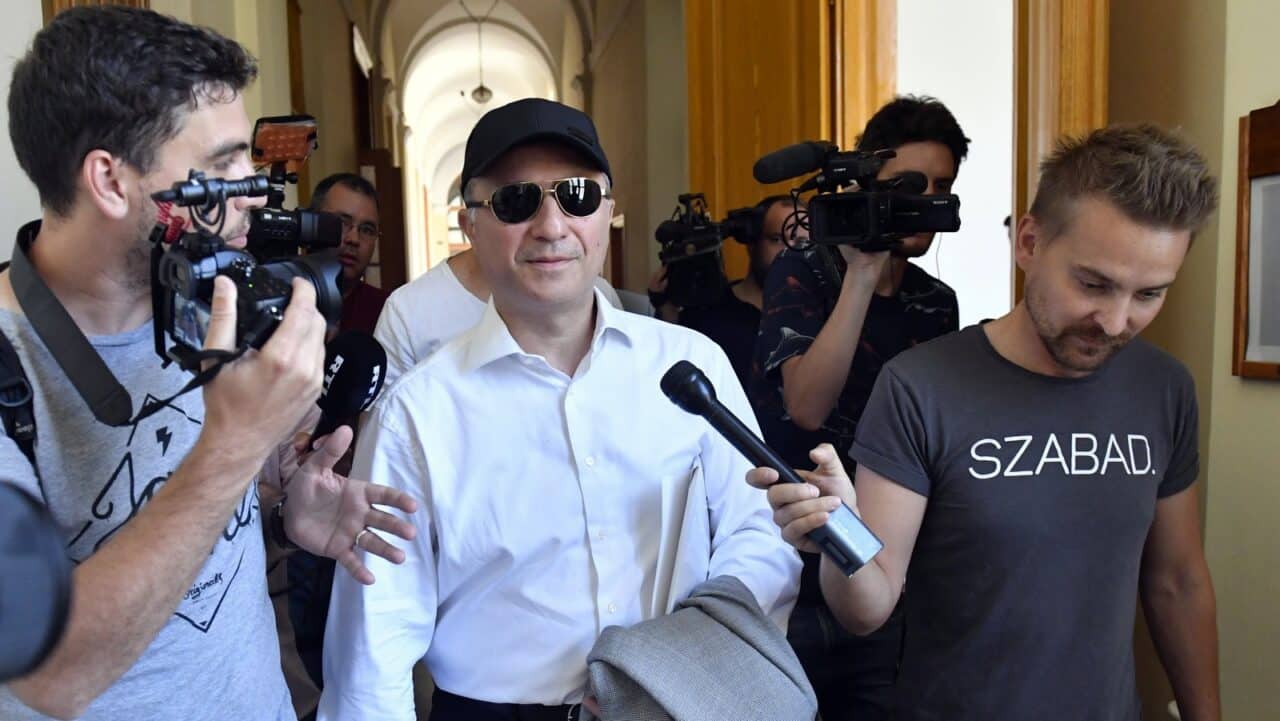
North Macedonia’s former Prime Minister Nikola Gruevski in Budapest, June 2019. Photo: EPA-EFE/ZOLTAN MATHE.
The Skopje Criminal Court on Tuesday ruled that prosecutors had failed to prove that former Prime Minister Nikola Gruevski abused his official position in connection with the construction of his VMRO DPMNE’s party HQ in Skopje, popularly known as the “White Palace”.
The court said the verdict in this retrial reflected the legal consequences of 2023 amendments to the Criminal Code, which significantly altered the legal framework for prosecuting abuse of office cases.
The verdict means the state can no longer seek the confiscation of the party headquarters, allowing VMRO DPMNE, now led by Gruevski’s successor, current Prime Minister Hristijan Mickoski to freely hold onto the multimillion-euro property.
Gruevski, PM from 2006 to 2016, was tried in absentia. Shortly after his authoritarian government was toppled, he fled to Hungary in 2018.
His party returned to power in 2024. However, Gruevski remains a fugitive and if he returns or is brought back to North Macedonia, he still faces serving 10-and-a-half year sentence for two other corruption cases whose verdicts are final. He insists he is the victim of a political witch-hunt.
The so-called “Talir 2” case centred on allegations that Gruevski and former government secretary-general, Kiril Bozhinovski, illegally enabled the construction of VMRO DPMNE’s headquarters, circumventing the rules governing political party financing.
In 2022, a court sentenced Gruevski to six years in prison and ordered the confiscation of the party headquarters estimated to be worth some 14 million euros. The Court of Appeals overturned that verdict in 2024 and ordered a retrial after the 2023 Criminal Code amendments fundamentally changed the legal basis of the charges.
The acquittal is the latest example of the far-reaching impact of the 2023 amendments, adopted by parliament under a fast-track procedure and widely criticised by anti-corruption campaigners, legal experts and the European Union.
Among other changes, the amendments reduced maximum prison sentences and shortened limitation periods for abuse of office and organised crime offences, resulting in many high-profile corruption cases being weakened or terminated.
The Constitutional Court last year ordered parliament to correct what it deemed “damaging” changes to the Criminal Code, which parliament still has not done.
Prosecutors were forced to amend the indictment during the retrial to reflect the new legal provisions and, in the retrial, there was no indictment for Bozhinovski, only for Gruevski.
On Tuesday, the court concluded that, under the revised legislation and the modified indictment, “the prosecution had not established Gruevski’s criminal liability, beyond reasonable doubt”.
Even if the first-instance verdict had been different, the case would have expired next month under the statute of limitations.
The “Talir” investigation has been highly politically sensitive and controversial since it was launched, in 2017.
In April senior prosecutor Lence Ristoska resigned after the new Chief Prosecutor, Nenad Saveski, who assumed office in March, removed her from the two “Talir” cases, both of which target the alleged illegal financing of the party, fuelling claims that he did this under political pressure, which he denied.