

Critics say agency is making emailed appeals over denied access to public information harder by insisting on electronic signatures, which cost money.
 Vasko Magleshov



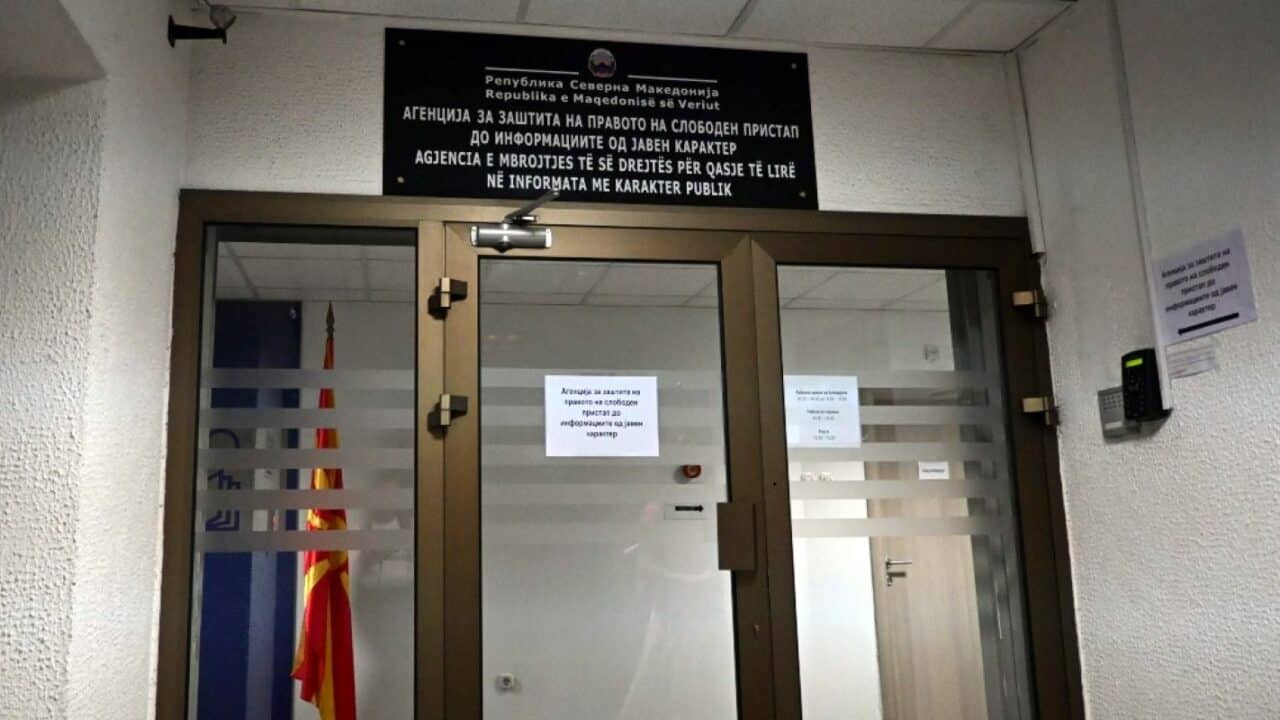
North Macedonia’s Agency for the Protection of the Right to Free Access to Public Information. Photo: BIRN.
Legal experts and transparency advocates have criticised North Macedonia’s Agency for the Protection of the Right to Free Access to Public Information after it began requiring electronic signatures on email appeals, arguing that this unlawfully restricts access to public information.
The Agency is the only institution responsible for deciding appeals when public bodies refuse or fail to provide information requested under the country’s freedom of information law.
Until recently, appeals could be submitted by email without additional formalities. However, the Agency has started rejecting emailed appeals unless they are certified with an electronic signature, which costs 2,000 to 4,000 denars (30 to 65 euros) annually.
Critics say the changes create an unnecessary financial and administrative obstacle to exercising a constitutionally guaranteed right.
“I believe they obstruct free access to public information in this country,” German Filkov, one of the authors of the Law on Free Access to Public Information and president of the Centre for Civil Communications, an anti-corruption and transparency watchdog, told BIRN.
Instead of creating new barriers, Filkov said, the Agency should focus on the growing number of state institutions that fail to respond to freedom of information requests.
The Agency has defended the new requirement by citing the 2015 Law on General Administrative Procedure, which it says obliges anyone communicating electronically with state institutions to use an electronic signature.
However, the State Administrative Inspectorate, which the Agency initially cited as the source of the guidance, told BIRN it had issued no written decision or instruction requiring such a practice.
One of the authors of the Law on General Administrative Procedure, which the Agency cites as the legal basis for its new practice, Skopje university law professor Borce Davitkovski, also questioned the Agency’s interpretation.
“They are not allowed to reject an appeal because it lacks an electronic signature,” Davitkovski told BIRN, noting that the law was designed to protect citizens rather than burden them with unnecessary bureaucracy.
Konstantin Bitrakov, an assistant professor at Skopje’s State Faculty of Law, argued that the Agency was misapplying the legislation and “setting a negative example for public institutions that hold information, whose decisions it is supposed to review on appeal”.
He said the legal provisions on electronic signatures apply to officials issuing administrative decisions, not to citizens filing appeals.
Lawyers told BIRN that citizens and organisations whose appeals have been rejected for lacking an electronic signature should challenge the Agency before the Administrative Court within 30 days.
The dispute comes amid concerns over access to public information.
A BIRN analysis found that the number of appeals filed with the Agency over administrative silence or incomplete responses had doubled last year, from over 300 filed in 2024 to over 600 in 2025.
The European Commission’s latest Rule of Law Report warned that some public institutions continue to reject information requests on arbitrary grounds or with significant delays.
In April, the new head of the Agency, Petar Gajdov, told BIRN in an interview: “As institutions, we are service-oriented towards citizens.”