Stuck in a tug of war between Russia and the EU, Armenians are heading to the polls without much outlook for internal affairs, as remnants of a displacement crisis and civil liberty concerns loom unaddressed.
 Gaia Neiman



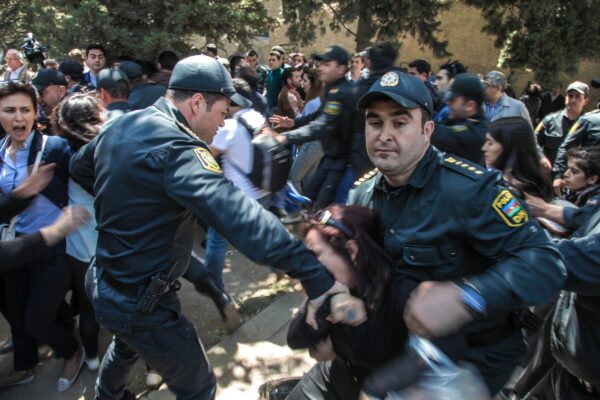
Artur Osipyan, a refugee from the Azerbaijan-annexed region of Nagorno-Karabakh, last month publicly confronted Armenia’s prime minister Nikol Pashinyan. Osipyan was subsequently arrested.
Osipyan had accused Pashinyan, who was on his election campaign trail, of perpetuating Azerbaijani narratives and of destroying his homeland.
Alluding to Azerbaijan’s 2023 military operation on Nagorno-Karabakh that forced 100,000 ethnic Armenians into displacement, Pashinyan reportedly responded: “You should have gone and died in place of our children…why are you alive?”
Osipyan was arrested for hooliganism and election campaign obstruction.
Politically-motivated arrests and hate speech have increasingly emerged out of Yerevan in the wake of national elections set to be held on 7 June.
The ruling Civil Contract party is forecast to secure about half of the nation’s votes this Sunday, while its primary opposition led by Samvuel Karapetyan, Strong Armenia, is polling to get 19 percent of the vote.
The incumbent prime minister, while in the race for re-election, has faced harsh criticism for arresting various members of the church, as well as the leader of the largest opposition party, Karapetyan.
“They are abusing the criminal justice mechanism to silence critiques and any dissent,” Anna Melikyan, legal expert at Protection of Rights without Borders, told EUobserver.
Melikyan’s work aids refugees from Nagorno-Karabakh, a region that was formally recognised as Azerbaijan’s sovereign territory following meetings between Yerevan and the US.
“The ruling party presents itself for the electoral campaign as a vote for peace,” said Melikyan, in reference to the resulting peace treaty from August 2025, “although there is nothing about the Nagorno-Karabakh population in the treaty.”
Following two violent conflicts in the historically contested region, killing 4,000 people in 2020 and 200 in 2023, Pashinyan gave up Armenia’s control of the region in the name of assuring peace and appeasing relations in the South Caucasus.
Yerevan’s foreign policy has played a major role in election campaigns, as Russian interference looks to jeopardise Pashinyan’s chances, while the EU and Washington rushed to endorse the sitting prime minister.
“Russia aims to hurt Armenia’s economy and influence the outcome of the parliamentary elections in Armenia. We will continue supporting Armenia to handle such attempts of coercion,” Anouar El Anouni, an EU Commission spokesperson, told reporters in Brussels earlier this week.
Armenia has become the subject of Western favour since its neighbour elected the pro-Russian party Georgian Dream in Tbilisi in 2024, as well as following developments to build the Trump Route for International Peace and Prosperity (TRIPP), a trade corridor running through the south of Armenia connecting Europe with mineral-rich central Asia.
Brussels also organised the first ever EU-Armenia summit in May to expand its foothold in an increasingly eastern-facing region.
“We are used as a platform against Russia,” Karapetyan, leader of the opposition party Strong Armenia, told reporters on 27 May. “Every day we could scream about the best relationship with the EU, but not be able in any way to capitalise on that relationship.”
The billionaire businessman opposition leader has been regarded with suspicion for his ties to Russia, yet argued that his opponent “hasn’t taken a single step for Armenia to adopt at least one European value. The easiest of them democracy.”