

Prime Minister Alexandru Munteanu’s surprise departure adds to political uncertainty – as high-profile corruption scandals pose risk to pro-European government’s credibility.
 Marian Chiriac



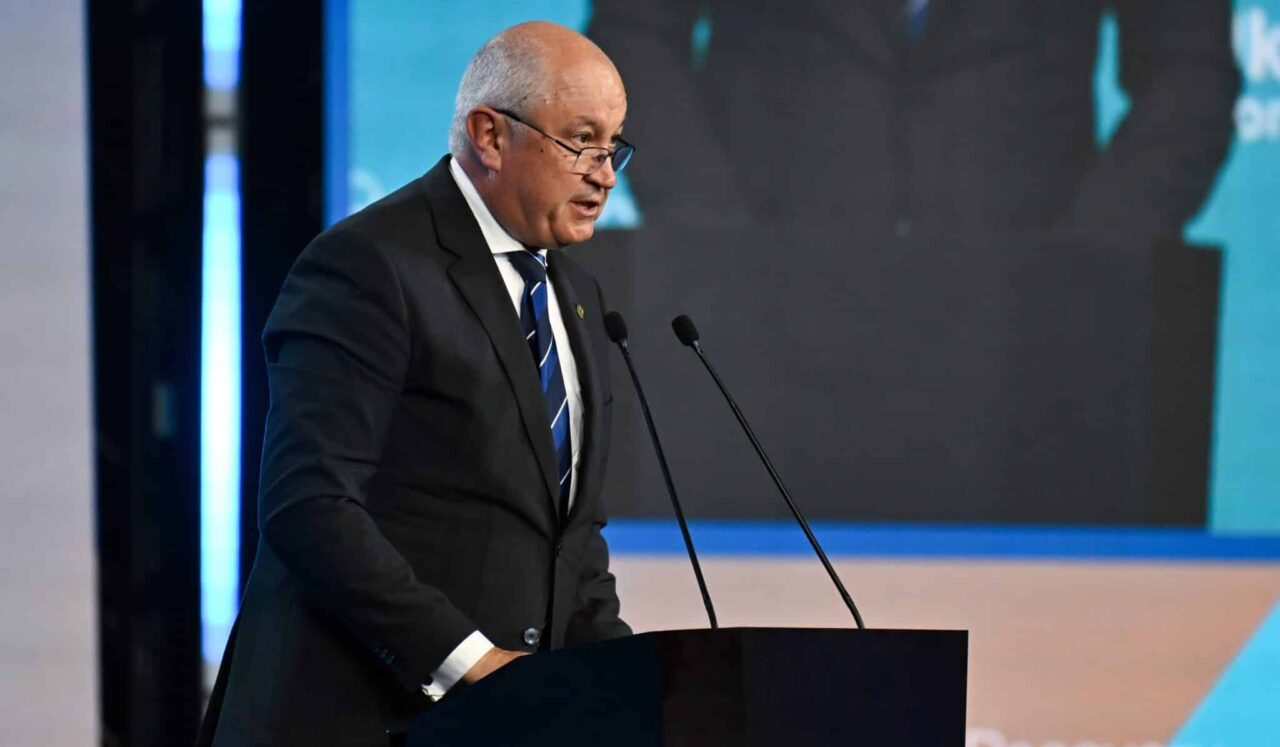
Prime Minister of Moldova Alexandru Munteanu in Gdansk, Poland, 25 June 2026. Photo: EPA/MARCIN GADOMSKI.
Moldova’s Prime Minister, Alexandru Munteanu, unexpectedly announced his resignation on Friday, but will remain in office in a caretaker capacity until a new government is formed, according to official statements.
Munteanu, Prime Minister since November last year, did not provide a full explanation for his decision to quit.
“Today, my term comes to an end,” he said on social media, adding only that he could no longer carry out his mandate “in line with the principles and convictions that guide me.
“I will continue to serve my country from whatever position I may hold,” he continued.
His resignation presents a fresh challenge for President Maia Sandu and her ruling pro-European Party of Action and Solidarity, PAS, which is serving its second consecutive term in office.
At a press conference shortly after Munteanu’s announcement, Sandu thanked him for his service but also hinted at tensions.
She had expected “greater involvement in difficult decisions, a stronger public presence to listen to people’s concerns, and a greater effort to explain the reforms we need to undertake and why they are necessary”, she said.
Sandu added that she will start consultations with parliamentary parties on Monday to designate a new prime ministerial candidate, and, until then, Munteanu will remain in office as interim.
Munteanu’s resignation comes amid a crisis for the pro-European government, following media reports alleging inflated salaries and politically sensitive appointments at several state agencies, including the hiring of Sandu’s own relatives.
In recent weeks, a new package of fiscal and public-sector wage reforms has also drawn public criticism and prompted street protests, adding to pressure on the government ahead of a crucial political period.
Shortly after the resignation was announced, opposition leaders called for early parliamentary elections, arguing that the government had lost its mandate and its credibility.
Analysts say Moldova’s European Union accession process risks being set back if a new government is not formed quickly.
“It is essential that a new government be approved as soon as possible, given the commitments Moldova has undertaken under the Economic Growth Plan and in its accession negotiations with the EU,” political analyst Andrei Curararu told Teleradio-Moldova.
“We are expected to open at least two more negotiation clusters, and any indication that the country lacks a fully functioning government could undermine its relationship with the EU,” he added.
Bordering Ukraine and Romania, Moldova has been an official candidate for EU membership since 2022.
The country is home to a Romanian-speaking majority as well as a sizeable Russian-speaking minority, and its politics have long been shaped by rivalry between pro-European forces and parties favouring close ties to Moscow.