As Ukraine chips away at Russian supply lines and oil infrastructure, Western analysts say the Kremlin’s hopes of a rapid push towards Kramatorsk are slipping into a drawn-out war that could drag on for several more years.
 Tomáš Vasilko



Every day, the Ukraine Battlefield update newsletter offers a clear look at how the war is unfolding on the ground. Subscribe for free here to get the full text delivered to your inbox.
According to the DeepState UA account, the Russians captured only 14 km² of Ukrainian territory in a month. The pessimistic scenario for Russia for this year is coming true. The number of combat engagements is rising, but the question is what this means. Equipment losses show the current nature of the war: a record low number of destroyed Russian tanks, a record high number of trucks. Kyiv has experienced one of the largest attacks in recent months. Videos of the day: strikes on trucks closer to the front line, an overcrowded waiting area for ferries to Crimea, an F-16 shot down a Kh-101.
May was one of the worst months for Russia since the start of the full-scale invasion. According to Bloomberg, over the past month Ukrainians attacked a record number of Russian refineries, tankers, and other oil infrastructure. Oil processing in Russia fell after the attacks to the lowest level at least since 2020.
In addition, Ukrainians are attacking Russian logistics in the south of occupied Ukraine, causing fuel shortages not only at the front but also in Crimea, where queues at filling stations that still have petrol reach up to 3 km.
The difficult month was also confirmed by statistics on the Russian advance. On Monday, the DeepState UA account wrote that Russia, in net terms, expanded its occupation by only 14 km². This is the lowest figure since October 2023, when the unsuccessful Ukrainian counteroffensive was ending.
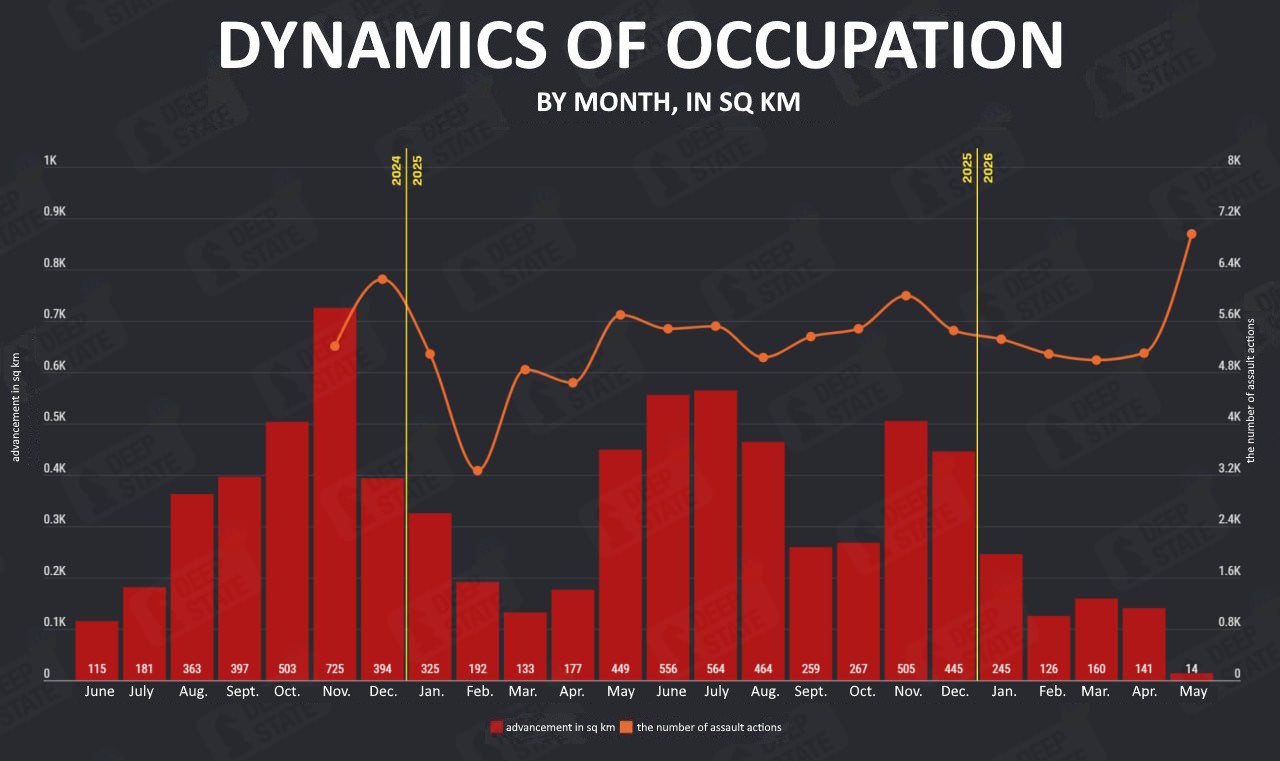 Monthly Russian advance in square km. Source: DeepState UA
On a daily basis, the Russians thus occupied only 0.4 km².
In reality, things may look even worse for Russia. As the Ukrainian account wrote, the latest Ukrainian successes have so far not been plotted on the map due to operational silence. If these were included, then in May the Russians would, for the first time since the Ukrainian counteroffensive in 2023, have lost more territory than they gained.
“The war is entering a new phase and it is important for the Ukrainian state not to lose the initiative. Fortunately, there are positive personnel changes – the new defence minister Mykhailo Fedorov has taken office, the new commander of the ‘East’ operational group Viktor Nikoliuk, many competent corps and brigade commanders are taking up their posts, while many problematic commanders have been transferred somewhere and promoted. Let us hope this trend will continue,” the DeepState UA account wrote in an optimistic post.
According to the Oko Hora account, the Ukrainians advanced in Kharkiv oblast (12.4 km²) and Dnipropetrovsk oblast (8.6 km²), while the Russians expanded their area in Donetsk oblast (26.7 km²), and Zaporizhzhia oblast (8 km²).
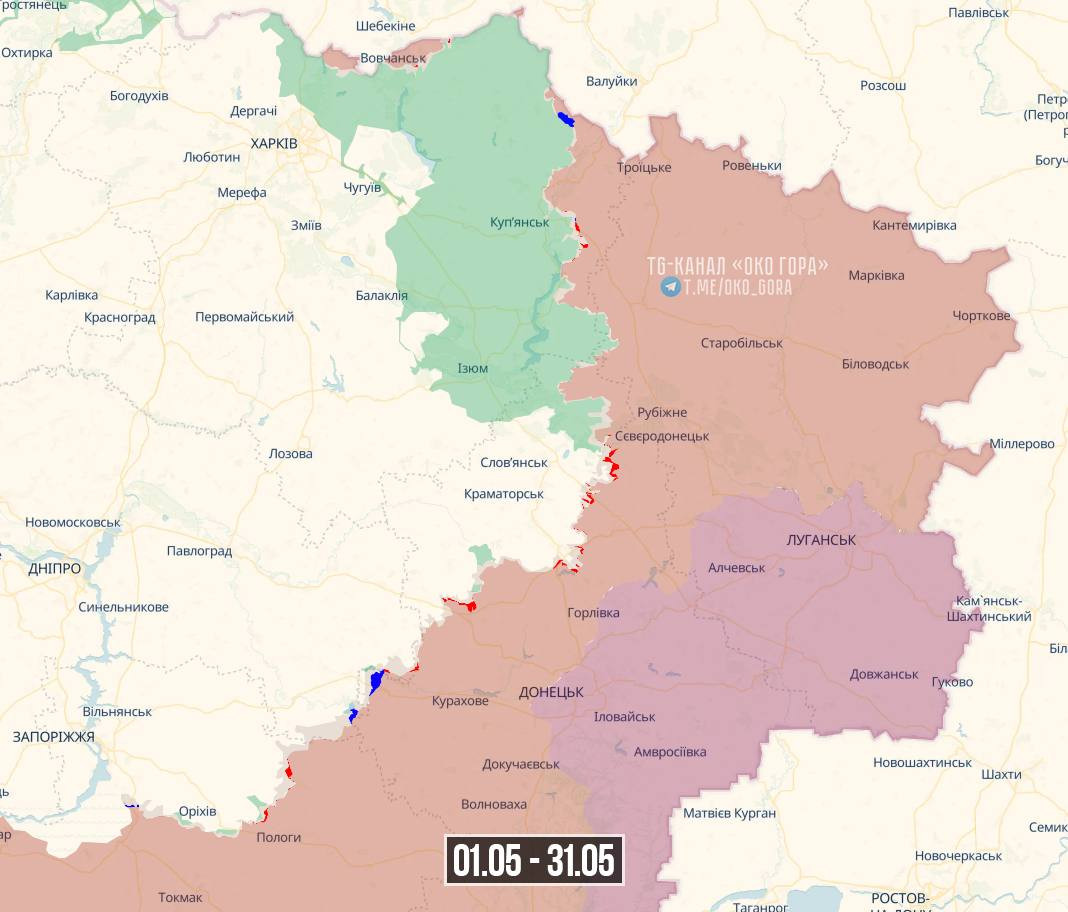 The precise advances can be seen here: Russian gains are in red and Ukrainian ones in blue. Source: Oko Hora
Of course, these figures should not be taken as indisputable data. The grey zone complicates mapping of the front line.
DeepState UA is just one of several accounts that map territorial shifts. It can hardly be described as completely independent, since it has been mentioned that its analysts are close to the Ukrainian Security Service, the SBU.
On the other hand, the account does not simply copy the claims of the Ukrainian army. For example, in February, general Oleksandr Syrskyi said that the Ukrainians had liberated more territory than the Russians captured, which DeepState did not confirm.
It should be added that the main Russian advances during this war usually come in the second half of the year. Nevertheless, the advance this spring is extraordinarily slow.
“Russia usually advances faster from late spring to autumn, but we are currently not seeing any acceleration of Russian gains,” US analyst Rob Lee said to the Kyiv Independent.
The slow Russian advance in May is also confirmed by some other accounts that map the war. According to Playfra, the Russians occupy 15 square km of new territory; the account Vitaliy gives a net advance of 39 square km, and French OSINT analyst Clément Molin 18 square km.
Occupied territory in Donbas by phase of the war.
After russian failure to exploit the Dobropilla breakthrough in august 2025, the Donbas offensive have slowly stalled, with only small gains due to the final fall of Pokrovsk between december and january.
The Kramatorsk offensive did not see too much sucesses yet. pic.twitter.com/MmMoe656A4
— Clément Molin (@clement_molin) June 1, 2026
The Institute for the Study of War has long been more optimistic. Its May data indicate that the Russians lost 281 km². That does not mean that the Ukrainians liberated this entire area; most of it is probably grey zone.
However, if ISW analysts also count Russian infiltrations, the Russians gained 48 square km of new territory.

From Russian sources, similar data are published by the Telegram account Slivochnyj kapriz. It claimed that even in May the Russians advanced by 209 square km, which is, however, the second-lowest figure in almost the last two years. The Russians often consider as captured territory even places where a single Russian soldier appears.
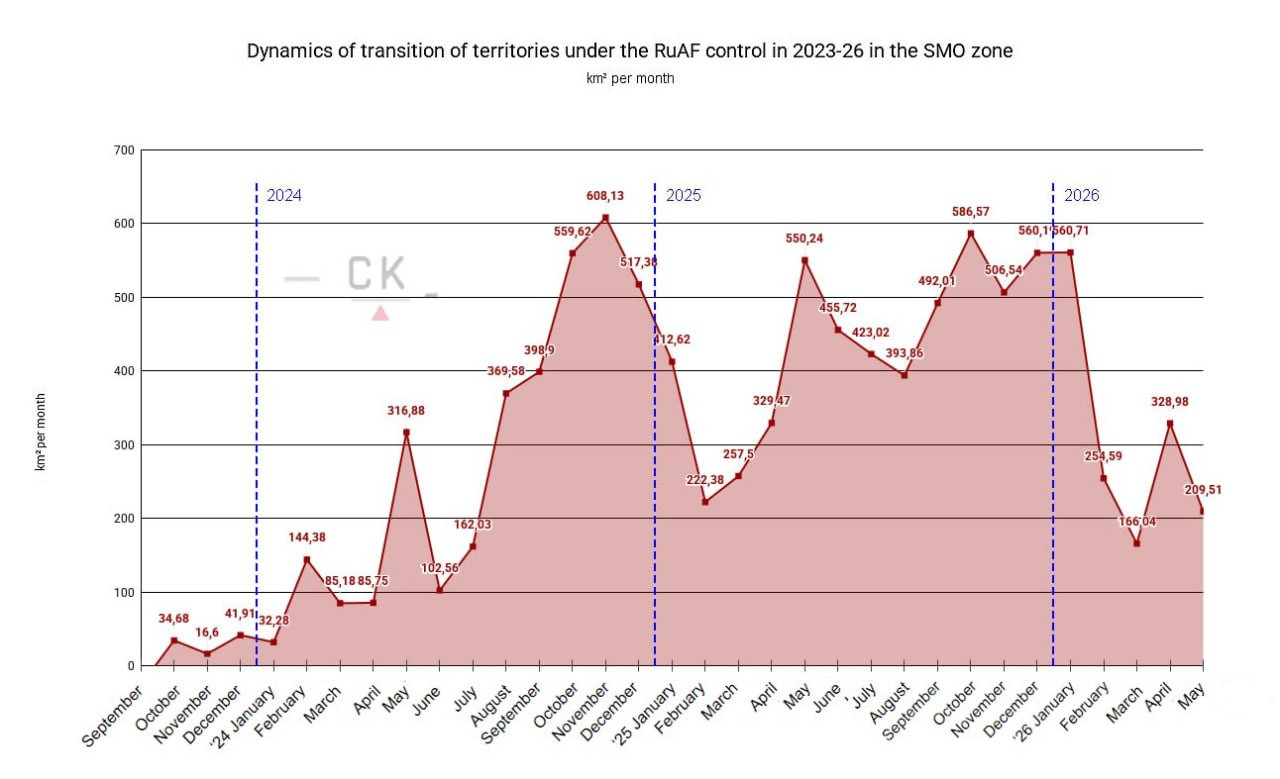 Source: Slivochnyj kapriz
As pointed out by Ukrainian volunteer Serhiy Sternenko, who works for the Ministry of Defence, even Russian propagandists spoke of a weak month. “May became an anomaly for the Russian army. The advance is practically zero,” one Russian source said.
Of course, progress cannot be measured only in square km, since there is a difference between an army capturing empty fields and capturing a heavily fortified town. At the moment, the Russians are pushing on Kostyantynivka, where the situation is worsening, as the DeepState UA account also recalled. It is quite likely that the town will fall in the coming months through a similar tactic (numerous infiltrations) as Pokrovsk.
Whether May turns out to be an anomaly or the beginning of a new trend will become clear in the second half of the year. For now, the Ukrainians are holding good cards.
French OSINT analyst Clément Molin returned to his January forecasts on what can be considered an optimistic and a pessimistic Russian scenario for 2026. So far, he believes, the pessimistic scenario for the Russians is materialising.
“The capture of Kostyantynivka (likely in the summer) will not be a big victory for Russia, as it is not prepared for the next battle (no offensive on Druzhkivka yet, no advance on Lyman, no direct control over the supply routes leading to the town),” he wrote.
In his view, at this pace the battle for Kramatorsk will not even begin this year, which means the war will continue for at least another year, perhaps two, unless political decisions or something unexpected change it.
The number of combat engagements is rising, but the question is what this means. The DeepState UA account also wrote that the number of combat engagements had increased sharply, reaching almost 7,000 in May, a 35-percent rise compared with the previous month. It drew on data published daily by the General Staff of the Ukrainian army.
“Videos keep reaching us in which the ‘Katsaps’ (a derogatory term for Russians – editor’s note) at best conduct assault actions in pairs, and very often one ‘Katsap’ attacks alone. But before he gets anywhere, he becomes the target of several weapons,” DeepState UA wrote.
The account Vitaliy believes that this is in fact not an increase in the number of Russian attacks. Those remain the same, but, in his view, Ukrainian attacks have been added. He bases this on the fact that Ukrainian official sources mention figures for repelled Russian attacks and also for engagements (the difference between them should thus be Ukrainian attacks). The number of combat engagements in which the area is not identified is also rising. However, this remains just a hypothesis.
A second explanation for the increase in the number of engagements is that the Russians are attacking in ever smaller groups, of one or two soldiers. Therefore, the number of engagements can be higher even if the total number of soldiers taking part in them does not have to change.
May equipment losses for both armies are already known. The overall numbers are hard to compare, since the Oryx website has removed some categories of equipment from its list and the aggregate figure has therefore fallen.
However, it is possible to compare losses of tanks, armoured vehicles and infantry fighting vehicles. The Russian army lost only five tanks in May – the lowest number since the start of the war. It also had a record low number (seven) of infantry fighting vehicles damaged or destroyed. The Ukrainians also lost five tanks.
Russian tank losses by month
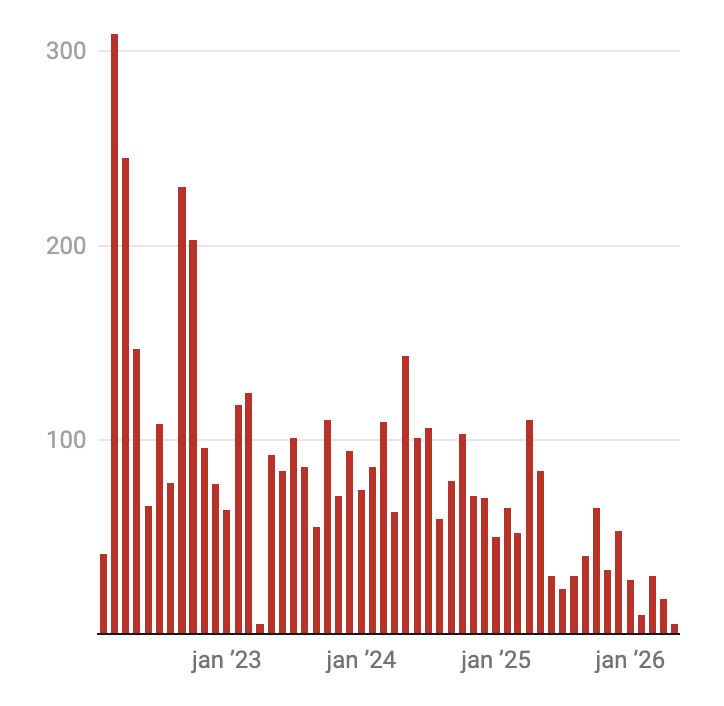 Verified losses. Source: Oryx/ Dennik N.
Ukrainian tank losses by month
 Losses for two months are shown as negative because the authors corrected previously inaccurate data. Source: Oryx/ Dennik N.
 It is quite telling for the current state of the war that the fewer tanks the Russians lose (because they do not deploy them due to the drone threat), the more trucks they lose. The Ukrainians say that in May they hit more than 8,600 vehicles and fuel tankers, sometimes as many as 500 a day. This is twice as many as at the start of the year.
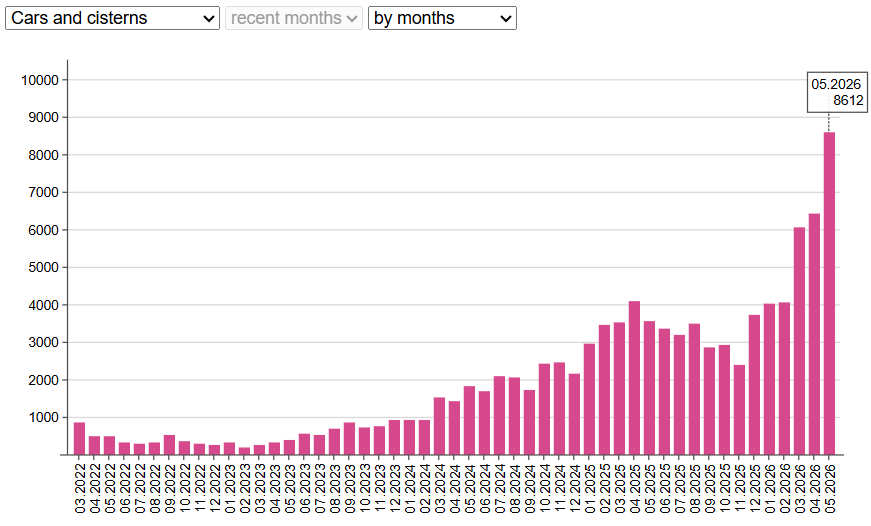 Number of vehicles and fuel tankers hit. Source: minfin.gov.ua
These are not independently confirmed figures. On the other hand, in May the Ukrainian Unmanned Systems Forces hit (and have visual evidence for this) 2,356 light vehicles, heavy vehicles and special-purpose vehicles. In February they reported 1,100 such vehicles.
Photos of Russian military trucks such as KAMAZ and Ural, painted in black-and-white stripes and patterns, have appeared on social media. The Russians probably believe that this zebra-style camouflage will help them evade Ukrainian Hornet drones, which to some extent also use AI assistance when targeting.
Russian forces are increasingly painting their trucks in a “zebra” camouflage pattern, hoping to deceive the machine vision systems of Ukrainian UAVs. This type of camouflage was actively used during the First and Second World War to mask warships. It worked at sea; we’ll see if… pic.twitter.com/8Qfv929MKR
— WarTranslated (@wartranslated) June 1, 2026
This is not a novelty in military history. During the First World War, so-called Dazzle camouflage began to be used, when ships were painted with large geometric shapes in black and white (among other colours).
As the Ukrainian website Defence Express wrote, the aim then was to prevent enemy ships or submarines from accurately determining a ship’s speed or distance, since such patterns made this more difficult (they essentially “broke up” the ship’s shape), and therefore made it harder to aim torpedoes or missiles. “It could only be effective against large targets observed from a considerable distance,” the website said.
This camouflage was also tested in aviation, but it never took hold there. After the spread of radar, this type of masking became unnecessary even for ships.
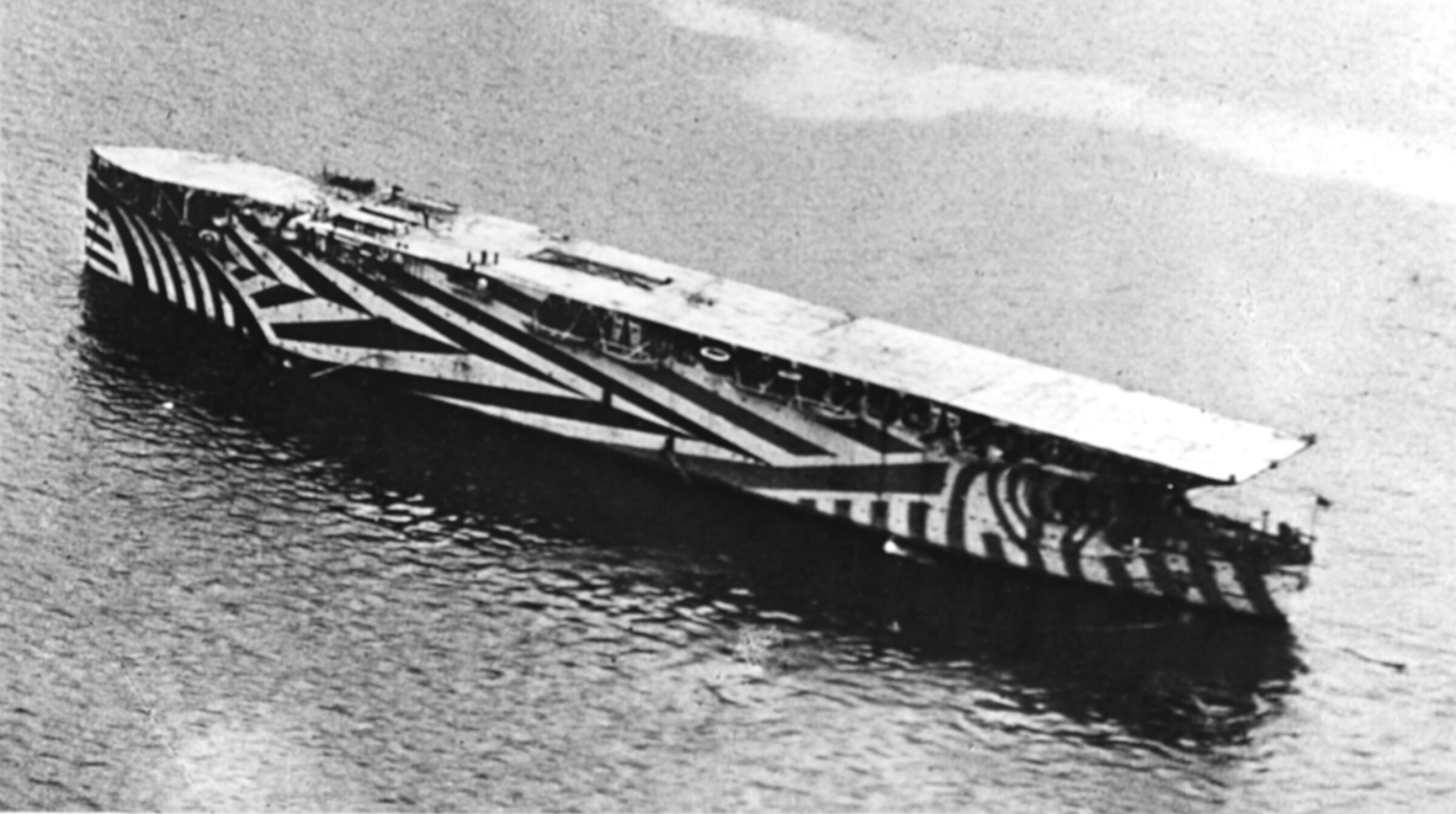 British aircraft carrier from the Second World War era HMS Argus. Source: Wikimedia
It is not entirely clear how this is supposed to work when defending against drones in the 21st century. Most observers are sceptical that it would help the Russians in any way. And it hardly matters whether the targets are selected by AI or by a human operator.
“Machine-vision algorithms estimate distance in a different way than optical rangefinders used to,” Defence Express wrote, adding that it should not confuse a human operator either. Moreover, if a thermal camera is used, this camouflage will most likely not be noticeable at all.
According to the Woofers account, it seems that painting vehicles is not just a one-off case but a spreading phenomenon. We will see whether such camouflaged trucks actually appear on the main roads in the south of occupied Ukraine and whether this camouflage from the African savannah will help them on the Ukrainian steppe as well. As one account wrote jokingly, perhaps the next Russian step will be to release zebras and hide the trucks in the herd.
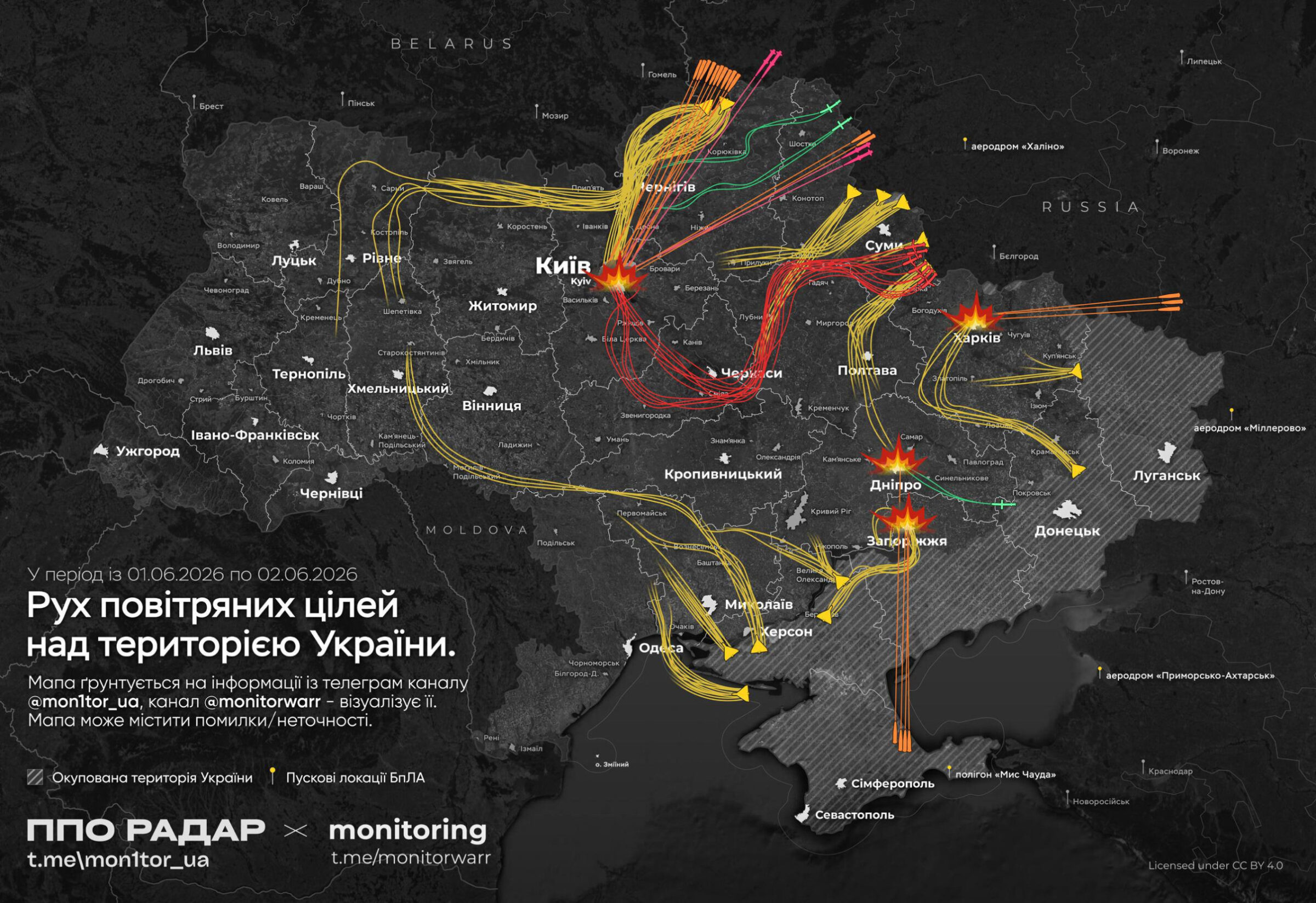
Ukraine has once again experienced one of the heaviest Russian attacks in recent months. The aggressor launched more than 70 missiles and 656 drones, aimed mainly at Kyiv but also at Kharkiv, Dnipro, Zaporizhzhia and other cities.
In total, according to the General Staff of Ukraine, Ukrainian air defence neutralised:
602 out of 656 Shahed and similar drones (a 92-percent interception rate). 11 out of 33 Iskander-M ballistic missiles (33-percent success rate). 26 out of 27 Kh-101 cruise missiles (96 percent). 0 out of 8 Zirkon missiles, originally anti-ship (0 percent). 3 out of 5 Kalibr missiles (60 percent).
The Ukrainians have improved at shooting down drones (previously the success rate was just above 80 percent), but they still struggle to intercept Iskander ballistic missiles, as they do not have enough interceptor missiles for the Patriot systems.
After the attack on the city of Dnipro, at least 12 people died, including a three-year-old boy whose body was pulled from the rubble of a heavily damaged four-storey apartment block. A rescuer was also killed – the Russians often strike the same locations repeatedly at the moment when emergency services arrive.
In Kyiv, at least six people were killed and 65 injured, including three children.
Over the past week, the Russian foreign ministry had threatened a major attack and told foreign embassies to leave Kyiv. It is not clear whether this was the “big” attack it had promised.
❗️Today’s massive ruSSian missile and drone attack on Ukraine:
🎯 The main target was Kyiv.
🌃 The cities of Dnipro, Zaporizhzhia, Kharkiv, Sumy, Poltava, Chernihiv, Zhytomyr, Khmelnytskyi, Shostka, and Starokostiantyniv were also hit by missiles and UAVs.
🚀 Up to 24… pic.twitter.com/iCTzw1R6H4
— 𝔗𝔥𝔢 𝕯𝔢𝔞𝔡 𝕯𝔦𝔰𝔱𝔯𝔦𝔠𝔱△ 🇬🇪🇺🇦🇺🇲🇬🇷 (@TheDeadDistrict) June 2, 2026
Videos of the day
Much has been written about Ukrainian attacks on lorries and trucks on the main roads in southern occupied Ukraine. However, Ukrainians are also successfully striking Russian military logistics at locations closer to the front, where goods are being unloaded. This video shows a strike on three trucks.
“This video is very interesting. Because hitting some trucks on the main roads is one thing, but hitting them at the moment they arrive at tactical positions is just as important,” Clément Molin commented.
Russian freight transport has once again begun to use ferries on a larger scale for the route to Crimea. This is what it looked like on the Russian side of the Kerch Strait. Overall, it is about 300 km from Ukrainian positions, and the Ukrainians have the capability to strike at such distances as well.
Russians are back using the ferry in the Kerch Strait connecting Russia with the occupied Ukrainian peninsula of Crimea.
Imagine the firework if only one drone visits this place. Coordinates are probably here:
45°20’40.71″N 36°40’55.71″E pic.twitter.com/bF5XIBPQPO
— (((Tendar))) (@Tendar) June 2, 2026
A Ukrainian F-16 fighter jet flying low over the ground shot down a Russian Kh-101 missile. First the missile and the hit are visible, then the aircraft.
💥✈️ A Ukrainian Air Force F-16 shoots down a Russian Kh-101 cruise missile flying at extremely low altitude. pic.twitter.com/HjOWwnIna8
— Special Kherson Cat 🐈🇺🇦 (@bayraktar_1love) June 1, 2026
What are the losses
As of Tuesday morning, without update
By Monday (11 May), Russia had verifiably lost 23,556 pieces of heavy equipment (on Monday (11 May) the figure was 23,439). Of these, 18,551 (18,444) pieces were destroyed by the Ukrainians, 979 (971) were damaged, 1,199 (1,197) were abandoned by their crews and 2,827 (2,827) were captured by the Ukrainian army. This includes 4,394 (4,390) tanks, of which 3,293 (3,297) were destroyed in combat. Ukraine has lost 11,397 (11,253) pieces of equipment, of which 8,863 (8,737) were destroyed, 678 (666) damaged, 669 (665) abandoned and 1,187 (1,185) captured. This includes 1,424 (1,422) tanks, of which 1,089 (1,087) were destroyed in combat.
Note: Neither side regularly reports its own dead or destroyed equipment. Ukraine publishes daily figures for Russian casualties and destroyed equipment, which cannot be independently verified. In this overview we use data from the Oryx project which, since the beginning of the war, has been compiling a list of equipment losses documented exclusively by photographic evidence.