There are seven months left for European countries to reach an agreement on the EU budget. But negotiations are moving very slowly. So what is at stake for Europeans?
 Léa Marchal



Production: By Europod, in co-production with Sphera Network.
EUobserver is proud to have an editorial partnership with Europod to co-publish the podcast series “Briefed” hosted by Léa Marchal. The podcast is available on all major platforms.
Find the full transcript below:
There are seven months left for European countries to reach an agreement on the EU budget.
That is the timeline currently envisioned for the next Multiannual Financial Framework to begin in 2028.
But negotiations are moving very slowly.
So what is at stake for Europeans?

In the United States, they talk about a “shutdown.” It happens when Congress fails to agree on the federal budget in time. Parts of the administration are then forced to shut down, and civil servants can be on temporary leave while politicians try to reach a deal.
The EU works differently. In the event of a delay, it can continue covering ongoing expenditures and previously approved payments. But of course, it cannot plan for new spending.
For the continuity of the many European programmes, it would clearly be better to avoid such a situation.
The goal, therefore, is to secure a political agreement by the end of the year on the long-term budget covering the 2028–2034 period. a budget that matches today’s realities: the loss of competitiveness of European businesses, the climate transition, not to mention the growing security threats facing the EU and its partners.
Why do they need to agree by 2027, you would ask? Because another full year will still be needed to put all the details into legislation.
Negotiations are currently underway between the EU’s 27 member states, which are the main decision-makers in this process.
And for now, they remain far from an agreement.
Why is it taking so long?
Adopting a budget is already difficult at the national level. So imagine at the scale of 27 countries.
What is really at stake here is the amount each member state will have to subsequently contribute to the common budget.
For many governments, increasing their financial contribution is simply not an option. Domestic budgetary pressures are already too high.
That leaves another source of funding for the EU budget: taxes collected directly by the European Union itself. These are known as “own resources” and include customs duties, the plastic levy, and a share of VAT revenues.
But here again, things get complicated. A majority of member states are reluctant to introduce new EU-wide taxes, fearing they could drive businesses away. Such taxes could also interfere with national taxation systems — something governments are generally unwilling to accept.
So, back to the negotiations.
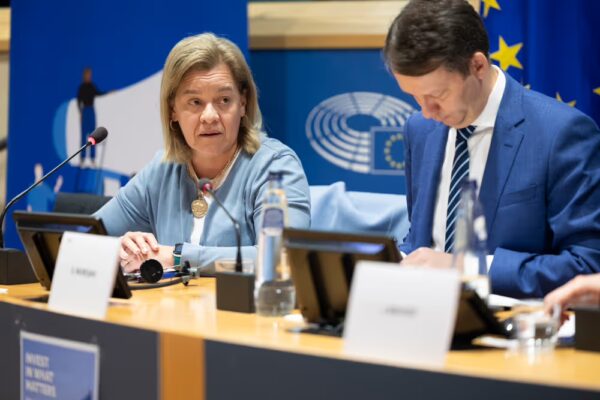
At this stage, the proposal currently on the table is a two-trillion-euro budget covering seven years.
That is slightly larger than the previous budget, because financial needs keep growing.
Could that two-trillion-euro figure still be reduced?
Yes, it is possible. But since some countries want to cut this amount while others want to increase it, the most likely compromise may actually end up being close to the commission’s initial proposal.
Even that would be seen as insufficient by the European Parliament, which is calling for a more ambitious budget. Unfortunately, they don’t have a big say in the discussion.
So what exactly is at stake?
All EU funds are concerned, but some policy areas are more exposed than others. That is especially true for the so-called cohesion funds — the envelope used to finance projects aimed at reducing wealth disparities between European regions.
When a school renovation is partly financed by EU money, for example, that usually falls under cohesion funding. The same goes for transport infrastructure projects or renewable energy installations.
Then there is the Common Agricultural Policy (CAP) which remains one of the most hotly debated items. Countries such as France and Poland are strongly attached to it, while others believe European farmers already receive too much support.
Finally, sectors that receive less public attention could also face cuts. I’m thinking here of research programmes, initiatives related to media and democracy, and environmental policies.
For example, in the Commission’s proposal, the LIFE programme — dedicated to the environment, climate, and biodiversity — has been absorbed into a broader programme focused on clean industrial transition. The consequence is inevitably less money specifically earmarked for environmental and biodiversity objectives.
To sum up: sacrifices will have to be made. The remaining question is how deep they will be, and which sectors will ultimately bear the cost.
As for the timeline, the 27 member states may not manage to strike a deal before the end of the year, that’s a possibility. Negotiations could spill over into 2027, after which technical work would likely accelerate and conclude at the very last minute.