Last week, the European Commission condemned Russia and expressed solidarity with Romania after a drone carrying explosives struck a residential building in the Romanian border city of Galați, injuring civilians. If this is not a red line, what is? Shouldn’t it trigger a stronger response?
 Léa Marchal



Production: By Europod, in co-production with Sphera Network.
EUobserver is proud to have an editorial partnership with Europod to co-publish the podcast series “Briefed” hosted by Léa Marchal. The podcast is available on all major platforms.
Find the full transcript below:
This is not the first time Russian drones have entered Romanian airspace.
But this time, the incursion caused a fire and injured two people in the city of Galați last Friday.
So here’s a simple question: why don’t Europeans shoot down Russian drones when they enter their airspace?
“Russia’s war of aggression has crossed yet another line.”
That was the European Commission’s response to the Russian drone attack—or accidental strike—in Galați.
When the drone crashed, it caused a fire in a residential building. 70 people had to be evacuated, and two were injured, including a teenager.
The commission condemned Russia and expressed its solidarity with Romania.
But shouldn’t this latest crossed line trigger a stronger response?
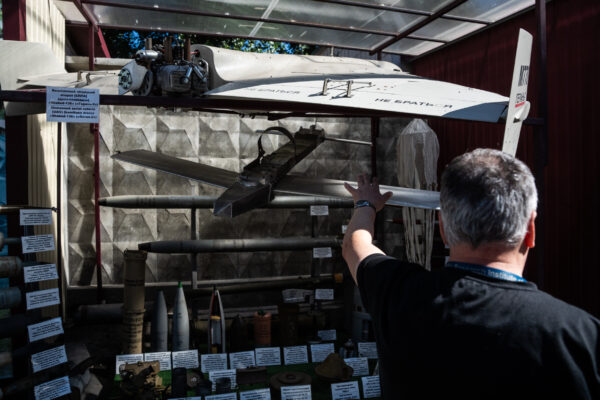
Since 2022, there have been 28 drone incursions into Romanian airspace. The Baltic states have also faced similar incidents.
Last Friday, the Romanian military detected the intruding drone very quickly. Two fighter jets and a helicopter were scrambled. Yet the Russian drone could not be intercepted before it struck the building.
Why?
The military said the drone was detected and tracked, but not intercepted for both technical and legal reasons.
The drone remained in Romanian airspace for only four minutes, leaving very little time to react.
Another challenge is that these drones fly at very low altitudes. Shooting them down can be risky because the resulting debris could seriously injure civilians on the ground.
Then there are the political and legal considerations. Shooting down a foreign aircraft can be seen as a disproportionate response.
That view has generally prevailed during previous drone incursions in the Baltic states, Poland, and Denmark.
In fact, only one foreign drone has been shot down in European airspace since 2022. That happened on May 19, when a Ukrainian drone—likely diverted by Russian electronic warfare—entered Estonian airspace.
In the case of Galați, Romania’s ministry of defence concluded that this was not a Russian attack against Romania itself, but rather an unfortunate consequence of the war in Ukraine.
That did not stop Romanian president Nicușor Dan from calling on allies to deliver a firm, coordinated, and proportionate response.
Romania’s foreign affairs Minister has even suggested that it may be time to invoke not Nato’s Article 5, which concerns collective defence, but Article 4, which provides for urgent consultations among alliance members.
For now, however, the European Union’s response is focused on strengthening preparedness—and, therefore, military capabilities.
Which brings us to another question: what is the status of the anti-drone wall that the European Commission has been advocating?

The initiative aims to equip the entire eastern flank of the European Union with radars and other technologies capable of detecting even the smallest drones. Frontline countries would then be able not only to detect drones, but also to jam them and, if necessary, intercept them.
So where does the project stand?
Deployment is currently underway. Each country is gradually expanding its capabilities, but the eastern flank is still far from fully equipped. The European Commission’s goal is to have a genuine anti-drone wall in place by the end of 2027—which is still some way off.
To sum up, the countries most exposed to Russia’s hybrid threats are indeed strengthening their defences. Romania, like its neighbours, is gradually acquiring anti-drone systems, but significant work remains to achieve more comprehensive protection.