

The biggest rupture on the Polish right in many years could sharply reduce PiS’s chances of returning to power in next year’s parliamentary election.
 Ada Petriczko



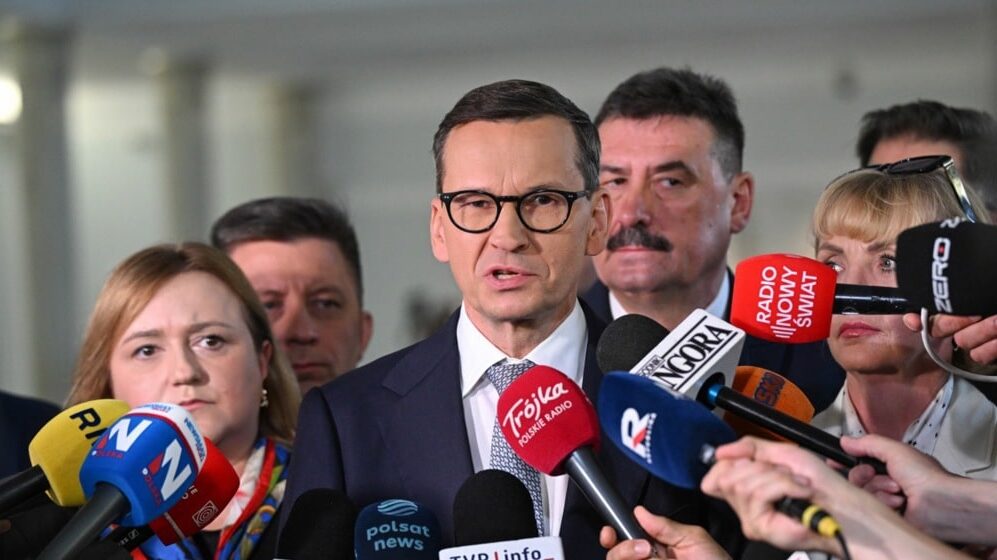
Following a months-long power struggle, more than 30 MPs – including former prime minister Mateusz Morawiecki – are set to be expelled from the Law and Justice party, in the biggest rupture seen on the Polish right in many years.
Law and Justice, or PiS, is Poland’s largest opposition party and one of the country’s two dominant political forces, alongside the governing Civic Coalition led by Prime Minister Donald Tusk. The split could sharply reduce PiS’s chances of returning to power in next year’s parliamentary election.
On early Friday afternoon, PiS leader Jaroslaw Kaczynski announced that “around 30-something” of the party’s 186 MPs had effectively chosen to leave after refusing to sign declarations of loyalty. The documents required them to state that they did not belong to any political associations operating within the party – an obvious reference to Development Plus (Rozwoj Plus), an organisation created by Morawiecki, until now one of PiS’s deputy leaders.
“Everyone knew what they were supposed to sign, and knew the consequences of not signing,” Kaczynski said. “And so they made the decision they did.”
Kaczynski has been PiS’s undisputed leader and chief power broker for more than two decades, selecting loyal candidates for prime minister who largely continued to defer to him once in office. Morawiecki was initially one of them, serving as prime minister between 2017 and 2023.
But in recent years, Morawiecki – an economist, former banker and comparatively moderate conservative – has grown increasingly impatient with Kaczynski’s dominance. He has pushed for changes to both the party’s internal structure and its political program, arguing that PiS was failing to speak convincingly to younger voters and entrepreneurs.
Friday’s rupture was the culmination of months of increasingly open conflict.
“Until the very last moment, we fought for the unity of the Law and Justice camp,” Morawiecki said at a press conference. “We could not accept being forced to sign a loyalty pledge.”
He accused the party leadership of using ultimatums and political blackmail to discard a strategy that had been agreed only recently.
Morawiecki did not formally announce the creation of a new party. He did, however, declare the beginning of “a new chapter in Poland’s political history”, promise a major nationwide tour and announce that his camp would soon present a new political program.
He said his political circle now included 40 MPs (which stands at odds with Kaczynski’s estimate), one senator and three members of the European Parliament, describing it as a “very strong representation”. Its offer, he said, would reach beyond PiS’s traditional base and target young people, entrepreneurs, local-government officials and even some voters currently supporting the governing coalition.
Morawiecki presented his project as a modern, patriotic and pro-state conservative force, capable of responding to social and economic change without falling back on outdated ideas.
The electoral consequences could be enormous. An Opinia24 poll conducted before the split tested precisely such a scenario. With PiS united, the party would receive 23 per cent of the vote, behind Civic Coalition on 31.6 per cent. When respondents were offered a separate Morawiecki-led Rozwoj Plus list, support for PiS fell to 17.7 per cent, while Morawiecki’s group received 6.2 per cent. Civic Coalition remained clearly ahead on 30.9 per cent.
Tusk responded with a single cutting line: “They are fighting so hard for party unity that there won’t be one stone left standing.”
Deputy Prime Minister Krzysztof Gawkowski was blunter: “Kaczynski went all in and lost.”