Ukraine’s 155th brigade chief, Luchanov, is on the run after murders of two men over insults to his wife in the village of Kalynivka, near Kyiv, in June.
 Roman Pataj



Every day, the Ukraine Battlefield update newsletter offers a clear look at how the war is unfolding on the ground. Subscribe for free here to get the full text delivered to your inbox.
A scandal has hit the 155th Mechanised Brigade, with a trivial and foolish motive for the crime. The Russian fleet in the Sea of Azov has de facto ceased to exist. Russia is responding with attacks in the Odesa region. Kostyantynivka has still not fallen and it will take weeks before it does, Russians themselves admitted. Russian soldiers infiltrated Dobropillia for the first time. Russian pressure on Orikhiv has almost stopped, the Russian army is probably regrouping ahead of a new offensive. Maps of the day – Orikhiv axis, Dobropillia axis; Kostyantynivka. Videos of the day – farewell to a fallen comrade in a trench; attacks on the Azov fleet; Russian retaliation in Odesa; drone landing on the Kinburn Spit; Bakhmut three years after its “liberation”; heavy machine gun defeated the gunner.
A scandal has hit the 155th Mechanised Brigade, with a trivial and foolish motive for the crime. The 155th Anna of Kyiv Mechanised Brigade was formed at the beginning of 2024 and was one of the so‑called 100‑and‑50th brigades. This particular one, however, was supposed to be the model and the best among them. Almost all of its equipment was provided by France, and it also had a tank battalion armed with Leopards from Poland. Personnel training took place in France, where approximately 50 members of the brigade deserted.
The 155th Brigade attracted much more attention after its return to Ukraine, before being deployed to combat. According to information at the time, more than one thousand members left the unit, which had a strength of four thousand soldiers, without authorisation. Frequent personnel rotation did nothing to help its cohesion. Later, however, the brigade fought relatively successfully around Pokrovsk and gradually worked on improving its image. Now that image has been dealt a very serious blow by its own commander, Stanislav Luchanov.
What he and nine of his subordinates did was a crime on the level of mafia-style murders. For a country at war, every such incident is very painful. Naturally, it also resonated among the soldiers. One of them, writing under the nickname Bakhmut Demon, commented on the case like this:
“The army is a huge organism, it has more than 1 million people. It is not a perfect organism, but thanks to the fact that the army works, Russia has not occupied Ukraine. That does not excuse all the misconduct that happens in the army. The point is that every case must be investigated and punishments must follow. But just because such incidents happen due to the misconduct of individuals, we should not draw conclusions about the entire army and attribute them to everyone.”
The crime, like something out of a book, took place on 28 June in the village of Kalynivka in the Kyiv region. It was not about drugs, war, the mafia or anything similar, but a trivial dispute. Information from Ukrainian media indicated that on that day the brigade commander ordered eight subordinates, including the commanders of one of the battalions, to kidnap two men from the village in question because they had insulted his wife. They really did so and later, according to preliminary information, murdered them in the Dnipropetrovsk region.
All of them except Luchanov were detained relatively quickly; in his case this happened only on Monday in Kyiv.
Luchanov is a very experienced soldier. He has been in the army since 1998. Over almost 30 years he has held various positions. Before he was promoted in February to commander of the 155th Mechanised Brigade, he served as chief of staff in the 425th Separate Assault Regiment Skala, elements of which fought, among other places, near Pokrovsk on the same section as Luchanov’s brigade.
Skala is currently probably the most criticised unit in the Ukrainian army for cases of torture of soldiers and heavy losses. That is why several Ukrainians link the abuse of the soldiers of the 155th Brigade to the fact that, in their view, Luchanov brought authoritarian methods from there.
“Being chief of staff in Skala is in fact more than being commander of the 155th Brigade,” said Bohdan Krotevych, for example, who was chief of staff of the 12th Azov Special Forces Brigade until he left the army.
Skala is nominally only a regiment, which is a lower-level unit than a brigade, but in practice it has 13,000 to 15,000 personnel, which is five times more than the largest brigades. Krotevych furthermore claimed that the 155th Brigade and several others are directly subordinated to Skala, which uses them for its assault operations that are frequently criticised. If the regiment complains that “brigade commanders do not carry out their ‘brilliant attacks on quad bikes’, you replace the brigade commanders with ‘your own’ people from the regiments. When investigations into the murders and torture of Ukrainians by people you appointed then become public, you say you did not know anything and put on a surprised face,” Krotevych wrote, with these words assigning responsibility to the army commander Syrskyi. Skala, after all, falls directly under him.
However, the 425th Regiment rejected any link to the crime: “Skala has nothing to do with the circumstances of this criminal offence, and has nothing to do with the decisions that might have been taken in another military unit … If you agree with the logic of such statements (about Skala’s shared responsibility), then, by analogy, responsibility for the actions of any soldier should be transferred to every unit in which he ever served. This approach is wrong. Criminal responsibility is always personal and cannot be transferred to the military units in which someone served at various stages of his career.”
The regiment also claimed that it does not command the 155th Brigade, which is an independent unit outside its remit, and it assured that it is in a period of “deep transformation”, during which it acknowledged the need to change its internal processes.
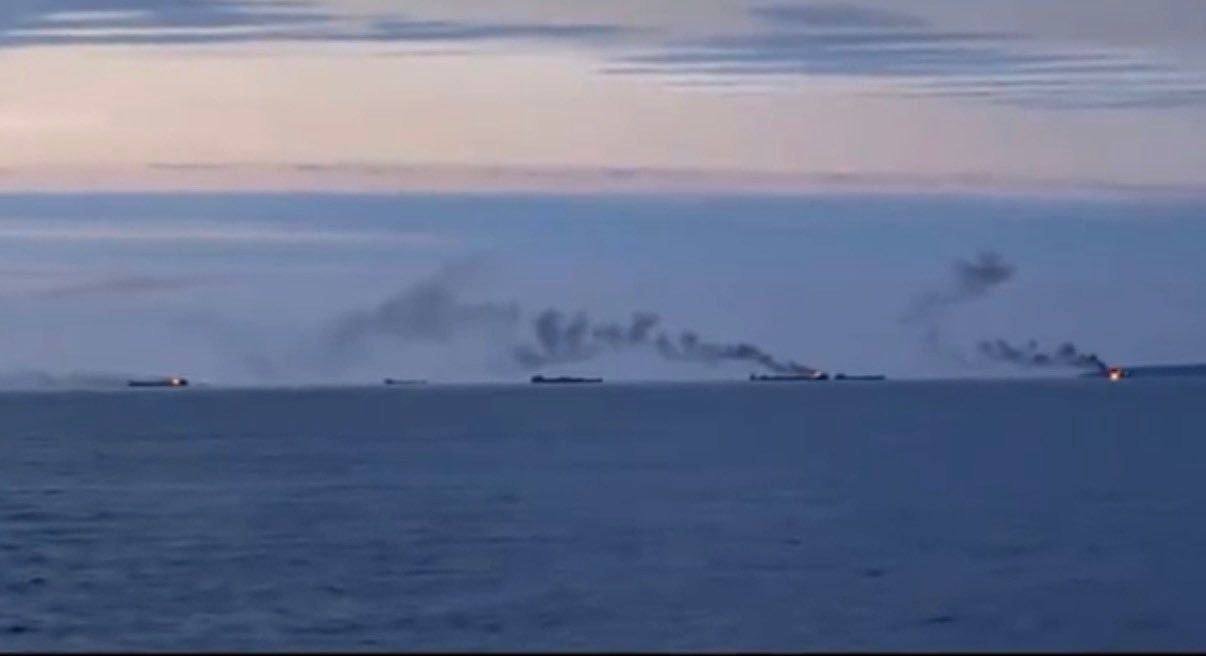
The Russian fleet in the Sea of Azov has de facto ceased to exist. As recently as Friday we wrote that drones had hit roughly one third of Russian ships in the Sea of Azov. At that time there were more than 30 of them; after the attacks from Sunday to Monday, 105 ships had already been hit. We do not know how many of them were struck repeatedly and it is impossible to determine precisely the extent of damage to all of them, but the result is a halt to shipping through the Kerch Strait, which already occurred on Saturday.
Magyar’s poetry update: Russia’s shadow fleet is on its way to the Red Book of the Sea of Azov.
15⚓️🔥overnight. 105 vessels engaged by the Birds of the Unmanned Systems Forces over 8 days.
Operation “MoLoChKa” will continue until russia’s shadow fleet is listed in the Red… pic.twitter.com/7JaDnadNHg
— 414 Magyar’s Birds (@414magyarbirds) July 13, 2026
The available footage shows that the drones mostly strike the ship’s bridge. Their warhead is not sufficient to sink oil tankers and other classes of vessels, but as can be seen from the following video, the result is a disabled ship even without sinking it.
Russia is responding with attacks in the Odesa region. It showed drone strikes in Odesa. During the attack it used a relatively new type, the Geran‑4 with a jet engine. In Russia this met with positive reactions, but it cannot be described as enthusiasm.
The large Russian Telegram channel Rybar criticised several details shown in the videos. It did praise the fact that the Russian defence ministry had begun to publish videos like the one below more frequently, but “when you look at these shots, questions arise.”
First, it missed footage of the actual strikes themselves, and second, it did not like that the grain warehouses in the port “show no signs of any damage.” More seriously, however, it considered that the footage proved that cargo ships had been adapted for military purposes and therefore, according to Rybar, the question arose as to why such an idea “occurred to the enemy and not to our own navy, which does not have ships to spare and whose pace of building new ones is low?”
Rybar also criticised the use of drones with small warheads, which are unable to inflict serious damage on ships, while the Russian army is not using weapons designed specifically for fighting ships, which it considered absurd.
“It cannot be blamed on any secret agreements, because for some reason the same ships are being attacked without any problem by both Gerans and Iskanders. The explanation is much more prosaic and does not lie in the realm of conspiracies, but in the competence of those responsible for the attacks,” he added.
Russian operator-controlled Geran-4 jet-drone strikes on a cargo ship and a Ukrainian fishing trawler at the Chornomorsk Port, Odesa Oblast.
The Russian Ministry of Defence claimed that the fishing trawler was converted to launch drone-boats. pic.twitter.com/Y8eWTRn69F
— AMK Mapping 🇳🇿 (@AMK_Mapping_) July 12, 2026
Despite Rybar’s dissatisfaction, the attacks caused serious damage. The port of Chornomorsk suspended operations after them. Ukrayinska Pravda reported this.
Kostyantynivka has still not fallen and it will take weeks before it does, Russians themselves admitted. On Friday (3 July) the Russian president announced the capture of Kostyantynivka. This is another in a series of fabricated victories, because although the town will almost certainly fall, this has not yet happened. Since then, Russian sources have struggled not to attack Putin openly while at least hinting at the true state of affairs.
“According to my estimate, it may take from several weeks to one month to completely clear Kostyantynivka and eliminate the enemy soldiers hiding there. So in August, at the beginning or a little later, the main task of full control over Kostyantynivka should be solved. This follows from the logic and the trend on this sector of the front,” the Russian Z‑blogger Yuriy Kotenok wrote, for example.
His maps are notoriously inaccurate; he constantly draws Russian positions much further forward than they actually are. If such an author indirectly contradicts Putin’s statement, he should be believed.
A much more reliable OSINT channel, Playfra, sees the situation in the town like this:
Kostyantynivka, nothing particularly new lately.
The Russians continue attempts to consolidate and, especially, infiltrate; the Ukrainians continue to defend and work with different fire methods.
And for the thousandth time, no, the Russians haven’t occupied the city at all.… pic.twitter.com/GKHqzEYlhb
— Playfra (@Playfra0) July 12, 2026
The Ukrainian military channel Officer also refused to compare the situation in Kostyantynivka with Kupiansk, which the Kremlin also claimed had been captured by its army. It saw the difference in the fact that while in Kupiansk there had been a real chance to save the town even at the most critical moment, in the case of Kostyantynivka it was sceptical. “Therefore, comparing the battles for these towns and likening them – as if with a hint that history might repeat itself – is pointless,” the author wrote.
Russian soldiers infiltrated Dobropillia for the first time. This is a worrying development, because they had to cover approximately ten km. The OSINT account Playfra said that the report was several days old and involved a small number of men, but it might be a harbinger of a broader operation. In addition to Dobropillia, according to it the Russians are conducting similar reconnaissance towards the village of Zolotyi Kolodiaz (which they entered in August last year, when the threat of an encirclement of Kramatorsk arose) and already towards Olexiyevo‑Druzhkivka (north of Kostyantynivka).
It may seem that these are locations far apart from one another, but together they form the western arm of the imaginary pincer that Russia would like to close around Kramatorsk and Sloviansk.
Dobropillia general direction, addendum.
It seems that rumors that are circulating regarding a Russian entry in Dobropillia are true, according to my information: at the moment there might still be some Russians hiding somewhere in Dobropillia, having first infiltrated a few… https://t.co/mKeMIP801w pic.twitter.com/0QcVc9Kg3u
— Playfra (@Playfra0) July 12, 2026
Russian pressure on Orikhiv has almost stopped, the Russian army is probably regrouping ahead of a new offensive. As Clément Molin wrote, this is also reflected in a reduced number of airstrikes. While in May there were 500 every ten days, in June there were 350 over the same period, and currently there are only 200.
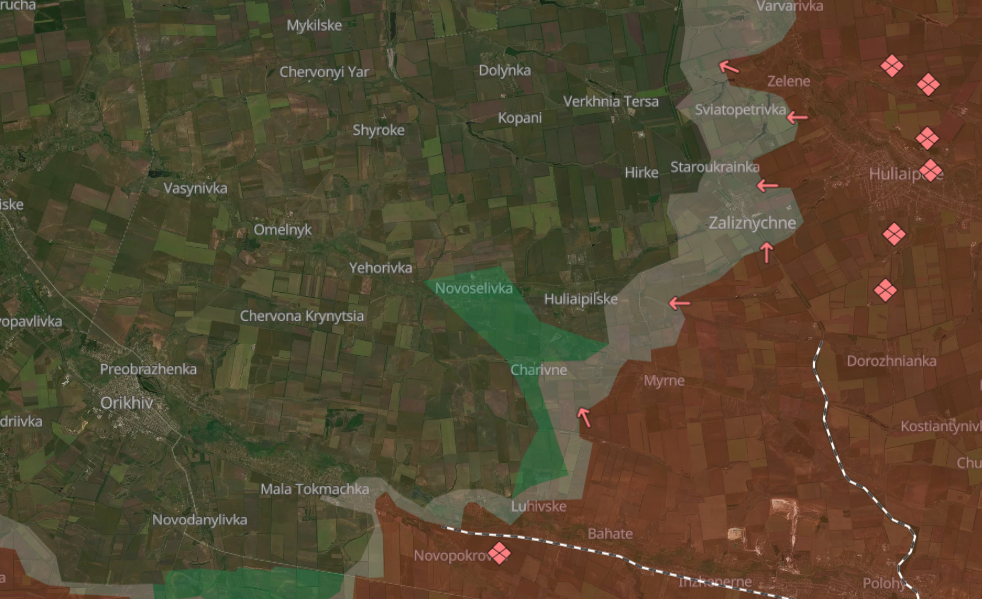
There is consensus everywhere, except on Russian maps, that Russian attacks in the area have stalled. The maps claim that fighting is taking place west of the village of Novoselivka, which we wrote about last week. The Russians sent flag‑bearers into it, who were promptly killed or captured, as videos show, but Russian sources still consider the village to be theirs.
Je partage ses conclusions sur l’état de l’offensive russe 🇷🇺 dans le secteur d’Houlialpole.
🔹Le nombre de frappes aériennes russes est passé de 500 tous les 10 jours en mai, 350 en juin et moins de 200 actuellement. Le ralentissement dans le secteur est visible depuis… https://t.co/zm7TaWOHpn pic.twitter.com/bRvzeRTuu6
— Clément Molin (@clement_molin) July 11, 2026
Several sources claimed that despite the Russian lull, units are not leaving the area for more promising directions, and it therefore cannot be ruled out that Russia is regrouping and preparing for a new offensive. However, the Ukrainian analyst Kostiantyn Mashovets has repeatedly explained that this would only be possible at the cost of weakening units in other parts of the Zaporizhzhia front. The Russian armies deployed here are, in his view, severely depleted.
Paradoxically, Ukrainian analysts from DeepStateUA reported the only Russian advance for the whole of Sunday precisely on this axis, specifically near the village of Zaliznychnе. In the very centre of the map is Novoselivka, which Russia claims to control. Above it is the village of Kopani, which falls into the same category.
Videos of the day
A short video shows Bohdan’s dead body in the company of his comrades‑in‑arms. He was a sniper of the 3rd Separate Assault Brigade and had just fallen in battle. This is what saying goodbye to a friend at the front looks like.
🕯 Вічна пам’ять Герою, який боровся до останнього подиху за Україну 😢🙏
📹 Відео з соцмереж. pic.twitter.com/hSbgZqRx4j
— Breaking News (@breakingUAnews) July 9, 2026
Kinburn Spit in the Black Sea is a place where a Ukrainian ground operation cannot be ruled out. If it happened, it would be very risky. On Monday, Ukrainians showed a video of how to avoid loss of life. They sent a ground drone armed with a heavy machine gun onto the narrow peninsula, carried there by a naval drone.
❗️Soldiers of the 🇺🇦123rd Separate Territorial Defense Brigade conducted the world’s first combat mission of this kind: a ground robotic complex was delivered to the enemy shore by an unmanned marine platform, landed on occupied territory, and successfully used to complete a… pic.twitter.com/eKdmKZIzwM
— 🪖MilitaryNewsUA🇺🇦 (@front_ukrainian) July 13, 2026
Bakhmut three years after its “liberation” by the Russian army. Three years of heavy and constant fighting after the fall of the town have left the front nine km from its western edge. The nearest positions of the Ukrainian army are still in the south‑western part of Chasiv Yar.
The four‑barrel rotary machine gun from the video is normally used on Mi‑24 attack helicopters, where it is mounted in a turret under the front part of the fuselage. This attempt to adapt it for shooting down drones from the bed of a truck turned out to be risky for the gunner.
Russian mobile fire group training goes wrong while using a YakB-12.7 rotary machine gun originally built for Mi-24 helicopters. pic.twitter.com/R7rkcfNgxl
— Special Kherson Cat 🐈🇺🇦 (@bayraktar_1love) July 12, 2026
What are the losses
By Monday (13 July), Russia had demonstrably lost 23,837 pieces of heavy equipment (on Tuesday (7 July) it was 23,806). Of these, 18,815 (18,785) pieces were destroyed by Ukrainians, 993 (992) were damaged, 1,199 (1,199) were abandoned by their crews and 2,830 (2,830) were captured by the Ukrainian army. This includes 4,427 (4,424) tanks, of which 3,329 (3,327) were destroyed in combat. Ukraine has lost 11,690 (11,683) pieces of equipment, of which 9,123 (9,068) were destroyed, 689 (687) damaged, 687 (683) abandoned and 1,191 (1,191) captured. This includes 1,443 (1,440) tanks, of which 1,104 (1,101) were destroyed in combat.
Note: Neither side regularly reports on its dead or on destroyed equipment. Ukraine publishes daily figures for Russian casualties and destroyed equipment, which cannot be independently verified. In this overview we use data from the Oryx project which, since the start of the war, has compiled a list exclusively of visually documented equipment losses.