Inside the race to create summer’s poshest corporate hospitality dishes Later this month, the thrice-Michelin-starred chef Simon Rogan will be serving Cornish lobster with pickled gooseberries, oysters with chicken glaze and Miso-roasted cod with smoked roe. In many ways, it will be the same as any other day for the
 Adam Bloodworth



Thursday 02 July 2026 4:40 am | Updated: Thursday 02 July 2026 1:47 am
Inside the race to create summer’s poshest corporate hospitality dishes
Later this month, the thrice-Michelin-starred chef Simon Rogan will be serving Cornish lobster with pickled gooseberries, oysters with chicken glaze and Miso-roasted cod with smoked roe. In many ways, it will be the same as any other day for the 57-year-old from Southampton.
At his restaurant L’Enclume in Cumbria, where he spends most of his time, he cooks solely with ingredients from his own farm, experimenting with wild, unusual combinations.
But these dishes are unlike any other, because they are being cooked not in his restaurant, but in a field. With skeleton equipment, and the potential for downpours, Rogan is entertaining guests in the Royal Enclosure at Ascot, on a strictly invitation-only basis.
Those top-and-tailed guests expect Michelin-level food despite the challenging conditions, which include horses galloping adjacent to the pass. L’Enclume serves around 40 covers a night, but at Ascot he’s feeding hundreds. What could possibly go wrong?
#mc_embed_signup { background: #fff; clear: left; font: 14px Helvetica, Arial,sans-serif; width: 100%; max-width: 600px; margin: 20px 0; } #mc-embedded-subscribe-form { margin: 20px 0 !important; } .newsletter-form-flex { display: flex; gap: 0; align-items: center; margin-top: -10px; } .newsletter-form-flex input[type=”email”] { flex: 1; padding: 2px 10px; border: 1px solid rgb(18, 22, 23) !important; border-radius: 12px 0 0 12px !important; } .newsletter-form-flex input[type=”submit”] { padding: 4px 10px !important; margin: 0 !important; background-color: rgb(18, 22, 23) !important; color: rgb(255, 255, 255) !important; border: 1px solid rgb(18, 22, 23) !important; border-radius: 0 12px 12px 0 !important; } .newsletter-banner-content { margin-bottom: 15px; } .newsletter-banner-content h2 { margin: 0 0 10px 0; font-size: 18px; font-weight: 600; } .newsletter-banner-content p { margin: 0 0 10px 0; line-height: 1.5; } .newsletter-banner-content ul, .newsletter-banner-content ol { margin: 0 0 10px 20px; } .newsletter-banner-content a { color: #0073aa; text-decoration: none; } .newsletter-banner-content a:hover { text-decoration: underline; } .newsletter-banner-content img { max-width: 100%; height: auto; margin: 10px 0; } #mc_embed_signup #mce-success-response { color: #0356a5; display: none; margin: 0 0 10px; width: 100%; } #mc_embed_signup div#mce-responses { float: left; top: -1.4em; padding: 0; overflow: hidden; width: 100%; margin: 0; clear: both; } New corporate hospitality benchmark at Silverstone
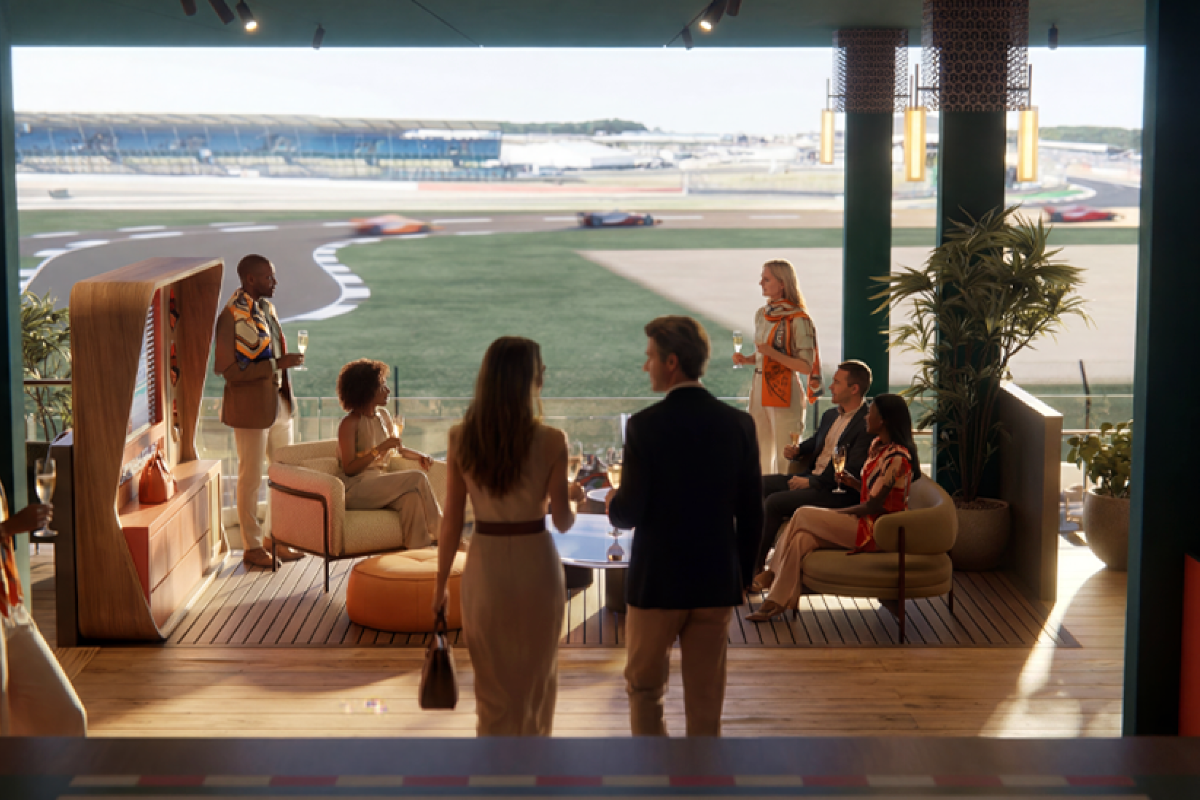
The race to create the highest quality hospo food has been steadily ramping up. With its relaxed lounge aesthetic and high staff-to-guest ratio, Soho House’s House 44, which launched at Silverstone last year, raised the bar for what sports hospitality could be, making the venue’s other corporate catering options look soulless and out of touch.
New launch The Vale at Silverstone is cut from a similar cloth, and the prices might set new records: a day in that enclosure on F1 race day costs north of six grand.
“People are coming to a world-class sporting event, so the food has to try and match that,” says Rogan. He believes that there’s “as much rivalry in the corporate restaurants as there is on the field. Chefs all want to be known as the best. They’re always trying to do new things to outdo each other.”
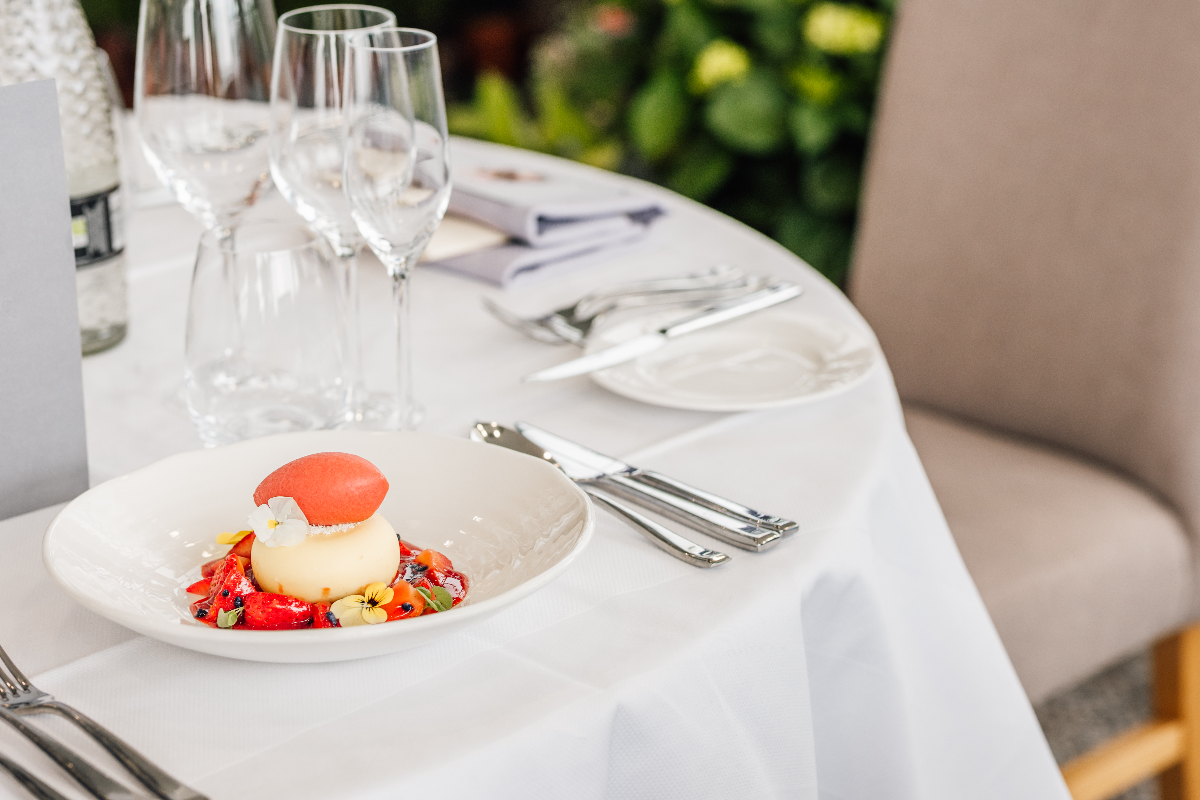 Corporate hospitality at this year’s Ascot
Micro herbs are on the banned list
Tommy Banks, who runs the Michelin-starred The Black Swan at Oldstead in North Yorkshire, is cooking venison with beetroot and fish chowder with smoked potato and bacon at the Allianz Stadium Twickenham later this year. “It’s military precision, really,” says Banks of how he manages to cook at such volume without sacrificing quality.
He’s particularly looking forward to preparing Yorkshire lamb for the New Zealand versus England game. “We need to troubleshoot every little thing, you can’t leave anything to chance,” he says. “We test the dish in different scenarios, really make sure it’s robust, because on match day we want to make 1,000 of them that are perfect. In a restaurant, most things are a one job per person, whereas on that scale it could be six or eight or 10 people for one job.”
There’s no denying that the pressure of producing this food on this scale is totally back-breaking: “We push ourselves as much as we can,” says Rogan. “Sometimes we create our own problems by pushing it too much.”
Corporate work inspires my Michelin starred kitchen
There’s no time for fiddly devices like tweezers, so micro herbs are on the banned list when it comes to finalising dishes and laying them out on the pass to be rushed out to hundreds of hungry – and potentially drunk – guests. “The food can’t be too intricate, it can’t be too labour intensive,” says Rogan. “Service has got to involve minimal hand movements but still look absolutely amazing.”
Read more Ynyshir: Gareth Ward’s shrine to heavy metal cooking
Jonny Lake, who runs the twice-Michelin-starred Trivet in Borough and the one Michelin-starred Labombe by Trivet on Park Lane, is working on his first corporate hospitality event this year, cooking at The Vale at Silverstone.
Packages include priority helipad landings – apparently it can be a right pain trying to land on race day – and for Lake, crafting the menu has been a baptism of fire. “They’re versions of dishes we do at Labombe,” he says of his upcoming menu. “I mean, obviously I don’t know how to make them for like 400 or 500 people, but these guys are going to show me how to do that.”
Lake is collaborating with the high-end catering company Last Supper to scale his food, whereas Rogan and Banks both have corporate hospitality arms to their cheffing brands.
Hospitality dishes need to be delicious but repeatable
Lake had to ditch the idea of bringing his much-loved veal chop, one of Labombe’s signature dishes, to the race tracks. In test kitchens he discovered he wouldn’t be able to guarantee restaurant-quality servings, which was a useful lesson. “I tried to make a version I thought would work, but again, it’s just one of those things, it wouldn’t, so unfortunately we had to drop that.”
He’s proud to be bringing six dishes he’s confident will be popular instead, including his hot tongue bun, wild seabass crudo with orange ponzu and anchovy garum, and lamb rump. “You’ve got to do what you think is possible within those logistical compromises,” he says.
For Lake, who has over two decades of cheffing experience, the hospitality work has been educational. For one, it is a mistake to think this type of cheffing is purely for financial gain. “Innovation doesn’t always go downwards, from your flagship Michelin star restaurant,” he says. “[In hospitality environments] you get exposed to different things. It can definitely go both ways. It’s interesting to see the level [of quality] that can be produced for the numbers, and also the speed of service that needs to happen.”
Lake says he’ll be focusing on sharing-style dishes at the centre of the table, whereas Rogan and Banks are plating up individual main courses per person.
Horses make the ground shake as chefs turn sauces in the pan
Contrary to the idea that hospitality experiences can feel soulless and mass-produced, Banks argues that “more development work goes into the dishes that we do on scale” than in his twice-starred restaurant. “Not only do they have to look delicious, taste delicious, be interesting, but we need to know that they’re ultimately repeatable, so actually there’s probably more pre-work for this than anything else, which people probably wouldn’t have thought.”
With race cars belting past at 200 miles per hour, and horses making the ground shake as you turn sauces in the pan, it helps if the chefs also love the sports they are catering for.
For Tommy Banks, watching the rugby is a privilege that comes with the job. Unlike at Ascot, where service powers on throughout the races, at Twickenham the food stops for the duration of the match, giving chefs time to enjoy the action. “Me and Tom Kerridge watch every England rugby match together,” says Banks. “He runs a restaurant on the floor below. Being a chef, sometimes you’re lucky enough to experience amazing things, things that you know people will pay a lot of money to see. I think that’s the biggest thing for me.”
‘Just give me free hospitality tickets, and I’ll be there’
It’s a similar story for Rogan, who most days is rooted at L’Enclume but treats hospitality contracts as an excuse to pair work with his passion for live action, particularly tennis. Cooking at the Australian Open earlier this year was a career highlight, he says. “Me, myself, my team, we love sports. Tennis is my sport: just give me some free tickets, I’ll be there.”
The hard work is worth it for the reward. Banks remembers a “very intricate” Paris choux bun he’d made at a posh hospitality event that had been an enormous effort to pull of. But it all seemed worthwhile when the legendary Raymond Blanc heaped him with praise. “He said the choux was ‘perfect’, and to do it for this many people… he was very impressed,” says Banks. “That was a feather in the cap.”
Read more Ikoyi founder Jeremy Chan: ‘Eating my own food is forbidden’
Similarly tagged content: Sections Categories People & Organisations