


Ukrainian drones reshape the war and expose Russian vulnerabilities but Europe’s disjointed weapons factories and looming US pull-back could leave its own cities unprotected in a future confrontation.
 Ondřej Kundra



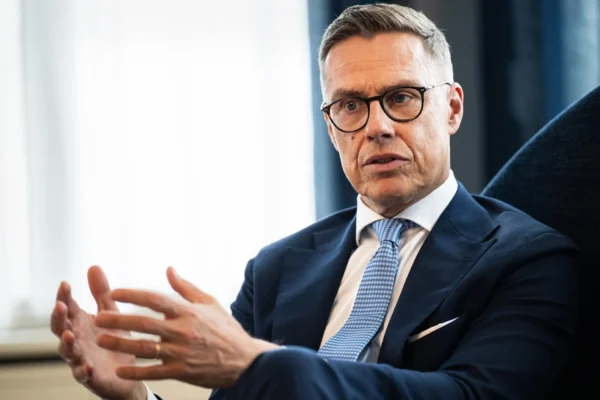
As Europe faces its most significant security challenges in decades, questions about defence, industrial capacity, and support for Ukraine have become central to the continent’s future. In this interview, EU defence commissioner Andrius Kubilius discusses Ukraine’s ability to win, the fragmentation of the defence industry, and what would be a fatal mistake.
You are historically the first EU commissioner for defence of the European Union. At the same time, you come from Lithuania, one of the smallest member states. What is it like for you personally to lead the defence of a continent of almost half a billion people?
It is of course a completely new experience, compared to everything I have gone through before, including the position of prime minister or member of the European Parliament. I have a demanding agenda, I have to keep learning new things and their context to understand how complex decision-making works. Referring to the country I come from, I would in any case say that we Baltic people are well prepared to perceive current threats.
You do your job in increasingly complex security times, do you ever have sleepless nights because of that? What goes through your mind when you cannot sleep?
The challenges we face certainly bring a lot of late-night thinking, including reading various documents, writing and preparations. But it is nothing entirely new, because when I was still Lithuanian prime minister, the global financial crisis was raging, and that did not let one catch a breath either. Difficult times do not only have these negative aspects, they also have a positive side, because they mobilise you.
We are speaking a few days after a massive attack by Ukrainian drones on the largest refinery in Moscow. What went through your mind when you watched the videos from the operation?
I can repeat the words that were just heard at the G7 meeting, where it was also discussed: they called it a new momentum. And it is not only about this attack, but overall, if you look at what has been happening on the front over the last half year, you see positive shifts from Ukraine’s point of view.
How do you mean that?
The current minister of defence, Mykhailo Fedorov, already as minister for digital transformation at the very beginning of the fighting initiated the creation of a drone army, which Ukraine is now capitalising on in the war. Look at how many logistical problems they are causing the Russians in Crimea and elsewhere. When I discussed this with Minister Fedorov, whom I know well, he used the expression that they were waging a cognitive offensive.
What does that mean?
With deep strikes on Russian territory, Ukrainians are sending a strong message to Moscow, Saint Petersburg and other major Russian cities that they are capable of winning. In Europe, but also globally, this is changing how they are perceived. And I think this is increasingly dawning on people in Russia as well. This struggle for a different perception is important in this war. And Ukraine is now doing a great job, while logically demanding from us that we focus even more on supporting this “new momentum” and on strengthening its very ability to win.
The war is nevertheless continuing into its fifth year, what do you infer from that?
I will not draw the wrong conclusion that the Russian army is weak and therefore we can disengage from supporting Ukraine. Ukrainians are demonstrating excellent combat skills, and if you consider that Russia is many times larger, we need to applaud how long they have been defending themselves, all they have achieved and that they have the initiative. I therefore agree with the assessment of United States Secretary of State Marco Rubio and Finnish president Alexander Stubb, who recently stated that the Ukrainian army was the best in Europe. Or, as Alex Stubb specified, perhaps even better than the American one.
What do you attribute that to?
I ask myself why the Ukrainian army is so good. And my personal answer is that not only do they have brave soldiers and smart generals, but they are also succeeding in creating a very innovative, dynamic defence industry. We as Europeans must understand that it is therefore in our vital security interest to integrate Ukrainian military capabilities and defence-industrial capabilities with our own as quickly as possible. Our intelligence services predict that Putin may in future try aggression against Nato and EU Member States. The Russian army is indeed not able to defeat the Ukrainian one, but we should not underestimate its battlefield experience. Ukrainians are undoubtedly right when they say that the Russians are also good at drone warfare, electronic warfare and so on.
As regards Ukrainian drones and the attack on Moscow, Russian air defence fired at them unsuccessfully. What lesson does that hold for the defence of European cities, which in future could conversely be attacked by Russian drones?