Belgian minister for the climate, Jean-Luc Crucke believes in simplification and the initiative of companies to collaborate with federal sustainability measures. Despite unequal footing with international partners and a slow pace of EU reforms, the minister is “not a pessimist”
 Gaia Neiman



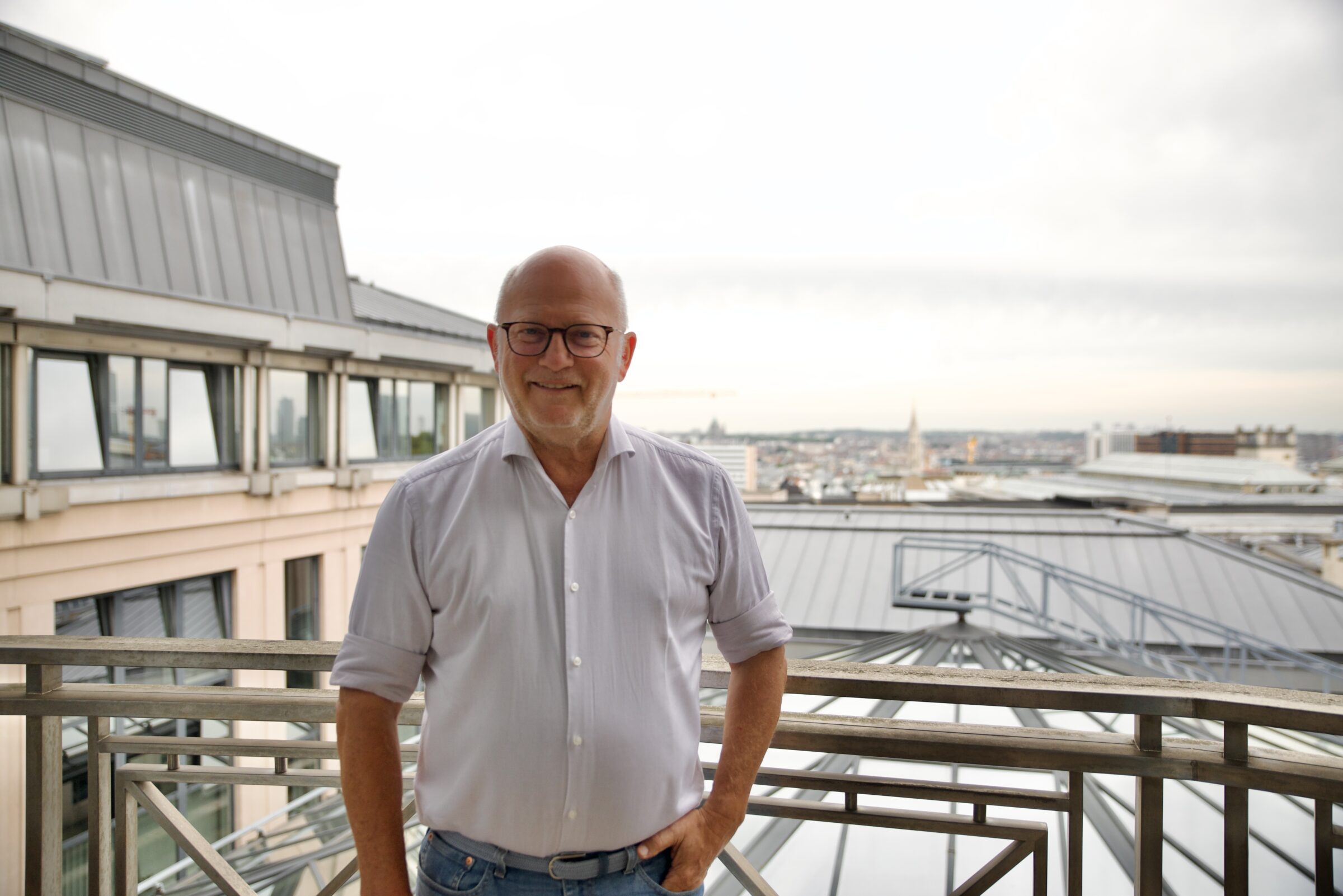
Jean-Luc Crucke has served as Belgian minister of climate and mobility in Bart De Wever’s government since February 2025, under the centrist French-speaking political party Les Engagés. Crucke sat down with EUobserver in Brussels on 30 June to talk about Belgium’s role in EU climate policy, and the simplification measures that may be needed to make it work.
Is the EU backtracking in its commitment to the Green Deal?
No, I don’t think Europe is backtracking. On the contrary, it has a well-established course of action. Yet within the framework of the Green Deal, it is only natural that after a certain amount of time, adjustments may need to be made. It is also natural that administrative procedures should be simplified where necessary. So, to me, the demands coming from the sector seem quite logical.
We must not confuse a simplification of the system with a deregulation of the system. And what we will be mindful of is that we retain the same objectives, but that, in order to achieve these objectives, we also have to take into account the interests of the business community, so that we can achieve them without overburdening those who are actually responsible for making it happen.
We’re not changing the objectives: they must remain the same. But if we can make life easier for all those who are subject to a certain number of obligations, well, I believe that’s in everyone’s interest, and in the interest of the climate in particular.
Are you optimistic of Belgium’s transition to net zero alongside progresses made by other EU member states?
Climate by definition, as I always say, is not a problem specific to any one country; it is an international problem. It must be addressed on a level playing field, which is Europe. Europe itself imposes a number of obligations, and its complexity is enormous. But the system’s complexity cannot be an excuse for failing to achieve progress.
It seems to me that the The Belgian National Energy and Climate Plan, as it has been approved by Europe, is a good indicator of how to achieve this. Is that why I am convinced and confident that we will succeed? As only a minority of decisions fall within the remit of competences, I must be extremely cautious on this matter and say: I hope that everyone has carefully read what Europe has written for us.
That is precisely why I am calling for greater coordination and greater collaboration; because that costs nothing. It’s simply a matter of asking ourselves: what if we worked towards the same goal rather than against one another within the microcosm that is the Belgian State?
What are the main challenges impeding Belgium’s full transition?