
Behind the friendly “pizza comunista” and open-door consultations lies a party that still hails Marx, Engels and Lenin and wants Austria out of the EU, raising awkward questions for voters who back its housing fixes but ignore its revolutionary long game.
 Soňa Weissová



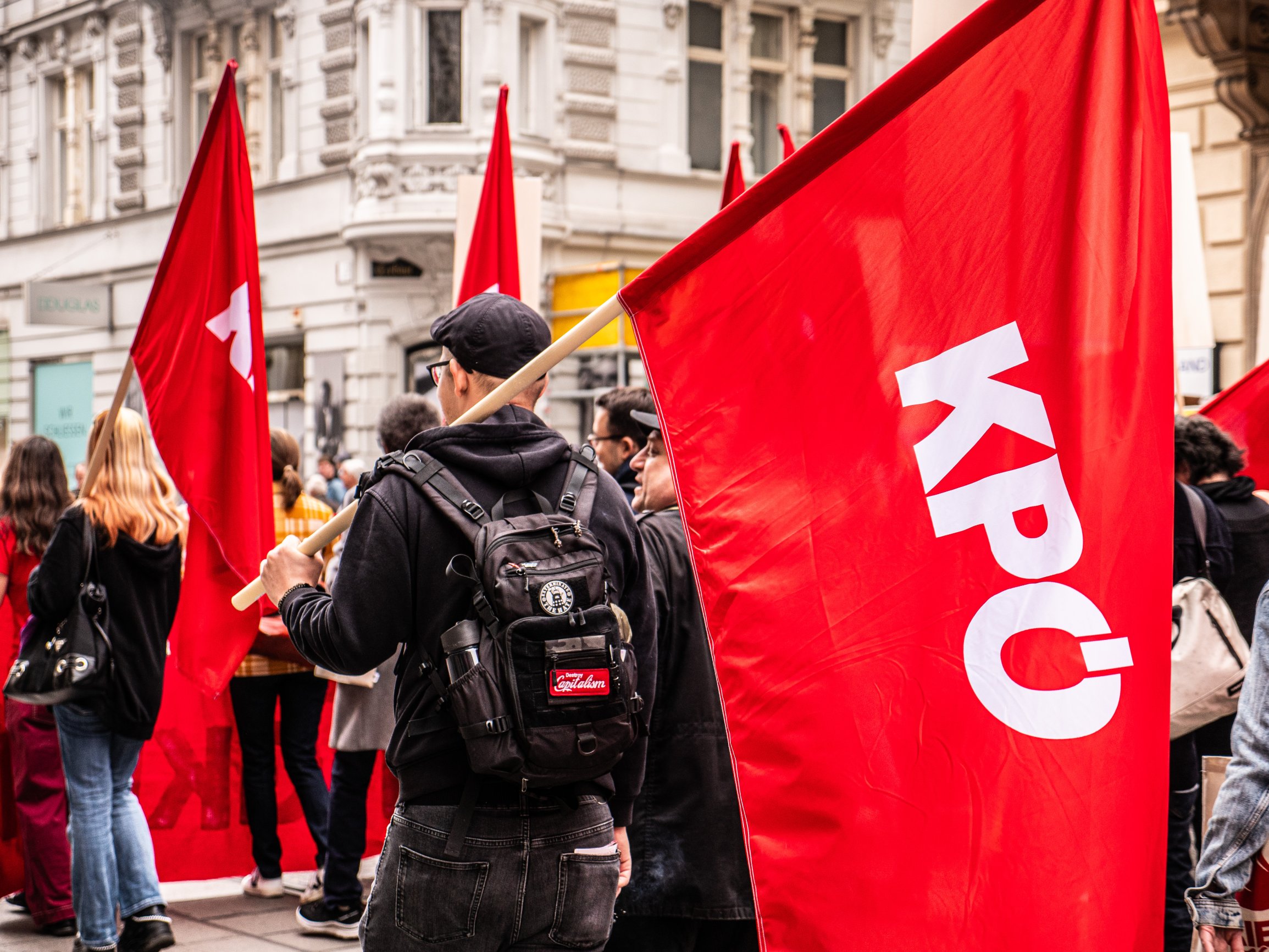
Every last Saturday of the month, a special event is held in Graz, organised by the Communist Party of Austria (KPÖ). Its supporters gather in their Volkshaus, or people’s house, to bake Neapolitan pizza. It also has a telling name – pizza comunista. They hand it out for free.
The project also has a deeper dimension. It is just one of the activities through which the communists show that they are close to ordinary people.
The KPÖ’s win in Graz in the 2021 local elections was a surprise, and a repeat happened in June.
“They present themselves as something new and different from the established parties. I know it sounds strange, but yes, it is possible,” Katrin Praprotnik, a political scientist at the Institute of Public Law and Political Science at the University of Graz, told Denník N.
In Austria and the federal province of Styria where Graz is located, the KPÖ has created a red island in a sea of far-right populists. Analysts say that the KPÖ has pushed its own left-wing populism.
Communism with a human face?
The city, home to 303,000 inhabitants and Austria’s second-largest, has two nicknames in the local press – Leningraz and Stalingraz.
When an event organised by the communist party takes place in the city, it is not unusual to see plastic cups decorated with the hammer and sickle.
KPÖ owes much of its success in Graz to its local leader, Elke Kahr. The daily Presse, which targets a more right-leaning urban readership, called her “perhaps the friendliest face of communism”.
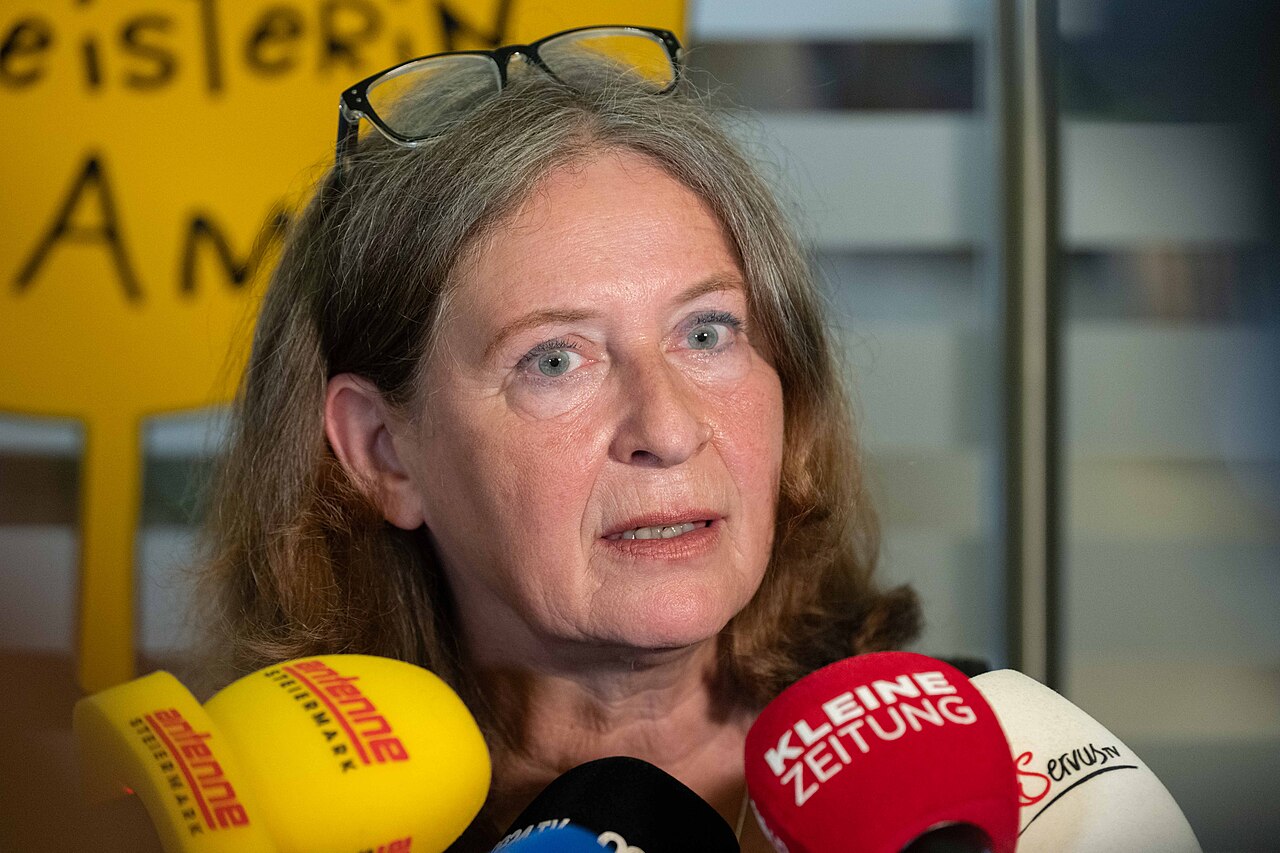 Elke Kahr, mayor of Graz (Source: Wikimedia)
Kahr often sits in the common room of the people’s house at a small table where she holds her “consultation hours”. In front of her are a cup of coffee, ashtrays and a pack of Parisienne cigarettes, which she repeatedly reaches for.
Her success has also attracted foreign media. Ahead of the elections, the German weekly Spiegel and the daily Neue Zürcher Zeitung both ran feature reports on her.
As the Swiss paper described, on one pre-election Saturday, Kahr listened as a 29-year-old mother explained how hard it was to come up with almost €3,000 for a deposit on a new flat. She was still €400 short. “Have you already tried Volkshilfe?” Kahr asked, referring to a charity.
The young woman shook her head. “Come and see me at city hall on Tuesday. My colleague will fill in the application with you,” the mayor said.
Kahr herself grew up on the poor Triestersiedlung housing estate in Graz. As a child, she reportedly saw, according to the weekly Spiegel, how other children were treated because of their poverty. That was how she learned to protest. One day, her teachers told her that “she spoke like a communist”.
“So I took the telephone directory to find out where I could find them in Graz,” she said to the weekly.
She liked that they did not just talk, but also acted.
“We cannot keep comforting people forever with the promise of a better world.”
In the NZZ report, another woman came to see Kahr. She had lost her job after her employer went bankrupt and had fallen into depression after her parents’ deaths. Kahr listened, several times placing a hand on her shoulder. Then she leafed through some papers and asked for details.
“With my 56 years, no one will employ me any more,” the woman complained, according to NZZ. Kahr offered to get in touch with someone on her behalf.
Kahr says that she receives hundreds of requests for meetings, typically seeking help to find a flat, a place in a nursery or resolve a transport problem. At this time of year, she frequently hears from parents who cannot not afford their children’s school trips.
“Elke Kahr is a phenomenon in her own; she is a truly very popular politician in Styria and in Graz,” Miroslav Kunštát, an expert on Austrian politics at the Institute of International Studies at Charles University in Prague, told Denník N.
Not only the poor vote for them
They are also successful among the better-off residents on the other side of the river Mur. In the past, the river formed a social boundary between industrial Graz shaped by migration, and on the other, the affluent bourgeois Graz. On the left bank lies the historic centre listed by Unesco, the elegant shopping street Herrengasse and well-off residential districts.
At the market behind the opera, those who can afford local organic food do their shopping. And many of them describe themselves as fans of “our Elke”.
A 47-year-old man in a light-blue linen shirt and expensive sunglasses described himself as a floating voter. “I have a problem with communism, but not with Graz’s KPÖ,” he explained to NZZ. He said he appreciated Kahr and believed that at municipal level she could not push through her ideological goals anyway.
A bank clerk told the Swiss daily that he himself lived in a privileged bubble. He lived in his own house, had another flat as an investment, and in his six-year-old son’s class there were only two children whose mother tongue was not German. “We are satisfied with the city’s policies,” he said.
When it rained in Moscow, they opened umbrellas in Graz
As the weekly Spiegel recalled, Austrian communists spent decades celebrating Joseph Stalin; they regarded the brutal and bloody suppression of uprisings in East Germany, Hungary and Czechoslovakia, as well as the construction of the Berlin Wall, as a necessary evil. The KPÖ was said to be so ideologically that it would open an umbrella at home whenever it rained in Moscow. And the most loyal party members were in Graz.
“The Austrian Communist Party did not change its name even after 1990, although it gradually – and not very convincingly – distanced itself from some chapters of its past, or from Stalinism. Until 1990, KPÖ was a loyal pro-Kremlin party which, in 1969, expelled the reformist communists led by Ernst Fischer, who supported the so-called Prague Spring in Czechoslovakia and condemned the Soviet occupation in August 1968,” explained Kunštát, an Austria expert from Charles University in Prague.
In the 1970s and 1980s, he added, the party also took a critical stance towards the Eurocommunism that came to dominate the strongest communist parties in Western Europe – in Italy, France, Spain and elsewhere.
Since there is no electoral threshold in Styria, KPÖ has always won at least one seat on Graz city council since 1945.
However, the party struggled in the city for a long time until the 1980s, when Ernest Kaltenegger won a seat on the city council for the first time – and this marked the start of a remarkable rise.
Political support of KPÖ in Graz
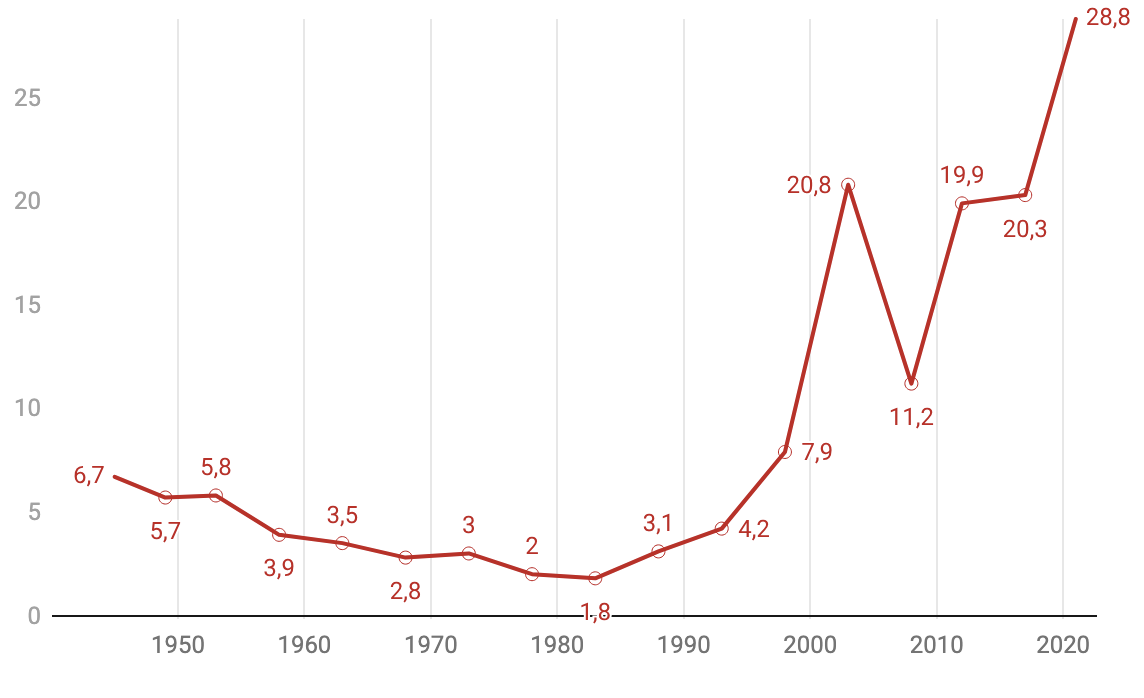 Between years 1945 and 2021. Support (%). According to opinion polls, KPÖ is expected to receive 32% of the vote in 2026. Source: Data Wrapper
Kaltenegger discovered the issue of housing for KPÖ and, in 1992, introduced the “emergency hotline for tenants”, which still operates today.
The politician soon became a well-known figure in Graz – and with him began KPÖ’s rise. From 1998 to 2005 he was a member of the city government and responsible for housing construction. Kahr, who came from modest circumstances, joined the party in 1983 aged 22 and became one of his closest associates. In 2005, she took over his portfolio in the city government after Kaltenegger had led KPÖ above 20 percent.
The fact that the party won the 2021 elections has remained difficult to grasp for many Austrian observers even five years on, as the daily Presse wrote. For two decades, the conservative People’s Party had ruled the city.
What the party owes its success to
Under his leadership, the party went through a serious and painful reckoning with its past while Kaltenegger instilled in his party members the idea that only a party with “social usefulness” had a right to exist. He identified the main problems facing the people of Graz as a lack of housing and high rents.
The issue of affordable housing still dominates among the communists today, and some say KPÖ could quite easily be renamed the Housing Policy Party.
Over the past five years under its administration, hundreds of municipal flats have been renovated or newly built, waste collection fees have been frozen, admission to municipal swimming pools has become cheaper, subsidies for all political parties have been reduced and the money redirected to social projects. These include Küche Graz, which delivers up to 15,000 meals a day to nurseries, schools and after-school clubs.
“KPÖ’s successes can be attributed not only to the two charismatic figures mentioned, but also to a non-ideological municipal and regional policy focused on practical problems, which did not overly emphasise the Marxist orientation of the national KPÖ. As mayor, Kahr has on several occasions distanced herself from her earlier statements in which, for example, she expressed admiration for the Yugoslav communist leader Josip Broz Tito,” Kunštát explained.
The Austrian political scientist Praprotnik from the University of Graz said that the communists in the city were successful because they were able to conduct regional politics at a high level.
“The reason why this is credible, in my view – and this is the second component needed to understand KPÖ’s success – lies in their understanding of politics as a kind of service to citizens, something very local. That is also why it works primarily at local level,” the expert said.
“People can come to them and have a chat. For example, if they have trouble paying the rent. We had an election campaign in which Elke Kahr herself put her phone number on the campaign posters. It is simply a different way of understanding politics – through these consultation hours and an approach of: ‘Here is my phone number, you can call me, we can talk about it and we will try to find some solution to your very individual problems,’” Praprotnik added.
Julia, a young single mother, is not on the left. In the last parliamentary elections, she voted for FPÖ, at the opposite end of the political spectrum. “FPÖ only talks as well,” she said. But she would not hear a bad word about Elke Kahr. “What she does is sensational.” Because of her, she will vote for the communists this weekend.
Politics of alms
Kahr has also kept the rule introduced by Kaltenegger, under which KPÖ councillors donate a large part of their salary to the party’s social fund.
“Everything above €2,600 they donate. I do not know exactly for what purposes, but they give part of their salary to charity. This too sends a certain signal in a society like Austria, where there is generally a high level of dissatisfaction with politics. In this way they present themselves as those who do something good for ordinary people,” Praprotnik explained.
According to its own figures, last year the party supported 2,521 people with almost €305,000. The money was said to be sent directly to landlords, hospitals or schools.
Kahr herself said that since she entered city hall in 2005, she had given away around €1.3 million from her salary.
Because she did this directly to people and without bureaucracy, her opponents labelled it “vote buying”. She herself called it “building trust”. What she did, she said, “is not a strategy, but a necessity”.
She also argued that she had never asked anyone about their political views. Half of the people who came to her consultation hours reportedly did not have Austrian citizenship.
Leaving the EU, an unclear stance on the war, and more
At national level, KPÖ has long been only a fringe force in Austria. It last entered the national parliament in 1956. In the most recent parliamentary elections, it won 2.4 percent of the vote across Austria and 6.1 percent in Graz. In the national elections, the Social Democratic Party (SPÖ) came first in the city with 21.9 percent.
“It is telling that her (Kahr‘s) position within the party as a whole is ambiguous; after all, she herself had no ambition to be chair at national level. The leading candidates on the KPÖ list ahead of the parliamentary elections in autumn 2024 became the relatively unknown Tobias Schweiger and Bettina Prochaska, while Elke Kahr and Salzburg’s (also very popular!) communist deputy mayor Kay Michael Dankl were placed only at the very end,” noted Kunštát.
While in Graz the party does not openly espouse Marxism, it does not want to give up the communist label, according to Austrian political scientist Katrin Praprotnik.
“They continue to embrace the term communism, so they are a communist party. In interviews they are often asked: ‘Why do you keep this label?’ But they want to keep it. Perhaps for reasons of tradition, but also because of the aspect of Gemeinwohl – the common good. They claim to be in politics in order to promote the common good, while maintaining a link to Marxism. That is important for the party,” she explained.
The regional branch in Graz does not push communist ideology in the way, for example, the KPÖ programme for the federal province of Styria does. It dates from 2014 and is still available on the website.
In it, the party writes that KPÖ is a Marxist party of the working class and that “as Marxists, we are particularly committed to the legacy of the classics of scientific socialism – Marx, Engels and Lenin”.
The programme also aims at the “abolition of capitalist ownership of large means of production”, which is “the crucial basis for building socialism”. To achieve this, the “capitalist class must first be politically deprived of power”. In order “in the long term to create the possibility of an escape towards socialism”, the EU must be left, since genuine “social progress” is “incompatible with EU membership”.
The KPÖ election manifesto in Graz also states that “privatisation is the theft of public property” and demands that private construction firms should be obliged to contribute to building public infrastructure, and similar measures.
KPÖ condemned Russia’s invasion of Ukraine in 2022, but its politicians still have a certain affinity with Russia; they are against sanctions and against arming Ukraine.
“The main criticism is that they do not distance themselves sufficiently from Russia. Although Elke Kahr always argues in favour of peace – that she is, of course, against the war and that she is there to support peace – she is not in favour of sanctions, because her argument would be that these sanctions will not end the war,” Praprotnik explained.
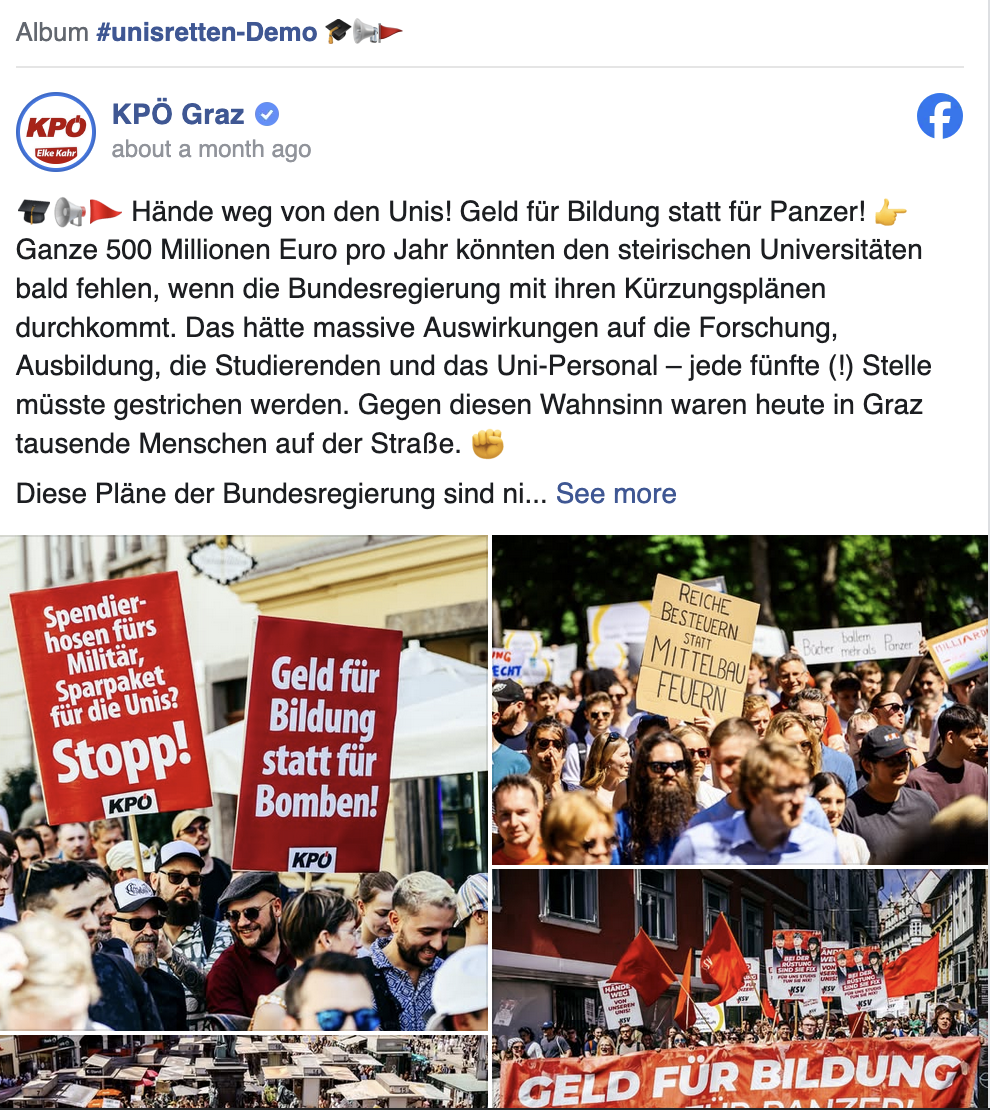
Communists are not an obvious no-go
Kahr joined the party long before KPÖ distanced itself from Stalinism in 1994. In the past, she expressed sympathy for Tito and the Chinese communist regime, which she said had managed to secure relative prosperity for millions of people. ÖVP therefore accused her of not being a “flawless democrat”.
Kahr avoids this topic and replies that she is a local politician and is only interested in the people of Graz.
“As for the term communism, a few years ago there was a Gallup poll in which roughly a quarter of the electorate said: ‘No, I no longer really have a problem with the term communism.’ For a significant part of the Austrian population, communism is not a no-go,” Praprotnik said.
One factor may be the city’s history. During the Second World War, it was one of the targets of Allied bombing. In May 1945, Graz was first occupied by the Red Army, but after three months the Allies agreed that the city would come under British occupation administration, meaning it did not go through the same experience as regions under Soviet control.
Praprotnik also points to the experience of Salzburg, where a communist candidate who is now deputy mayor was also successful, and polling data which suggests that voters for the communist party tend to decide for it at the last minute.
“KPÖ in Austria in fact does not have a solid core electorate, but occasionally, if there is an election with a candidate who appeals to many people, it can achieve very good results,” she said.
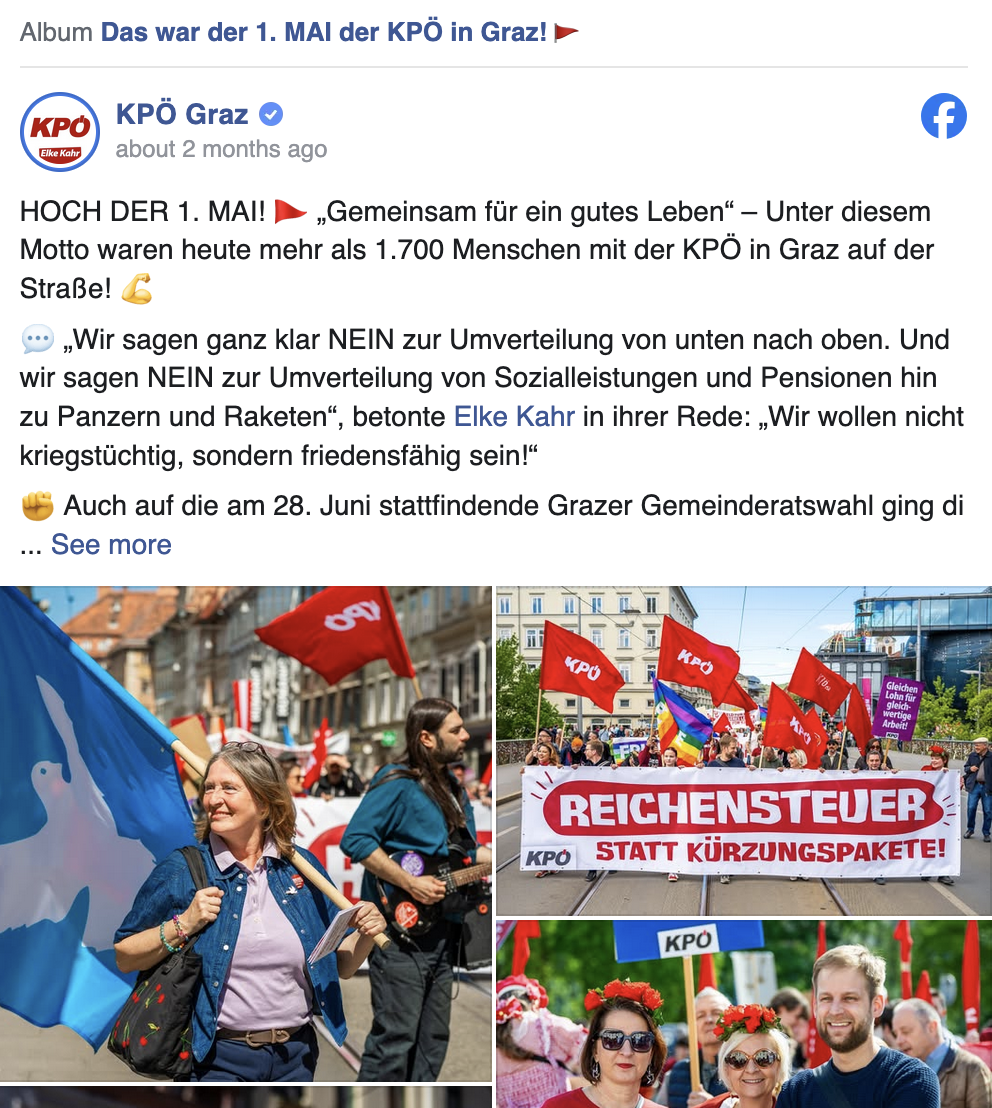
Political scientists from the University of Graz point out that KPÖ attracts protest votes against the system, which elsewhere in the country benefit the Freedom Party. The paradox is that at city level the Communist Party governs with the People’s Party and the Greens, while in the federal province of Styria the People’s Party governs with the Freedom Party.
Toxic conditions for businesses
Oliver Fritz, a regional economics expert from WIFO, argues that the city remained economically attractive. More than 80 percent of buildings are in private ownership, and tourism is doing well compared with other regional capitals, while job creation has increased in recent years.
According to him, Graz is a research-intensive city with a high rate of innovation, a dynamic industrial ecosystem with development potential, and the city is growing rapidly.
The city’s leftward shift is reflected in various projects – and in a massive expansion of social benefits. The city is building and renovating municipal flats on a large scale, and access to them has been simplified. Subsidies and social programmes are increasing across the board.
Social policy even extends to pets: for financially weaker pet owners, the Lennymarkt was introduced, where free pet food is available for low-income earners.
Graz, however, has serious budgetary problems. The debt of the provincial capital has risen sharply and, according to Statistik Austria, is roughly three times higher than in 2017. The city’s debt stands at almost €2bn.
Among the provincial capitals, apart from Vienna, it has the highest level of indebtedness, economist Fritz said. Even if the debt is underpinned by meaningful investments, this does not change the fact that “budget consolidation is essential”, he says.
According to critics, demands for extreme rent caps will halt private construction. If