Tamas Sulyok now faces a stark choice: either he signs his own dismissal within five days or faces impeachment.
 Edit Inotai



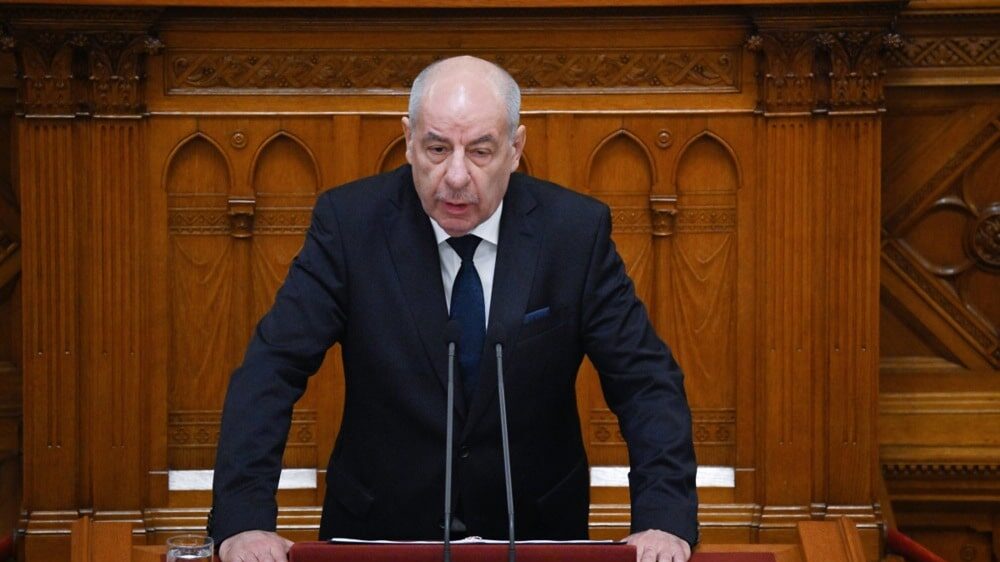
The Hungarian parliament passed a complex constitutional amendment on Monday evening, which – among other measures – ends the current president’s mandate in a single sentence: “On the day following the entry into force of this constitutional amendment, the mandate of the President shall terminate.”
Tamas Sulyok now faces a stark choice: either he signs his own dismissal within five days or faces impeachment. In both cases, the political battle is likely to be won by Hungary’s new prime minister, Peter Magyar, who is implementing his election promises with remarkable speed and determination.
Magyar made no secret of his intentions before the April 12 general election. One of his key promises was to dismiss the appointees of his predecessor Viktor Orban, among them the president, the chief prosecutor and the president of the Supreme Court – all regarded as Orban loyalists who would likely take steps to block the workings of a new government, especially if it had won the election by a narrow margin.
In the event, however, Magyar’s Tisza party won by a landslide and holds a majority able to amend the constitution and rewrite so-called cardinal laws – just as Orban’s Fidesz party did during its 16 years in power.
Even so, removing such key office holders will not be straightforward. Nor will it be uncontroversial.
Human rights watchdog Amnesty International Hungary has openly criticised the move, earning unexpected praise from the Fidesz camp. “We agree with the goal. We also believe that President Sulyok is unworthy of the office,” Aron Demeter, communications director of Amnesty International, told BIRN. “But it also matters how he is removed from office.”
Demeter thinks the chosen method – removing him via a single sentence – is “not elegant”, yet perfectly legal. “If we want to break with the methods used during the Orban regime, the new government should not fall into the trap of using the same methods,” he argued.
Sulyok was elected by parliament – there is no direct presidential election in Hungary – only two and half years ago, after Orban’s family-minister-turned-president, Katalin Novak, was forced to resign over a presidential pardon involving a paedophile scandal at a children’s home. The case affected Hungary to a degree that even Fidesz’s loyal voting base was shaken.
In crisis mode, Orban opted for what appeared to be the safest choice: appointing the then-president of the Constitutional Court.
A figure largely unknown to the wider public, Sulyok was certainly not someone that many Hungarians thought capable of uniting an increasingly polarised society. During his tenure, he remained so irrelevant that probably his most memorable image is an awkward attempt to present his “human side”: a video showing him ironing his own shirts.
Sulyok never criticised the Fidesz government nor voiced concerns even when Orban described his critics as “stinkbugs” or the government threatened civil society organisations and the independent media with a Russian-style “foreign agents” law. He also remained silent when Orban lashed out at Brussels and war-torn Ukraine.
Yet he felt moved to warmly praise Orban on his 62nd birthday last year, describing him as somebody who does not drift with history but shapes it. “Some say that it is difficult to find balance on the waves of politics. Yet you have not only maintained your balance, but built a ship, shown the way, and, when necessary, taken up the oar yourself,” he gushed on Facebook on May 31, 2025.
“The removal of the president has been one of Tisza’s key promises and it is also widely expected by the majority of the public,” Zsuzsanna Szelenyi of the CEU Democracy Institute commented to BIRN. “His removal is part of the dismantling of Orban’s illiberal system.”
Szelenyi believes the process is fundamentally political. Sulyok and other appointees of the Orban era have clearly lost the public’s confidence, as the institutions they lead failed to fulfil their constitutional role. However, she does not expect a quick end. Instead, she thinks Sulyok will use all available means and legal avenues to challenge his dismissal and raise concerns about rule-of-law deficiencies in Hungary – a complaint he never raised when Fidesz was in power.
Strikingly, he only started to worry about the implications of a two-thirds parliamentary majority when Tisza secured one in the last election, never during the 16 years that Orban’s Fidesz party held such a majority.
“I believe Fidesz is trying to build some political capital from this process,” Szelenyi says, with the former governing party standing firmly behind and advising Sulyok and the other appointees.
Fidesz’s main narrative, she says, will be that Tisza itself is creating an undemocratic system, trampling on the rule of law. “But we should not forget that these people, like Sulyok, who had also served as the president of the Orban-loyal Constitutional Court, or the president of the Supreme Court or other office holders, constituted the very elite of Fidesz. A credible regime change would not be possible without replacing them all.”
Fidesz and its satellite party, the Christian Democrats, now reduced to only 52 MPs in the 199-seat parliament, boycotted the session and called the constitutional amendment to remove the president as unprecedented in Europe. The party also protested the 12-year limit that will be introduced for MPs, retroactively, preventing two-thirds of the Fidesz parliamentary group from running for re-election in four years.
Yet Fidesz is under considerable strain and appears rudderless at a critical time. The parliamentary group leader Gergely Gulyas – Orban’s former chief of staff and a former close friend of Prime Minister Magyar – announced during the day that he was stepping down so as to clear the path for eligible candidates, while the president of the party, Orban, was boarding a flight for the US to attend the FIFA World Cup semifinals and the final, effectively leaving his party leaderless.
“Viktor Orban has abandoned his own community, Gergely Gulyas has left the sinking ship and resigned. The bubble has really burst now. It is over,” Magyar posted triumphantly on Facebook.
But for Amnesty’s Demeter, the battle to restore Hungarian democracy is still far from over. He believes the real test will be the election of Sulyok’s successor.
“The new president, who will serve on an interim basis until the new constitution is written, should genuinely unite Hungarian society. This is the real challenge: to find somebody in this incredibly polarised country who can maintain the dignity of this office but also be able to counterbalance the government when needed. The next few weeks will show how serious Tisza really is about regime change,” he said.
The new constitution is expected to pave the way for the direct election of a president, similar to the system in Poland, Austria or Czechia.