For some urban commuters, the new city location offers a better experience than older formats. Kelvin Dozier, who usually shops at an Aldi in Brooklyn, recently started visiting the Manhattan location right across from his office for convenience.
“The one here – it’s brighter,” Dozier told the BBC, noting the fresh sweet navel oranges in his basket. “The one in Brooklyn is a little smaller. It almost seems temporary, but here it looks like a permanent location.”
Still, winning over city slickers accustomed to premium brands remains an uphill battle. Ralph Montenegro, visiting Aldi for the first time, remained fiercely loyal to competitors.
“It has more variety than say Target,” Montenegro said, praising the prices on staples like flour and fruit, though he noted he still prefers Trader Joe’s. He added that Aldi’s heavy reliance on packaged, private-label processed foods was a detractor compared to the natural organic options he prefers.
This strict reliance on limited, private labels is exactly what keeps Aldi’s overheads low, according to Dustin York, an associate professor of communication at Maryville University.
He says that Aldi targets a lean, highly efficient model that provides about 80% of what a traditional big-box retailer carries, but at a much lower cost.
Still, York argues it is unlikely that Aldi will take dramatic market share from Walmart, because the retail giant is simply too massive. “I call Walmart the battleship, and I call Aldi a kind of submarine.”
But navigating those crowded waters can bring a distinct financial hazard.
“Their biggest kryptonite is real estate cost,” York warned, pointing to a brutal Manhattan retail landscape where average asking rents are between $350 and $700 per square foot.
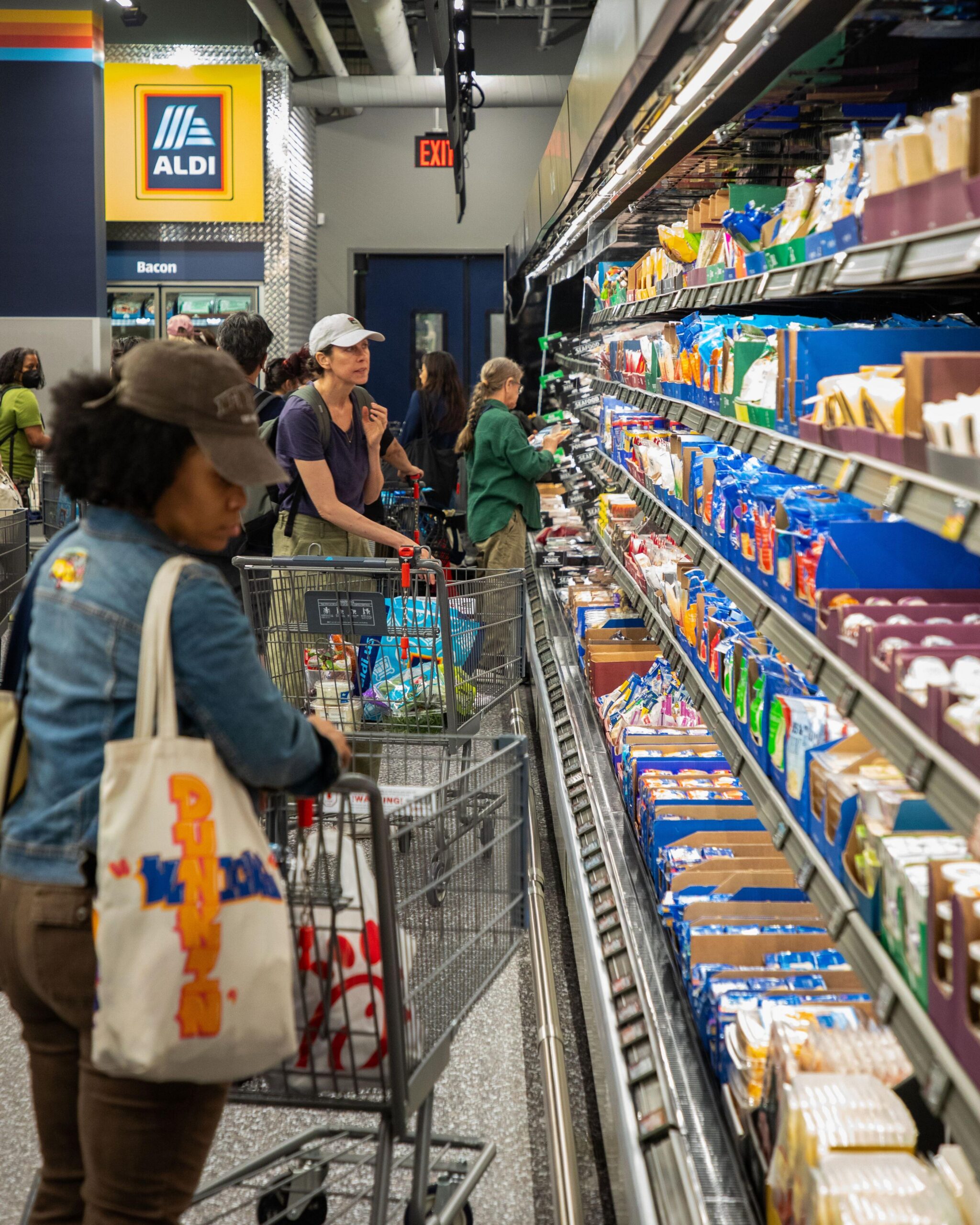 Image source, ALDI
In addition to high rents, Manhattan’s roads provide another challenge.
Speaking on Bloomberg’s Odd Lots podcast, Aldi’s US chief commercial officer Scott Patton detailed that supplying the Manhattan store requires trucking inventory in from South Windsor, Connecticut, using shorter, specialised trucks to navigate tight city streets.
“We come at night because of the congestion,” Patton said, noting that each truck requires a two-driver team to handle the city’s turning radiuses. One driver watches for blind spots while the other unloads the groceries. To keep shelves in the Manhattan location stocked, Aldi runs three to four of these trips every night, calling the operation a “logistical symphony”.
Walmart becomes first retailer to hit $1tn market value
Published3 February
Because of those structural constraints, beating America’s largest retailer is nearly impossible, says Jerry Sheldon, a retail analyst at IHL Group.
“The reason Aldi cannot simply out-discount its way to the throne is that Walmart fights with a war chest and Aldi fights with a scalpel,” Sheldon explained.
Walmart pours more than $20bn a year into its business, the bulk of it into technology, automation, and its supply chain, with robots moving product through its warehouses and AI setting its forecasts on delivery routes.
Furthermore, Sheldon points out that Walmart earns billions from things like advertising and membership, which Aldi does not.
“Aldi is a brilliant single-purpose machine, while Walmart is a money machine that happens to sell groceries cheaply. That gap is the whole ballgame,” Sheldon said.
For shoppers like Mary Porter, the corporate chess match matters less than the immediate relief to her wallet.
“I get on the subway with my big bag and go home with my cheap groceries. I mean, I’m so happy. This is amazing,” Porter said.
Additional reporting by Archie Mitchell




 admin
admin



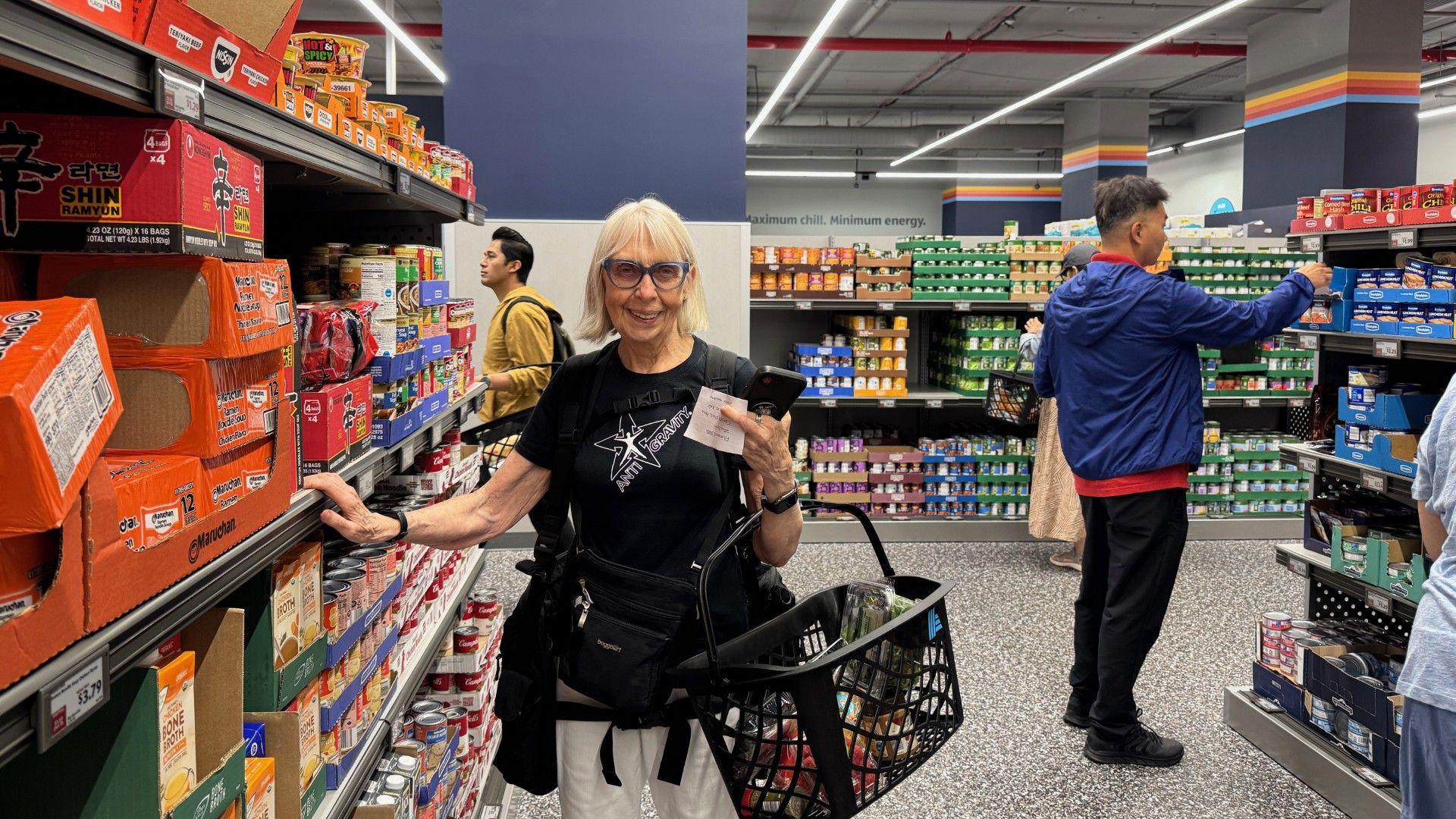 Image source, Francisco Velasquez/BBC