Conflict over Ukrainian Insurgent Army actions during World War Two recently escalated into biggest tension between Ukraine and Poland in decades. Now leaders of both nations keep returning each other’s honours and medals.
 Tomáš Hrivňák



Diplomatic relations between Ukraine and Poland haven’t been so tense in decades.
The fallout began after Ukrainian president Volodomyr Zelensky signed a decree last month naming an elite military unit, the Sever Special Operations Centre, after “the heroes of the Ukrainian Insurgent Army,” the UPA.
Since then, leaders of both nations have been returning their respective country’s medals.
In Ukraine, the UPA is seen as a symbol of heroic resistance against Soviet forces in the fight for independence.
In Poland, it is notorious for killing up to 100,000 Poles in the Volhynia and Galicia regions between 1943 and 1945, in an effort to ensure the territory did not become part of postwar Poland.
The Polish parliament unanimously declared the killings a “genocide committed by Ukrainian nationalists” in 2016.
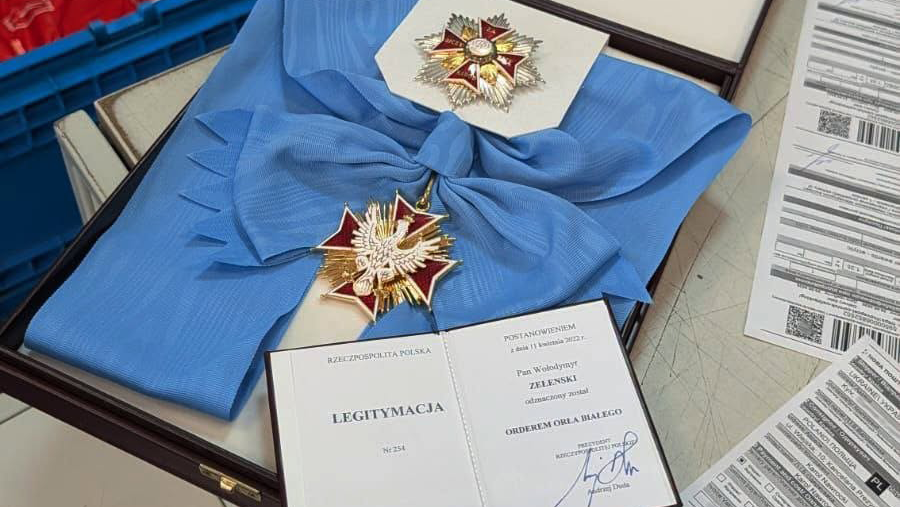
Polish politicians reacted with anger and accusations of historical insensitivity to Zelensky’s move. Conservative president Karol Nawrocki said he was outraged, and on 19 June confirmed he would strip Zelensky of Poland’s highest civilian honour, the Order of the White Eagle, conferred on him in 2023.
The honour was awarded, through Zelensky, to the whole Ukrainian nation for its heroic resistance to Russia’s full-scale invasion, which began in February 2022.
Nawrocki stripped his Ukrainian counterpart of the award less than a week ahead of a high-level conference on Ukraine’s postwar recovery, which opened in the Polish coastal city of Gdańsk last Thursday (25 June).
According to Roman Imielski, deputy editor-in-chief of the leading Polish daily Gazeta Wyborcza, speaking on the 8:10 podcast, that decision was intended to torpedo the conference and discourage Zelensky from coming to Gdańsk.
As his colleague Bartosz T. Wieliński added, Nawrocki might have been offended that he was not invited to the conference in Gdańsk, and sought to undermine Donald Tusk’s ruling government with his gesture.
“This conference was taking place in [Nawrocki’s] hometown of Gdańsk. This is a dispute between two Gdańsk natives about who is the more important citizen of this city — Tusk or Nawrocki. Two Lechia Gdańsk fans,” Wieliński said on the podcast.
It partly worked. The leader of the country the conference was meant to help cancelled his attendance, and the delegation was led instead by prime minister Yulia Svyrydenko.
Despite the conflict, though, Ukraine secured more than €10bn in international support and investment agreements during the conference, making it, in the end, a success.
Deliberate trolling
Over the weekend following Nawrocki’s gesture, Zelensky posted a photograph of the medal packed up and sent back to Warsaw via Nova Post, a private Ukrainian courier firm — a deliberate piece of trolling that treated Poland’s top decoration as an ordinary parcel.
He accused Nawrocki of exploiting rising anti-Ukrainian sentiment ahead of next year’s parliamentary election, drawing a parallel with Hungary’s Viktor Orbán. Other Ukrainian figures followed his lead, returning their own Polish honours: former presidents Leonid Kuchma, Viktor Yushchenko, and Petro Poroshenko, along with military intelligence chief Kyrylo Budanov and foreign minister Andrii Sybiha.
Polish prime minister Tusk warned that the quarrel “delights Putin and shocks our allies,” and Zelensky himself cautioned that the dispute would weaken Polish–Ukrainian ties at a moment of war with Russia.
Criticisms of Zelensky’s decision to name the military unit after UPA, are pretty much universal across the Polish political spectrum, though – despite the difference in magnitude.
But perhaps thanks to Tusk’s moderate stance, for all the heat between Poland and Ukraine, neither side currently disputes the basic framework of their relationship, and Poland remains one of Ukraine’s most important backers.
The Order of the White Eagle episode in Poland has also reopened a debate about the order itself, which over the centuries has gone to deeply contentious figures — Russian imperial names such as Catherine II, Grigory Potemkin and Alexander Suvorov; the leaders of the Targowica Confederation, remembered in Poland as national traitors; and, in the twentieth century, Benito Mussolini.
But the tit-for-tat spiral of events did not end with the returning of the Polish awards.