Kyiv is probing Russia’s weakened defences and testing the reach of Western cruise missiles in a bid to raise the Kremlin’s economic and military costs.
 Tomáš Vasilko



Every day, the Ukraine Battlefield update newsletter offers a clear look at how the war is unfolding on the ground. Subscribe for free here to get the full text delivered to your inbox.
“Today’s air raid was relatively weak,” wrote the pro-Russian war blogger and propagandist Yuriy Podolyaka on Telegram. He was responding to the Ukrainian attacks on the Crimean peninsula during the night from Monday to Tuesday.
Podolyaka claimed that, in his view, Ukrainians were stockpiling drones for another large attack. “In the meantime, attempts to weaken our air defence with small raids continue. And above all in the area of the Crimean bridge!!!”, he added, with three exclamation marks.
Ukrainians really did attack the area around the city of Kerch, as shown by records of fires on Tuesday morning, which are mapped by the NASA FIRMS system.
In recent weeks, Ukrainians have been deliberately focusing on blockading the Crimean peninsula, where over the weekend the authorities completely banned the sale of fuel. Russia is having major problems getting it to the occupied peninsula.
Transport of fuel across the Crimean bridge in the east of the peninsula is banned for fear that a precise Ukrainian strike could cause a major fire and seriously damage the bridge. This leaves Russia dependent on land supplies through occupied southern Ukraine along the main transport artery designated in Russia as R-280. However, this road is within range of Ukrainian medium-range drones on a daily basis.
Most recently, power outages have been added to the fuel shortages. On Tuesday morning, outages were reported across half of the occupied peninsula, according to the independent Russian agency Astra in Yevpatoria, Saky, Krasnoperekopsk and Dzhankoy, as well as in the Krasnoperekopsk, Saky, Dzhankoy and Krasnogvardeisky districts.
The company Krymenergoinform wrote that the cause of the emergency was “technical malfunctions in the electrical grids”.
Footage from the peninsula, however, showed the real cause. Ukrainians hit the thermal power plant in Kerch.
Photographs appeared showing a vast cloud of smoke rising from the power plant, which, according to observers, was 47 km long. The plant is located about eight km as the crow flies from the Crimean bridge, and Ukrainians had attacked it a few days earlier as well. In Crimea, according to the Ukrainian account Krymskyi Wiatr, long queues formed at cash machines.
At the same time, what Yuriy Podolyaka wrote also held true. The air raid was weaker – the Russian ministry reported 143 Ukrainian drones shot down, some over Crimea, which is indeed fewer than on some other days, when their number reached several hundreds. On the other hand, even that was enough to cause serious damage on the peninsula, which Podolyaka ultimately acknowledged.
“Today the attacks were mainly focused on energy facilities on the peninsula. Unfortunately, as we can see from the photographs that have already been published on Ukrainian social networks, it was not possible to prevent hits,” the pro-Russian war blogger wrote.
It appears that, in addition to fuel shortages, residents of Crimea and tourists have to reckon with power cuts as well. Ukrainian military analyst Kostiantyn Mashovets also wrote this. Even before the attack on the Kerch power plant, he stated that “difficulties” were gradually beginning to appear with electricity and water supplies, since the company Voda Krymu had been disconnected from electricity supply.
“The summer season on the occupied peninsula is revealing its new, ‘radiant’ sides,” the Ukrainian analyst wrote.
Despite cancelled bookings, there are still 400,000 Russian holidaymakers on the roughly two-million-strong Crimea, according to Slovak analyst Alexander Duleba. Many of them posted videos of unusually half-empty beaches or light traffic. Other videos showed them packing their things and wanting to leave.
There are not many options, however. Over the weekend, reports emerged that rail transport in Crimea had also been halted, with trains running only as far as the city of Kerch.
Several people believe that Ukrainians will now also target the Crimean bridge. Previously, they attacked the bridges linking the peninsula to southern Ukraine, and they also hit ferries. However, there are also views that Ukrainians are leaving the bridge untouched so that Russian holidaymakers, as well as people who moved there after 2014, can return to Russia. In this way, in the event of a possible liberation of the peninsula, they would rid themselves of a “disloyal” population. This is, however, only a debated hypothesis; we are not that far yet.
“All these attacks on bridges, crossings, oil refineries, ferries, etc. are carried out with the aim of making Crimea almost uninhabitable and completely unsuitable for tourism,” analysts from the Russian think tank Conflict Intelligence Team wrote.
Is Ukraine using new missiles from the Americans? In Monday’s Ukraine Battlefield update we wrote about how Ukrainians managed to hit a Russian plant in Voronezh that produced semiconductors used for manufacturing Kh-101 and R-500 cruise missiles. Videos and photographs showed that two floors collapsed after the strike and a large part of the plant was destroyed. According to Russian data, five people died in the attack.
According to the website Defence Express, there was a debate about what the Ukrainians used to carry out the attack. Ukrainians said only that they had struck the plant with cruise missiles, but did not specify which ones. There was speculation whether, in addition to Storm Shadow, they had also used AGM-188A Rusty Dagger missiles, which the Americans developed specifically for Ukraine under the ERAM programme. It has not yet been officially confirmed that Ukrainians already have these missiles, but a few weeks ago Russians published photographs of electronics that allegedly belonged to this missile.
According to Defence Express, in the past Ukrainians always specified precisely when they had used Storm Shadow.
Some Russian accounts therefore thought that AGM-188A Rusty Dagger missiles had been part of the salvo. Even though the missiles themselves have a warhead of only 45 kg (and a range of 930 km), so they could not by themselves have caused such destruction.
“I believe the ERAM systems were likely used in other recent attacks as well. That is another reason why costs for Russia will continue to grow,” US analyst Rob Lee wrote.
This debate was to some extent resolved by footage from an industrial camera that showed three precise Ukrainian hits. The missiles look like Storm Shadow. However, it is possible that during the raid they also deployed AGM-188A Rusty Dagger missiles, which could have saturated Russian air defences. The Americans promised to deliver up to 3,350 of them, significantly more than Storm Shadow missiles.
CCTV footage emerged showing the yesterday’s strikes at the Voronezh Semiconductor factory in Russia. There were three precise hits in very short order. pic.twitter.com/hJ3rf4c0ru
— (((Tendar))) (@Tendar) June 23, 2026
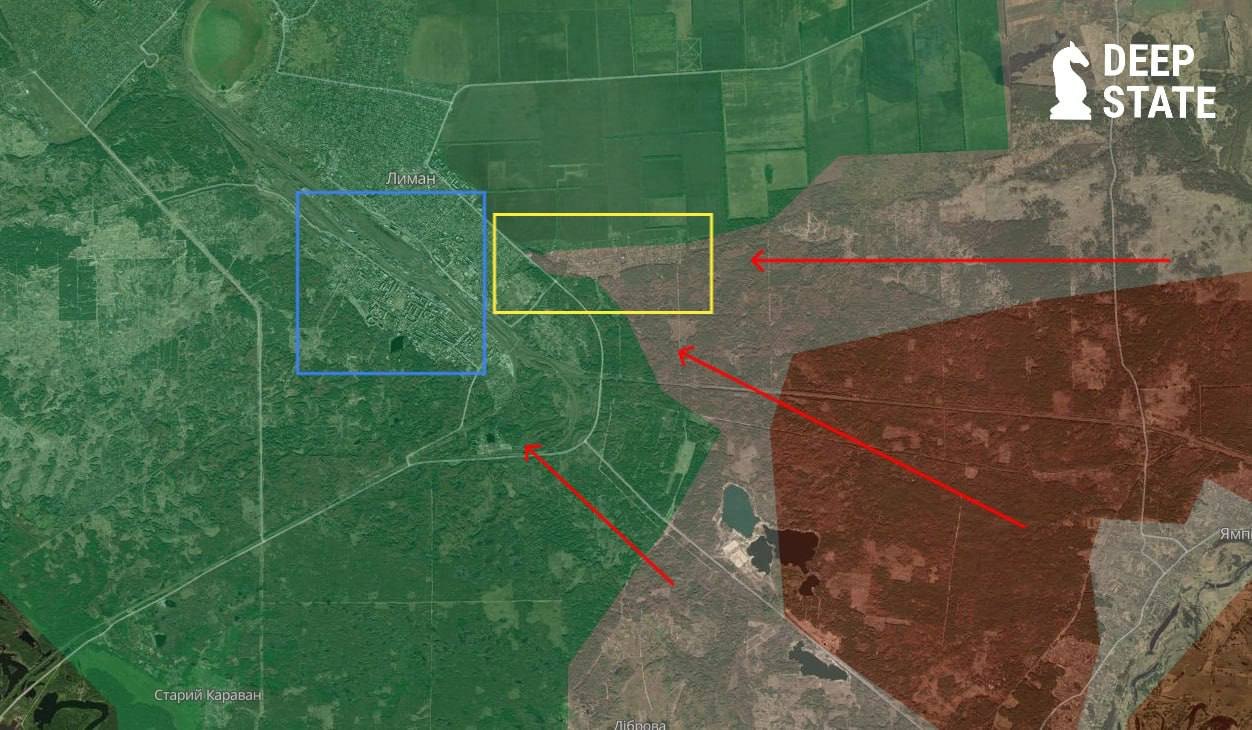
Lyman is the second town that is under threat after Kostiantynivka. Russians released a new video showing their soldiers in apartment blocks in one part of the town.
The Ukrainian account Petrenko wrote that the situation remained stable, because the new videos with flags were next to the apartment blocks where they had already filmed them before.
The Ukrainian account DeepState UA also covered the situation near this town.
“The largest area of enemy activity and control is the red and grey zone of the Serebriansky forestry. There they move, hide, settle and from there they try to penetrate deeper. In Lyman itself, activity and fortification continue to focus on the eastern outskirts of the town, which are marked in yellow and have a corresponding grey zone. Fortification has also taken place in the blue zone, but it is not yet systematic, so there are as yet no grounds to create a grey zone,” the Ukrainian account wrote.
Source – DeepState UA
Image of the day
Radio Svoboda journalist Mark Krutov published a detailed satellite image showing what Moscow’s Kapotnya refinery looks like after last week’s attacks. In the shot you can see the famous storage tank hit by a Russian air-defence missile, whose cover (or lid, if you prefer) flew high into the air after the explosion.
On further images, damage can be seen at the refinery, which processes almost half of Moscow’s fuel consumption.
2/4 Here’s my collection of before-and-after strike snapshots of the Moscow Oil Refinery and the ‘Sadovod’ wholesale market, proving that an AVT-6 refining unit was severely hit, along with many other facilities on the refinery’s premises. pic.twitter.com/4hMAqxmtGG
— Mark Krutov (@kromark) June 20, 2026
Chart of the day
Last week, Russian forces advanced by 23 square kms. They were most successful near Kupiansk.
Russian advance week by week
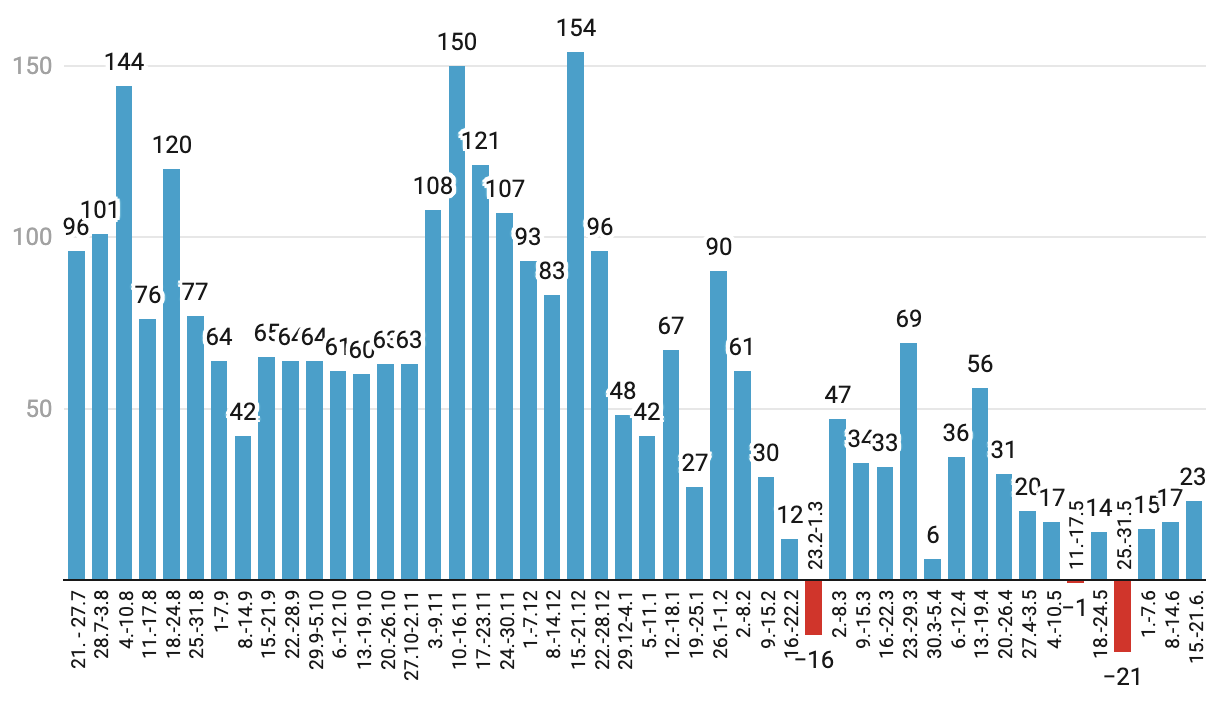 Amount of territory occupied by Russia per week. Data is in kilometres square. Source: Oko Hora, data wrapper.
 Map of the day
The independent Russian website The Bell summarised known measures by Russian regions regarding fuel consumption. It found that by last week, 53 out of 89 regions had introduced some form of restriction.
On the map, regions where the limit is up to 50 litres (most often between 20 and 50 litres) per refuelling are shown in dark red, and regions where the limit is above 50 litres are shown in light red. Regions where longer waiting times at filling stations are reported, or where some stations are completely closed, are marked with hatching. The map shows that fuel problems are not confined to a few regions, but affect quite a large part of Russia.
Last week, 53 of Russia’s 89 regions imposed restrictions on sales of gasoline or diesel, The Bell’s calculations showed. Most of these limited the amount of gasoline that can be sold in a single transaction (to between 20 and 50 litres). Oil production in Russia fell to its… pic.twitter.com/w242pqCBvP
— The Bell (@thebell_io) June 22, 2026
Videos of the day
Russians have deployed mobile teams to protect lorries, tasked with shooting down incoming Ukrainian drones. In this case, however, the protectors preferred to run for cover.
This Russian truck supposed to be protected by the anti-aircraft gunner in the technical behind, but the guy bails out and runs. A true hero of Russia. pic.twitter.com/Xea8j95nnF
— (((Tendar))) (@Tendar) June 23, 2026
Ukrainians hit a bridge near the village of Vasylivka in Zaporizhzhia region. It is located about 15 kms from the front line near the former Kakhovka reservoir.
✈️🔥 Occupied Vasylivka, Zaporizhzhia region, Ukrainian aviation carried out a very tasty airstrike on the bridge. pic.twitter.com/TXqpMjbDGL
— MAKS 26 🇺🇦👀 (@Maks_NAFO_FELLA) June 22, 2026
Russian soldiers later showed the bridge itself. It is completely destroyed.
Incendiary munitions fell close to a shelter of Russian soldiers.
What are the losses
By Monday (8 June), Russia had demonstrably lost 23,668 pieces of heavy equipment (on Monday (6 June) it was 23,593). Of this, 18,652 (18,585) pieces were destroyed by Ukrainians, 987 (982) were damaged, 1,199 (1,199) were abandoned by their crews and 2,830 (2,827) were captured by the Ukrainian army. This includes 4,404 (4,397) tanks, of which 3,307 (3,300) were destroyed in combat. Ukraine lost 11,564 (11,425) pieces of equipment, of which 9,011 (8,888) were destroyed, 687 (680) damaged, 677 (670) abandoned and 1,189 (1,187) captured. This includes 1,433 (1,426) tanks, of which 1,097 (1,091) were destroyed in combat.
Note: Neither side regularly reports its dead or destroyed equipment. Ukraine publishes daily figures for Russian losses and destroyed equipment, but these cannot be independently verified. In this overview we use data from the Oryx project, which since the beginning of the war has compiled a list of equipment losses documented exclusively by photographic evidence.