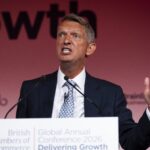
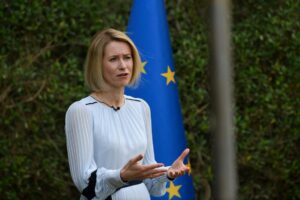
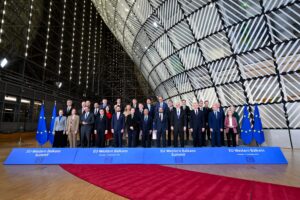
Monday’s meeting between Chinese commerce minister Wang Wentao and EU trade commissioner Maroš Šefčovič in Brussels has been billed by EU officials as a make-or-break event for the future of Europe’s trade with the manufacturing superpower.
 Benjamin Fox



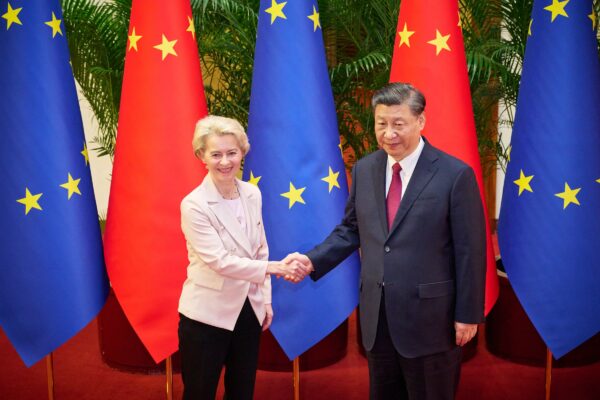
Monday’s meeting (29 June) between Chinese commerce minister Wang Wentao and EU trade commissioner Maroš Šefčovič in Brussels has been billed by EU officials as a make-or-break event for the future of Europe’s trade with the manufacturing superpower.
China’s oversupply and low domestic consumption was “an imbalance that the world just cannot digest,” outgoing EU trade negotiator Sabine Weyand told MEPs in the run up.
Šefčovič’s office had drafted plans for an ‘overcapacity’ instrument that would allow the EU to impose new tariffs on a raft of Chinese industrial goods and import limits.
His officials have also mooted a ‘diversification’ instrument that would force European companies to diversify supply sources in critical sectors, in a move to reduce industrial dependency on China.
But the momentum on putting those measures into law appears to have been lost.
Though a video conference on ‘global economic imbalances’ was held with China ahead of the French-hosted G7 summit last week, officials in Beijing cancelled several meetings with EU counterparts that had been intended to prepare the ground for the Wang-Šefčovič talks.
And at last week’s EU summit in Brussels, national leaders were notably circumspect in their remarks on China.
And all that appears to have kicked the can down the road until the autumn on the new ‘overcapacity’ and ‘diversification’ instruments
The divisions between EU capitals have been evident from the series of recent visits to Beijing by national leaders, including France’s Emmanuel Macron and Spanish prime minister Pedro Sánchez in December 2025 and April 2026, respectively.
Dialogue
The latest EU peregrination to China is a five-day visit by Austria’s foreign minister Beate Meinl-Reisinger, which started on Monday (22 June). Austria is one of the EU moderates on China.
“We want to remain in dialogue with China,” Austrian chancellor Christian Stocker also said at last week’s EU summit, adding that “it is too early to talk about [defensive]measures”.
Similar remarks came from Dutch prime minister, Rob Jetten, who told reporters the EU needed to “invest much more in new technology and innovation in the coming years, strengthen European companies, and also be critical of the imbalances in the global economy and address them.”
France, by contrast, has led calls for stronger tools to contain China’s overcapacity and market-distorting subsidies.
According to a paper by the Centre for European Reform (CER), which has been cited by commission officials in recent weeks as evidence of the urgency of the crisis posed by Chinese oversupply, China now accounts for roughly 30 percent of global manufacturing output, while consuming only 13 percent.
That, say officials, is driving the Europe’s growing trade deficit with China, which amounted to €360bn in 2025, and is set to reach €400bn this year based on the first five months of 2026.
Meanwhile, 55 percent of European manufacturing was exposed to Chinese market-share gains in the coming years, driven, in part, by what CER estimated was a 30 percent undervaluation of China’s currency, the renminbi, offering an unfair advantage over foreign competitors.
Change in attitude
The main change in attitude towards Chinese trade across European capitals has been in Germany, whose trade deficit with China is, at more than €90bn, the largest in the EU.
In his press conference at the EU summit on 19 June, German chancellor Friedrich Merz told reporters that the EU could “fully accept if productivity … is higher [in China] than in Europe”, as well as welcoming China’s rapid technological progress.
But when it came to “naked flooding of markets” and “when there is systematic subsidisation into overcapacity — and when all this is accompanied by a currency that is not freely convertible, that does not ultimately participate in capital markets because the capital market is sealed off — then these are competitive distortions that we do not simply want to accept,” said Merz.
Czech prime minister Andris Babiš described trade developments with China as “dramatic”, following EU Commission president Ursula von der Leyen’s presentation on macroeconomic imbalances at the summit dinner.
Those conflicting views leave the commission in an awkward position.
It is pushing to ban China-made power inverters from EU-funded projects, again in a bid to reduce dependency on China.
And von der Leyen said, following the summit, that the EU executive would develop new trade defence tools, including a diversification instrument, in the coming months.
“Europe has already built an extensive toolbox in recent years. Now we must use it more proactively and more strategically to defend our European interests,” she said.
While the pace of policymaking looks to be slower than seemed likely a month ago, the EU is not alone in wanting to impose new restrictions on Chinese industrial supply.
The day after his talks with Šefčovič, Wang will be in the UK for a three-day visit.
That will include a meeting with trade secretary Peter Kyle, who has moved to nationalise British Steel, which is Chinese-owned, and drawn up a steel-tariff regime, to protect the UK steel industry, which is very similar to the EU’s decision to cut Chinese steel imports by 47 percent.
And Chinese firm Jingye, which owns British Steel, is demanding £1bn
(€1.2bn) in compensation from London if outgoing British prime minister Keir Starmer goes ahead with nationalisation, in a show that China is ready to push back.