To fundamentally understand why it’s strange the EU Commission is throwing its weight behind this new for-profit social platform, you need to understand what lies beneath.
 Alejandro Tauber



Last week, the European Commission announced on all their 14 social media platforms that they were joining a new one: W Social.
Apart from the cringy name (W is the letter before X, get it?), the decision to join a new – European! – platform to reach more people is not very remarkable and possibly even good news.
That would be the view if you’re not freakishly interested in technology, how it actually works, ownership, incentives and what all that says about shiny new apps. I am freakishly interested, so indulge me with a little background to understand why this actually is a weird and poor decision on the part of EU institutions.
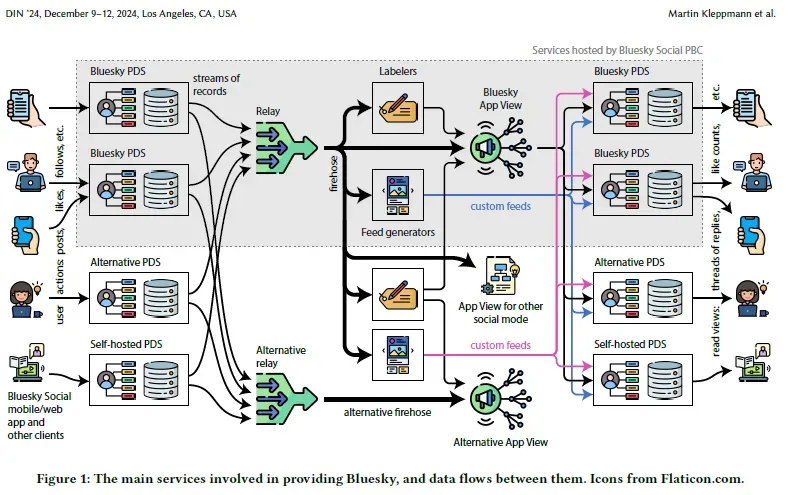
Let’s start with this graph:
Kidding! I’m kidding. You don’t need to study this graph to get it.
Let’s make it into a little story
Back in 2019 the writer Mike Masnick published an essay for Columbia’s Knight First Amendment Institute called “Protocols, Not Platforms,” and the argument was, roughly, that the reason social media keeps going wrong is that we built it as platforms in the first place, with a handful of private companies owning the entire stack and making every call about speech, ranking and moderation from the centre.
His proposed fix was to push the control back out to open protocols and to the edges of the network, the way email and the early web worked, so that no single company sits at the gate and anyone can build on top.
In tech lore, the essay inspired Jack Dorsey (the founder of Twitter, which became X, ironically) to start what is now the Bluesky project and the protocol powering it.
Here’s what is different about it, in a nutshell: on a normal social network your account lives inside the company. Your posts, your followers and your identity all sit on Facebook’s servers or X’s servers, and joining means renting a room in someone else’s building.
The AT Protocol, which is the technology underneath Bluesky, takes that apart. Your account and your data live on something called a Personal Data Server, or PDS, which holds your posts, your follows, your profile and, crucially, your identity and your signing keys. Someone on the internet explained it’s like RSS, but for all kinds of data (and if my explanation doesn’t land, read this one).
Everything you actually scroll through, meaning the app, the search, the ranking and the moderation, is layered on top and can be run by completely different people. The entire point, and the reason anyone in Brussels should find this technology interesting in the first place, is that you can host your own PDS and still talk to everyone else on the network.
For abundant clarity, in the protocol world, it means that you would be able to log into X, see all your Facebook followers and posts there, and if you post there, it also goes out on Facebook (if you so wish). The app you use to see content is just a window into the universe of other people’s PDS’s – just like how you can use a different email client to get the same emails.
Now, a PDS (so your user handle and all the associated data) can be ‘hosted’ or stored wherever you want – you can put it on a service like Bluesky or Eurosky or W, or if you’re more advanced, you can host it yourself.
This is the part that got lost in much of the coverage of the commission ‘joining’ W social – understandably, because it’s technical, and technical is boring.
Berlaymont migrates
The commission did not simply make an account on W. It moved its PDS onto W. You can see it on clearsky.app, which indexes this kind of thing, where the servers for the European Commission, von der Leyen, the European Central Bank and Christine Lagarde all show up as having been migrated off Bluesky’s infrastructure and onto W’s.
That is the part that matters, because by the standards of this technology, hosting your own PDS is the easy and affordable part, the bit you can do yourself. The commission already self-hosts a Mastodon presence, so it clearly has the people and the budget to run its own front door.
But instead it chose to hand its institutional identity, signing keys and all, to a private for-profit company run by a couple of Swedish entrepreneurs — couched in the language of ‘European sovereignty’.