


EU Council president António Costa has set an end-of-year deadline for the next budget – but negotiators say there is only a “50-50 chance” of success.
 Wester van Gaal



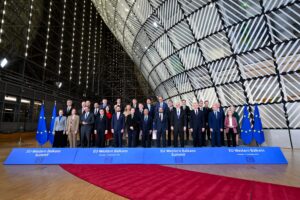
EU leaders met on Friday (19 June) to discuss the bloc’s next seven-year budget, which is expected to become one of the most contentious negotiations of the year.
While governments agreed on innovations to combine funding streams and invest more in defence, energy and innovation, the key question of how high the budget will be is “still under discussion,” an EU official said shortly after negotiations took place.
The commission and parliament want a larger budget than the current one to finance new priorities such as defence, competitiveness and energy security, while largely maintaining existing spending on farmers and economically less-developed regions.
A group of member states known as the ‘friends of cohesion’, made up largely of net recipient countries, are also broadly supportive of a larger budget.
But the rival ‘frugal countries’ — including Germany, the Nordic countries and the Netherlands, all of which pay more into the EU budget than they receive — are pushing for a much smaller budget than the almost two trillion euros tabled by the commission.
The Cypriot six-month rotating presidency last week circulated a so-called “negotiating box” in an attempt to identify possible compromises, which lowered the overall budget proposal by two percent (from €1.76 trillion to €1.73 trillion) while sparing agriculture and regional budgets from cuts.
But this failed to resolve the impasse.
The Netherlands was especially harsh in its rejection of the plan, with the country’s prime minister Rob Jetten describing the proposal as “truly unacceptable” on Friday.
“This proposal will never make it to the finish line,” he said.
“The proposal currently on the table is clearly too high,” German chancellor Friedrich Merz said. “To go to a figure of €1.6 or even €1.7 trillion for the next seven years is, in my view, a proposal that cannot be justified.”
Over to the Irish
It is now up to the Irish who will hold the EU’s rotating presidency from July to find a working compromise.
The next ‘negotiating box’ of proposals will be presented at the leaders’ summit in Brussels in October, with plans to finalise an agreement before the end of this year.
The task in the following months is to “find an appropriate level of resources to finance the EU’s increased ambitions,” one official said.
But with the frugals and the group of countries calling for a bigger budget still miles apart, “it is going to be very, very difficult to agree on the size of the budget and meet all the competing demands,” said Irish Taoiseach Micheál Martin whose country will chair the negotiations on Friday.
“We have a 50-50 chance to have a deal by the end of the year,” a senior diplomat also said.
Two solutions?
With the two groups at an impasse, two main solutions were explored. The first: to delay repayments of the EU’s pandemic loans which will cost €150bn over the next budgetary period.
This solution is hated by the frugals. When asked whether he thought this a viable option to give the EU more fiscal firepower, Dutch prime minister told press a simple “no.”
Central to Friday’s discussions are the issue of so-called ‘own resources.’ More than 70 percent of the EU budget comes from national payments.
But the EU also collects its own revenues called “own resources.” In the current budget, these come from customs duties and the Value Added Tax (VAT).
For the next period, the commission has proposed new revenue streams coming from the EU’s carbon market and its tariff on carbon-heavy imports, plus new levies on electronic waste, tobacco and large companies with turnovers above €100m, estimated to generate around €58bn a year.
The European Parliament wants to go further still, with proposed taxes on Big Tech, crypto and online gambling that could add another estimated €11bn annually.
Country leaders did not discuss the “scope” of such measures in detail on Friday, an EU official told EUobserver.
But with the overall budget level probably insufficient to meet commission ambitions, “finding new own resources will be very important,” the official said.
“Own resources can square the circle budget-wise, the problem is that all these proposals need unanimous support from all member states,” another EU diplomat told EUobserver.
2026 deadline
EU Council president António Costa has set an end-of-year deadline. Officially, to ensure the budget is finalised before the 2028 start date.
But it is widely speculated that the pressure to reach a deal is political. A string of high-stakes elections next year, in Poland, Italy and, crucially, France, could derail any agreement that isn’t locked in, which is widely seen as the real reason for the December deadline.

“We all know, even though it doesn’t say so officially, they want it closed in case Le Pen wins the French elections,” said Czech prime minister Andrej Babiš.