


After getting frostbite while trying to hike across a mountain from Bosnia into the EU, three migrants from Sudan had their legs amputated – all seemingly failed by Bosnia’s healthcare system.
 Selma Melez



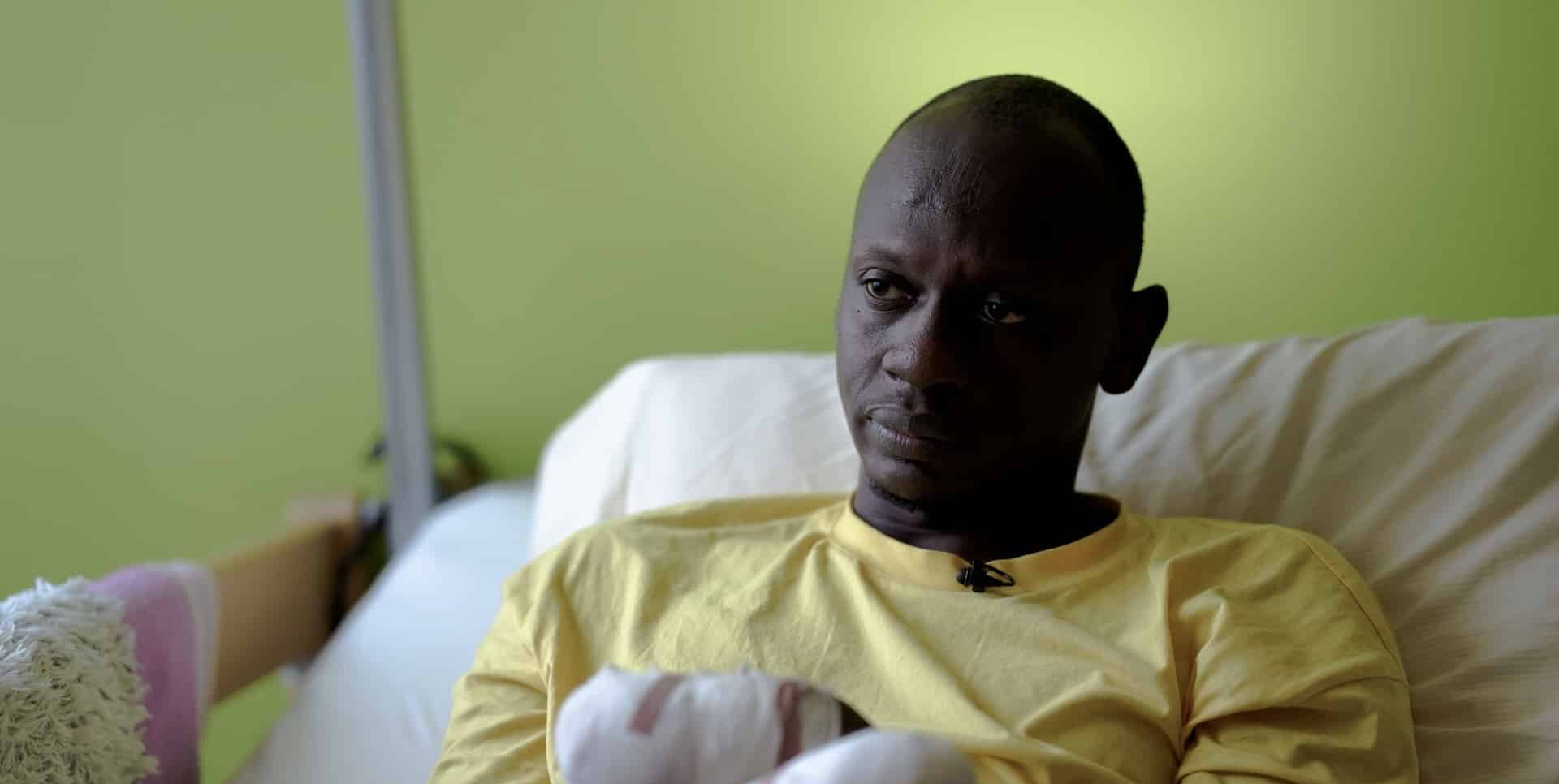
They were finally admitted to Bihac hospital in early December. Medical documentation reviewed by BIRN shows the three men were suffering from severe frostbite with tissue necrosis and that amputation was becoming increasingly likely.
Muhammad and Sabu were sent to hospital on December 1, four and five days after their rescue, where the doctors amputated their fingers the following day, Abdulah on December 4, a week after the rescue due to gangrene on both feet.
“I wasn’t even aware [of what happened during surgery]. When I came back to my senses, doctor told me: ‘Do this, do that’, and I suddenly found myself without hands,” Muhammad recalls.
In the following days, doctors in Bihac told Sabu and Abdulah they might have to amputate their feet. On December 5, a doctor wrote that Sabu needs to be transferred to another hospital if Bihac’s plastic surgery department did not have the resources. He remained in Bihac.
Muhammad was sent 300 kilometres away to the Clinical Centre of the University of Sarajevo two days later. Doctors in Bihac wrote that his condition required “complex treatment that Bihac hospital cannot provide at the moment”.
He was sent back to Bihac the following day. Sarajevo hospital told BIRN that he was sent back “in agreement with the hospital in Bihac” that was “completely capable of continuing treatment”.
All three were then sent to the University Clinical Centre in Tuzla on December 11, due to gangrene. There, they had their legs amputated below the knees.
Muhammad told BIRN that he had told doctors he believed his legs were still in good condition and asked to speak with his brother in London.
“I never gave consent for my leg to be amputated, nor was I allowed to contact my brother in London,” Muhammad said.
His medical records, however, state that he consented to the amputation.
Abdulah’s and Sabu’s medical records show that doctors in Bihac wrote that amputation should not be conducted on them just two days before.
Tuzla hospital did not respond to BIRN questions regarding their case.
Following surgery, the three men were transferred to a nursing home in Sarajevo to continue their recovery.
When BIRN visited them in February 2026, they were still heavily bandaged and undergoing rehabilitation.
They spoke about constant pain, uncertainty and concern for the families they had left behind in Sudan.
“In Bihac my legs were still functional. I wanted help so that I wouldn’t lose them. That’s why I feel I was treated unfairly. They could have saved my legs,” Abdulah said.
Sabu recalled arriving in Bihac with both his hands and legs intact.
“We had wounds on our hands, but they could have been treated. The doctor was against amputation,” Sabu said.
BIRN shared the complete medical of tree men with a Bosnian physician experienced in treating migrants, who agreed to provide an expert opinion on condition of anonymity for fear of professional repercussions.
The specialist noted that by December 3, doctors had already identified circulation problems in Abdulah, the youngest of the three.
He questioned why a plastic surgeon had referred the patient to Tuzla when, based on the available findings, a more limited amputation of the foot could potentially have been performed.
“Once gangrene has been diagnosed, surgery is unquestionably necessary, including amputation of the affected tissue. I don’t understand why that wasn’t done. In my opinion, that was a failure,” the doctor said.
Regarding Sabu and Muhammad, he concluded that the medical care they received was inadequate and that they should have been hospitalised much earlier.
He explained that frostbite injuries resemble burns and that their clinical progression can be rapid.
“It should be taken into account that the physician may not have had experience treating patients with dark skin. Nevertheless, there are established methods for determining both the severity and extent of frostbite.”
For the three men, their greatest wish is to receive prosthetic limbs, the ones Muhammad says they were promised, but still haven’t got.