Petrol shortages in Crimea trigger complaints among locals against Russian authorities. While such shortages persist, Russia soldiers appear to be closing in on Kramatorsk, a city in Ukraine.
 Roman Pataj



Every day, the Ukraine Battlefield update newsletter offers a clear look at how the war is unfolding on the ground. Subscribe for free here to get the full text delivered to your inbox.
There will be no petrol any time soon, plan accordingly – Crimean governor admits. Queues for fuel are growing across Russia, truck transport is collapsing. Russians have already been seen 9.5 kms from Kramatorsk. Ukrainians may have attacked Moscow with a ballistic missile for the first time. The SBU claimed it hit hangars with combat aircraft at the Saky airfield in Crimea. Maps of the day – Sloviansk–Kramatorsk axis Videos of the day – Russia without fuel; attack on a train carrying military transport; so far the best video of a raid by the Ukrainian Flamingo; a drone flies over Starobilsk under heavy ground fire
There will be no petrol any time soon, plan accordingly – Crimean governor admits. “Unfortunately, in the near future no larger amount of fuel will arrive for sale,” Sergei Aksyonov, prime minister of the autonomous local government, told the inhabitants of Crimea. In other words, he signalled that the fuel crisis would last for an unknown period. At the same time, he reported problems with electricity supplies.
Aksyonov addressed people on his personal VKontakte account.
Perhaps even more interesting than the content of his message were the thousands of reactions from Crimeans, which could be read even without logging into this Russian social network. To his credit, there were many critical and angry responses among them, which no one deleted and under which people continued to debate.
We could not verify whether they did so under real or fake names. Nor could we verify whether the discussion was moderated in any way and whether anti-Russian statements were being deleted.
In short, the mood in Crimea was explosive for reasons other than drone attacks. In their posts, ordinary residents did not even try to hide their dissatisfaction, including against even the highest authorities.
A certain Anatoliy Kovalyov went directly after Putin. His post contained several important pieces of information:
“When the president needed to hold the Victory Parade, he said that if even one drone disrupted the parade, Russia would destroy the centre of Kyiv.
In Crimea, people were already desperate; why not deliver Crimea fuel by rail across the bridge, after first giving Kyiv one more warning?
“Our president said on television to Pavel Zarubin that Crimea would soon receive fuel, by land and by sea, and you are saying there will be no fuel.”
The first sentence by Anatoliy Kovalyov referred to 9 May. It was not only in occupied Crimea; even in legitimate Russian territory, residents at that time asked how they differed from Muscovites, who could not be bombed, while they were being bombed regularly. This feeling had clearly not faded; on the contrary, it was deepening. All the more so because ordinary Russians saw how more and more air defence was being moved to Moscow, leaving other places exposed.
The second sentence, in addition to confirming the poor morale of the peninsula’s population, confirmed that although the Crimean Bridge still stood, it had only limited importance for supplies. Due to fears of further damage, fuel transports were not allowed onto it. When Ukrainians heavily damaged the bridge in 2022, major destruction was caused by burning fuel leaking from a tanker train, which weakened the structure of the rail section.
Kovalyov’s third sentence could only be interpreted as a rhetorical question – Do you want to claim that Vladimir Putin was lying?
When we write that morale among Crimeans was shaken, it did not mean it was turning against Russia. At least according to the discussion that unfolded under Kovalyov’s post. He himself wrote about “khokhols” (a slur for Ukrainians), another man wrote to him about Nazis in Ukraine, and so on. Nor elsewhere was it possible to find pro-Ukrainian statements. The discontent took only the form of anger at the authorities.
Eleonora Kulchytska, for her part, published a night-time photograph taken from a train of the promenade below. Everything around was dark; only the seashore and the surrounding area were lit by street lamps. The woman indignantly asked whether electricity was only for tourists, while the “poor” were meant to sit all day without power.
At the beginning of his post, Aksyonov assured people that “the citizens would be informed daily by the minister of fuel and energy of the Republic of Crimea, Vladimir Genadievich Voronkin”.
Zhasya Solnechnaya picked up on this part of the communication and asked Aksyonov: “Is this the minister who said at the end of May that Crimea was fully supplied with petrol, who advised people not to worry, and then the petrol completely ran out two days later and still has not reappeared a month on? And people are still supposed to trust this minister to inform the population?”
“Yes, that is exactly him,” other commenters replied.
Ilona Varfomolyeva was one of those who described problems with water and electricity. She lives in Krasnoperekopsk, a town of 30,000 in north of Crimea, near Armiansk, through which one of the few roads onto the peninsula leads. She said that residents had been without water and electricity for the second day. “In Dzhankoi, Razdolne and Pervomaiske, they say the electricity is switched on from time to time. But we were told not to expect it for at least three days; all the food in our fridges is already starting to go off,” the local resident said.
Queues for fuel are growing across Russia, truck transport is collapsing. A crisis similar to that in Crimea had already hit almost the whole of Russia, followed by numerous videos and testimonies from ordinary Russians. Two examples with English subtitles were enough to illustrate it.
The first was recorded by a truck driver, who said that “logistics had come to a halt”. The author claimed that the column of lorries he was passing stretched for 35 kms and all were waiting for fuel. If such a situation persisted, it would be devastating for any economy.
A Russian man is stunned by a 35-kilometer line for gasoline.
“Logistics have completely ground to a halt. Freight trucking is collapsing. Diesel is expensive. There’s no fuel. Everywhere there are limits – 40, 50, 200 liters. It’s insane!”
No need to thank tsar Putin. https://t.co/HvllSi4Q6y pic.twitter.com/AeZ8x4ldAn
— Anton Gerashchenko (@Gerashchenko_en) July 1, 2026
The second video showed an angry man in the Krasnodar region, where it was possible to buy only ten litres of fuel. The video’s author then drove through the town, showing either closed petrol stations (including one belonging to Gazprom) or ones with long queues of waiting cars in front of them.
The fuel shortage was only part of the problem. A campaign directly targeting lorries was also continuing. At one truck parking area in the Donetsk region, a drone strike set 20 of them on fire at once.
A Ukrainian drone strike destroyed 20+ Russian trucks parked in Leninsky, occupied Donetsk overnight. Part of the Logistics Lockdown campaign. pic.twitter.com/K8q6m00mmI
— Woofers (@NotWoofers) July 1, 2026
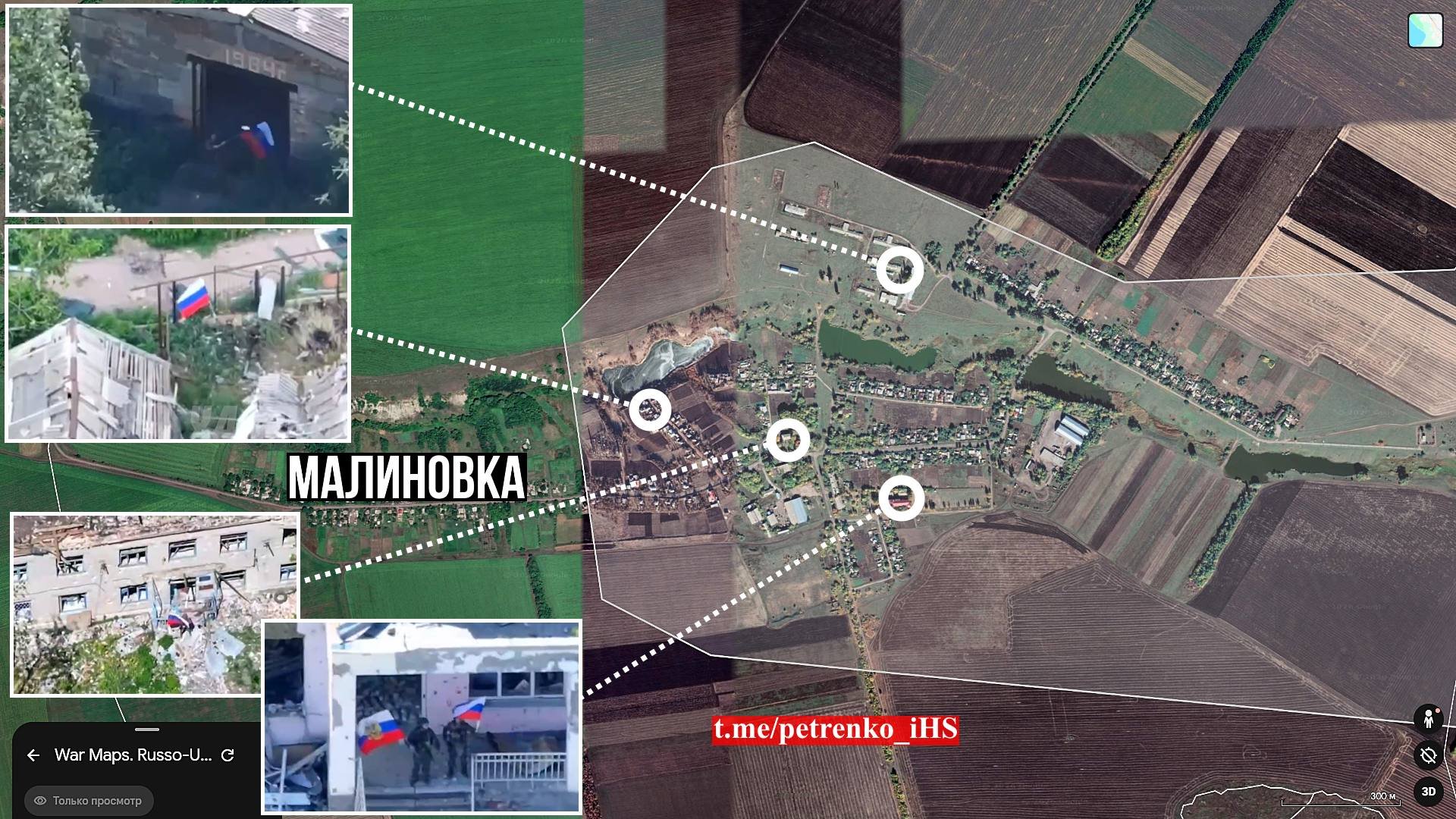
Russians seen 9.5 kms from Kramatorsk. The situation east of the Sloviansk/Kramatorsk agglomeration was gradually deteriorating. Most recently, the Russians sent their soldiers into the village of Malynivka, which lay less than 10 kms in a straight line from the north-eastern edge of Kramatorsk.
This did not mean the Russian army had occupied and firmly held these positions. It was using a typical tactic of “flag operations”, whose participants in the vast majority of cases died quickly, but even so, it was proof of a gradual advance westwards.
The Ukrainian analyst Petrenko again drew a map on which he marked the exact locations where Russian soldiers had been observed:
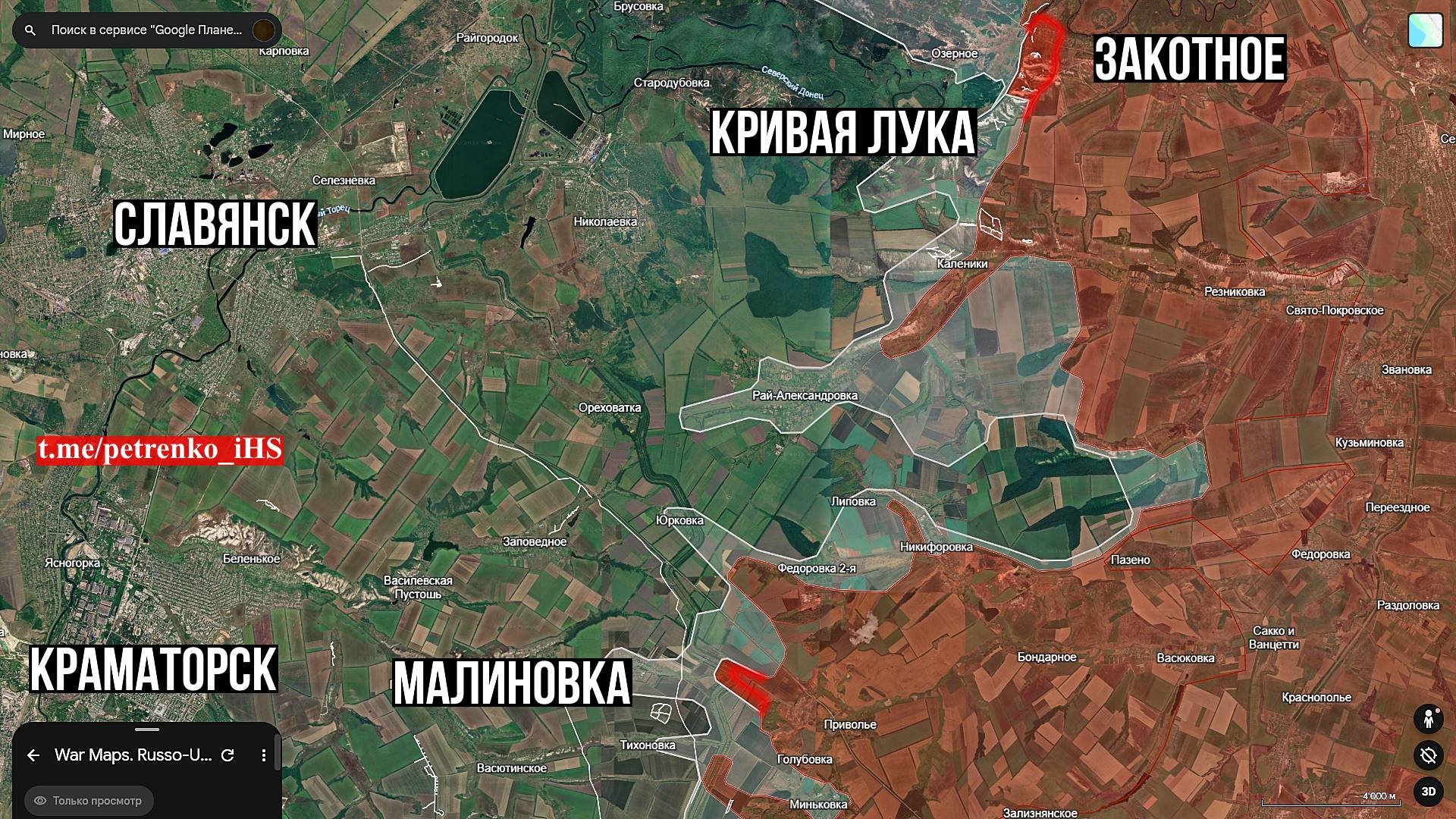
On the second map he showed a wider area. Malynivka was at the bottom in the centre. Above it in the middle of the map was the well-known Rai-Oleksandrivka. Kramatorsk and Sloviansk were impossible to miss on the left-hand side of the map.
Ukrainians may have attacked Moscow with a ballistic missile for the first time. For now, these were only unconfirmed speculations but the indications were strong. On Tuesday, videos emerged from Moscow showing air-defence systems firing at a high-flying target. Until now, everything that had reached Moscow’s airspace had been drones, which flew slow and low to the ground. The Russians shot them down with short-range systems such as Pantsir, man-portable air-defence systems (MANPADS), and mobile teams armed with firearms.
In this case, the surface-to-air missiles were aimed at a target flying at high altitude.
A second video from a Moscow suburb also showed a large crater, which an ordinary drone would not have caused.
“It cannot be ruled out that this might have been the shoot-down of a Ukrainian ballistic missile, but for the moment there is too little information for a definitive conclusion,” the Russian Telegram channel Military Correspondent wrote.
В Московской области сбили какую-то интересную цель. Судя по воронке – ракету.
Вариант с баллистикой не исключаю, но тревога в приграничных областях началась за 20 минут до тревоги в Московской области, что на баллистику не похоже. ⬇️ pic.twitter.com/EjmCvwRB0E
— Serg (@NHunter007) June 30, 2026
The SBU claimed it hit hangars with combat aircraft at the Saky airfield in Crimea. If the name of this airfield rings a bell, your memory served you well. Ukrainians had attacked it regularly. Their greatest success came in August 2022, when they destroyed around ten Russian air force aircraft in one strike. A video filmed by Russian holidaymakers on a nearby beach became legendary at the time.
[embedded content]
As a consequence of this attack and several others, the Russians limited the use of the airfield. The nearest Ukrainian positions were less than 190 kms away in a straight line, comfortably within drone range.
On Wednesday, the Ukrainian SBU announced that drones were behind the new attack on the base. They focused on aircraft hangars. “According to preliminary information, at the time of the attack both hangars contained Su-30 and Su-30SM fighter jets. After the strike, a fire was recorded in the hangar where the Su-30SM was located, which indicates a successful hit on the target,” the Security Service of Ukraine said in a statement.
Both the Su-30 and Su-30SM are twin-seat multirole combat aircraft, with the SM version being newer and modernised.
So far, the SBU had not published any video from which the outcome could be assessed.
Videos of the day
The video returned to this week’s attack on the arms factory in Volgograd (former Stalingrad). The detailed footage showed that at least three Flamingos hit the plant. Only two could be seen in the video, but the first one struck an area that was already smoking. The city resident who recorded the video immediately recognised the Flamingo. Thanks to this, it was clear that this was indeed a very large and relatively slow-flying weapon. In theory, then, it should be an easy target for defenders. Nevertheless, the Flamingos had repeatedly managed to penetrate Russian air defences.
Today, detailed satellite images also appeared, showing the aftermath of the raid.
The aftermath of Ukrainian-made FP-5 Flamingo missile strikes on Russia’s Titan-Barrikady plant in Volgograd.
The plant manufactures launchers and components for the Iskander-M, Tornado-S, Bastion, Topol-M, Yars and Oreshnik missile systems. https://t.co/b898Sewbxw pic.twitter.com/v3tEdwn5Fk
— Special Kherson Cat 🐈🇺🇦 (@bayraktar_1love) July 1, 2026
This seven second video is very interesting. First, because it showed an attack on a moving train. Second, because the first drone hit the tankers at the end of the train, while the others were already attacking the carriages used to transport soldiers. From the third second onwards, thanks to the thermal camera, you can see dozens of figures running for cover.
Occupied Starobilsk in the Luhansk region, where Ukrainian drones recently hit a dormitory in which 21 young people around 20 years-old were killed. This time, no such tragedy occurred; the drone continued on its course despite intense ground fire.
What are the losses
No update on Wednesday.
By Monday (29 June), Russia had demonstrably lost 23,703 pieces of heavy equipment (on Tuesday (23 June) it was 23,668). Of these, 18,686 (18,652) pieces were destroyed by Ukrainians, 988 (987) were damaged, 1,199 (1,199) were abandoned by their crews, and 2,830 (2,830) were captured by the Ukrainian army. This included 4,407 (4,404) tanks, of which 3,310 (3,307) were destroyed in combat.
Ukraine had lost 11,629 (11,546) pieces of equipment, of which 9,068 (9,011) were destroyed, 687 (687) damaged, 683 (677) abandoned, and 1,191 (1,189) captured. This included 1,437 (1,433) tanks, of which 1,099 (1,097) were destroyed in combat.
Note: Neither side regularly reports on its dead or on destroyed equipment. Ukraine publishes daily figures for Russian casualties and destroyed equipment, which cannot be independently verified. In this overview we use data from the Oryx project, which since the start of the war has compiled a list of equipment losses documented exclusively by photographic evidence.