Ten more victims of the 1995 genocide were buried on Saturday at the Srebrenica Memorial Centre, with survivors calling on the perpetrators to acknowledge the truth and ask for forgiveness.
 Azem Kurtic



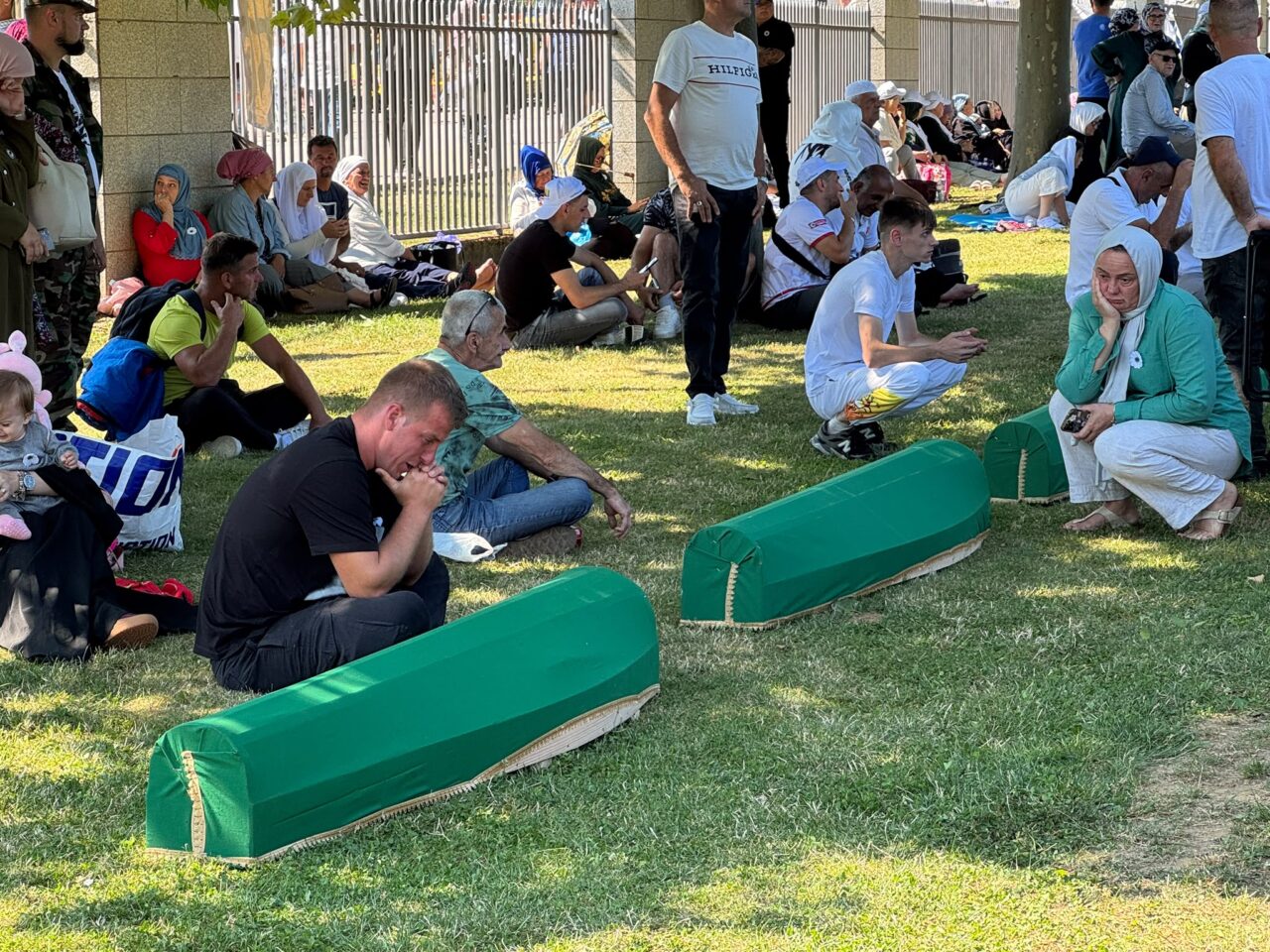
At the Srebrenica Memorial Centre, a man sits next to a coffin of his father, who he never met. Photo: BIRN/Elmedina Sabanovic.
Thousands of people gathered at the Srebrenica Memorial Centre on Saturday to mark the 31st anniversary of the genocide of Bosniaks carried out by Bosnian Serb forces in July 1995.
In the days following July 11, 1995, more than 8,000 Bosniak men and boys were killed in a series of systematic killings, which international and local courts have classified as genocide.
Ten more of the victims, identified over the past year, were laid to rest on Saturday after a mass funeral. They were 20 to 56 years old when they died.
Senad Jusic was the youngest genocide victim whose remains were buried this year at the Memorial Centre, alongside his brother Dzemail, who was buried previously.
His sister-in-law, Zirafeta Jusic, told BIRN that she had promised their mother before she died that her son would be buried next to his brother as soon as he was found.
“She asked only one thing of me: ‘Daughter-in-law, if they find even a single bone, don’t give up. Bury it, so that people will know where their graves are,’” Zirafeta Jusic said.
Mehida Jusic died in 2002. Nine years later, the remains of her elder son, Dzemail, were recovered and buried, followed by Senad Jusic, who was buried this year.
Zirafeta Jusic said she learned about their final moments from a relative who survived the attempt by Bosniaks to walk to safe territory from Srebrenica in July 1995.
“On Kamenica Hill [near Zvornik in eastern Bosnia], they walked into an ambush and ended up in hand-to-hand combat. He told me Senad was killed with a knife,” she said.
Prior to the funeral, a commemoration was held in the old car battery factory that once served as a base for UN peacekeeping troops before the Bosnian Serb forces overran the “UN safe-zone” of Srebrenica.
Kada Hotic, a member of the Association of Mothers of the Srebrenica and Zepa Enclaves, addressed the commemoration with emotional speech recalling life in Srebrenica before the Bosnian war and people’s suffering during the conflict.
Hotic said that the truth about the genocide must be preserved and passed on to future generations, and that those who committed crimes should admit what they did.
“The only cure for all those who deny the evil they committed is to acknowledge the truth. Let them ask for forgiveness, at least those who were forced to commit crimes. Perhaps I will forgive them too,” she said.
Courts have so far sentenced a total of 54 people to 781 years in prison – plus five life sentences – for genocide, crimes against humanity, and other crimes connected to the Srebrenica massacres in July 1995.