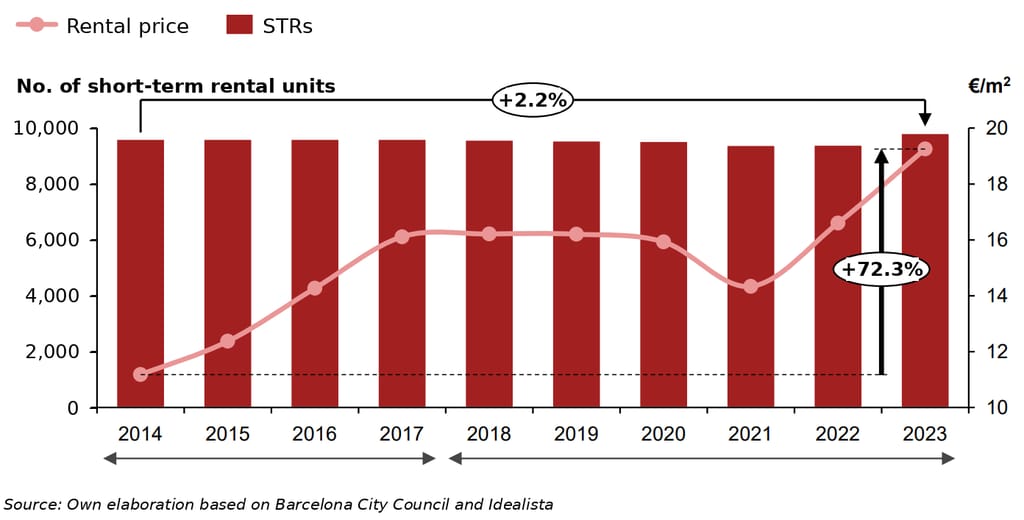
The City Council capped short-term rental licences in 2014. Rents still rose up to 70 percent. So what’s actually driving unaffordability?
 Taylor Reed



Mayor Collboni has placed eliminating STRs at the center of his housing agenda. The promise is simple: remove STRs and those homes will return to residents. But evidence demonstrates the opposite. The city council has yet to demonstrate how eliminating legally licensed STRs would result in putting those houses on the market.
The city’s own research undermines their objective. The Barcelona Institute of Economics’ study, commissioned by the city council itself in September 2025, acknowledged that a full conversion of STR units to residential use “could be partial or might not occur at all for various reasons. For example, some homes could move to the seasonal rental market or remain closed and vacant pending court rulings.”
The promise is simple: remove STRs and those homes will return to residents. But evidence demonstrates the opposite.
New York’s 2023 STR ban already offers a cautionary precedent: it did not slow rent growth or improve housing supply. Instead, it created an unaffordable tourism destination with one of the world’s most expensive hotel markets, averaging above $300 per night. Less competition does not mean lower prices, usually it means the opposite.
As Marian Muro, general director of Apartur (Barcelona Tourist Apartments Association), explains: “Barcelona’s affordability crisis is real, but its roots lie elsewhere: a chronic shortage of affordable housing, slow and rigid planning procedures, limited new construction, and a substantial stock of vacant properties that remain off the market. Rental prices have risen by up to 70 percent according to data from Barcelona City Council and Idealista — yet STR licences have been capped since 2014. If short-term rentals were driving the crisis, prices should have stabilised as supply held flat. They did not. None of those structural problems will be resolved by removing a regulated activity that has not grown in over a decade.”
Yet the Barcelona city council is deploying publicly funded advertising to present this unproven hypothesis as settled fact — less than a year before municipal elections in May 2027. There is a meaningful difference between a political party advocating for a position and a public administration using public funds to run what is, in effect, a pre-electoral political campaign.
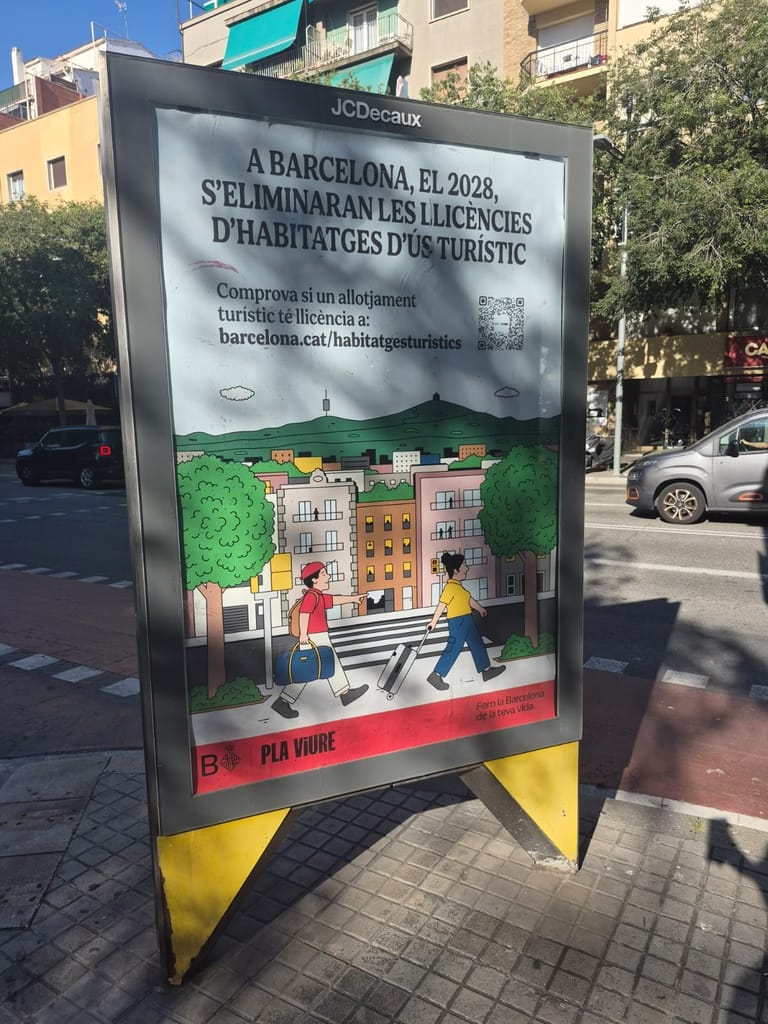 City Council announcement in the run-up to the elections: “In Barcelona, in 2028, short-term letting licences will be abolished”.
Barcelona keeps inviting the world, but can’t explain where to put it