Bulgaria, once quietly funnelling Soviet-calibre shells that kept Ukraine from collapse, is now invoking war fatigue and religious loyalty to justify slamming the brakes on further aid and sanctions.
 Anastasiia Furman



When the new Bulgarian defence minister Dimitar Stoyanov recently announced that his country would no longer supply weapons to Ukraine, some Bulgarians experienced déjà vu.
In the months immediately after the start of Russia’s full-scale attack on Ukraine in 2022, Bulgarian politicians insisted they had not sent Kyiv “a single bullet produced in Bulgaria”.
In reality, however, they increased exports to intermediaries such as the Czech Republic, Poland and Romania, which then supplied the ammunition to Kyiv.
This approach allowed the then Bulgarian coalition government to retain the support of one of its pro-Russian coalition parties.
Today’s new policy is symbolic and sad for Ukraine: in the initial phase of the war, Bulgaria was one of its main sources of Soviet-calibre ammunition.
The domestic arms industry is one of the largest producers of this type of ammunition in the European Union, especially artillery shells and howitzer rounds.
While Western countries were still adapting their defence industries to the demands of the new war in Europe, the Bulgarians helped save Ukraine.
When Russia attacked Ukraine in 2022, Bulgaria’s prime minister was Kiril Petkov. His pro-Western government claimed that Bulgaria was not directly supplying weapons to Ukraine, because the coalition also included socialists who were opposed to military aid to Kyiv.
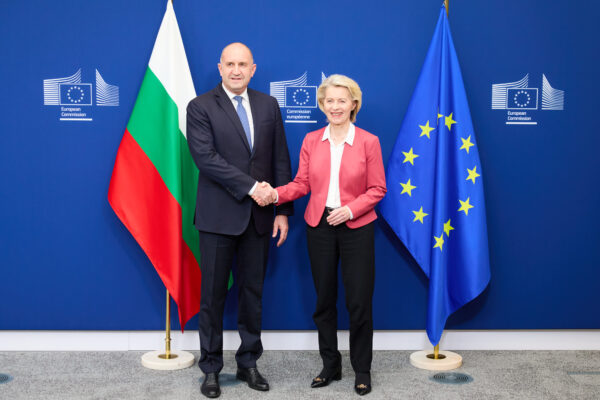
The new prime minister, Rumen Radev also took a sharply critical stance against military assistance.
He gained popularity in April’s elections partly thanks to rhetoric that some described as pro-Russian and others as strictly nationalist.
Although Bulgaria has sent 13 packages of military aid to Kyiv since the start of the war, last year Radev called broader arms initiatives financed from European funds “a thing doomed to fail”.
“We have already provided enough, while our country continues to suffer the socio-economic damage caused by this bloody war,” he explained.
Radev’s policy is inevitably compared with the approach of former Hungarian prime minister Viktor Orbán. But according to the Atlantic Council, a US think tank, Bulgaria “will not fundamentally abandon its Western orientation or attempt to revive the country’s Cold War era ‘special relationship’ with Moscow”.
The comparison with Orbán overlooks the domestic Bulgarian context.
After joining the EU in 2007, the country was dominated for more than a decade by the GERB party of former prime minister Boyko Borissov. Anti-corruption protests in 2020–2021, however, exposed dissatisfaction with clientelism and triggered a long period of political instability and repeated elections.
It was then that Rumen Radev strengthened his position. He was president from 2017 until this January and positioned himself against the government. At the same time, he has a pro-Western background, having studied at a United States Air Force school and, as commander of the Bulgarian Air Force, he helped integrate the country into Nato.
The question now is whether Bulgaria’s turn away from financial and military support for Ukraine will only be a temporary move or a deeper shift for the EU’s security formula.
Bulgaria announced that it would not support the new 21 EU sanctions package against Russia, as it wants to remove Patriarch Kirill, the head of the Russian Orthodox Church and an ally of president Vladimir Putin. It is Orthodoxy that most closely links Bulgaria with Russia.
Earlier in June, during a European Council in Brussels, Radev noted that Bulgaria would not obstruct common European decisions concerning Ukraine, including on Ukraine’s EU membership.
“Whoever wants to deliver military aid and military equipment to Ukraine is free to do so. We take a decision on our deliveries on the basis of what we have in stock and whether we can do it,” Radev said.