Hungary’s new prime minister is halving the job’s sky-high pay, pushing quasi-judicial inquiry committees and racing to clinch an EU cash deal – all while discovering he is no longer even his own party’s most popular face.
 Zoltan Szalay



Our weekly digest of Hungarian politics continues, as we report on developments after April’s historic election and on the formation of the Tisza government. This week we cover the following topics:
Magyar starts the belt-tightening with himself. Parliament sets up mini-courts. The most important foreign trip to Brussels to bring home billions of euros. Poll of the week: Magyar is not the most popular Tisza politician.
Follow Hungary’s road after the 2026 election — subscribe to The Hungary Briefing on Substack and get every edition, and other Hungary-related articles straight to your inbox.
Magyar starts the belt-tightening with himself
Then in the thick of the election campaign, on 5 January Péter Magyar posted on Facebook that Tisza would cap the prime minister’s salary at 2.5 million forints per month (around €6,500 at the exchange rate at the time). Magyar is now delivering on this promise: in an interview with RTL he announced that his monthly pay packet as prime minister will be 2.3 million forints (around €5,900 at the current exchange rate). On top of that he receives his 1.5 million forint (around €3,850) MP’s salary (in Hungary, unlike in Slovakia, the two functions can be exercised simultaneously).
Magyar will earn 3.8 million forints (around €9,750). This is a tidy sum, but it is significantly lower than his predecessor Viktor Orbán’s salary.
According to the G7 economic portal, Orbán’s income was 8.1 times the previous year’s national average wage, which meant 7.35 million forints (around €18,860). From July it would have risen to 7.83 million forints (around €20,000).
The highest-earning prime ministers
Orbán’s salary was hefty by European standards. Of course, leaders of larger countries may earn more in nominal terms, but if we compare it to the average wage in each country, according to data from Átlátszó the Hungarian prime minister was the best paid across the entire EU.
According to calculations by G7, Orbán earned 1,283 percent of the average wage: by this measure as well, he was the highest-earning leader in the EU, and he far outstripped Vladimir Putin too. According to Átlátszó, Robert Fico, who earns 7.6 times the average wage, ranks second after Orbán. Among EU leaders, G7 places only the German chancellor ahead of Fico, though the Slovakian premier is the best paid prime minister relative to his country’s economic situation.
In 2024 Fico substantially increased the salaries of cabinet members; the Slovak prime minister’s monthly salary, including allowances, rose to over €10,000 in total, roughly double the prime ministerial salary during the previous electoral term.
Cuts for others as well
Reducing the prime minister’s salary is a symbolic political gesture, but means little in budgetary terms. Magyar, however, plans to also cut ministers’ and MPs’ salaries, which would result in a noticeable saving.
The idea of cutting mayors’ salaries has also been raised, provoking immediate outrage from some of those affected. Péter Márki-Zay, the mayor of Hódmezővásárhely and a former prime ministerial candidate, who was a strong supporter of Tisza during the campaign, criticised the government and warned against Tisza’s becoming a one-party state.
As G7 notes, Hungary spends the most in the EU on state employees: 8.2 percent of GDP, while in Poland this figure is 5.2 percent, and in Czechia and Austria 4.4 percent. In the region, the other country struggling with economic difficulties, Slovakia, also spends a large amount for this purpose: 7 percent of GDP.
Parliament sets up mini-courts
The first more serious development in terms of accountability took place in parliament. Tisza has set up five parliamentary inquiry committees, which will examine the following matters:
the systemic crisis in child protection; the clemency scandal; spontaneous privatisation and the loss of public assets; abuses in enforcement procedures; abuses around the Magyar Nemzeti Bank (Hungarian National Bank).
Similar inquiry committees have existed before in the Hungarian parliament, and they generally don’t produce notable results. Tisza now wants to change this, with the new committees set to be given unusually strong powers.
Criminal liability
Each committee will have six members, three delegated by Tisza and the remainder by the opposition.
Attendance before the committees will be compulsory; anyone who fails to comply can expect a fine, and if that does not help, the police may bring them in. This does not apply to members of parliament, but it does apply to those who no longer hold office, such as former prime minister Viktor Orbán or former president Katalin Novák. Decisions may be appealed to the Kúria (Supreme Court).
Those appearing before the inquiry committees would also be subject to an obligation to tell the truth, under pain of criminal liability. As HVG summarised, obstructing the work of the committees, refusing to cooperate with them or giving false testimony would be punishable by imprisonment.
Civil society criticism
This proposal has been criticised not only by Fidesz but also by civil society. According to Máté Szabó, legal director of the Hungarian Civil Liberties Union (Társaság a Szabadságjogokért), these powers are disproportionately strong, and would in effect raise the inquiry committees to the level of the judiciary.
Magyar responded to the criticism on RTL by saying that in advanced Western democracies inquiry committees have even stronger powers than these. He responded to the criticism on RTL.
The most important foreign trip
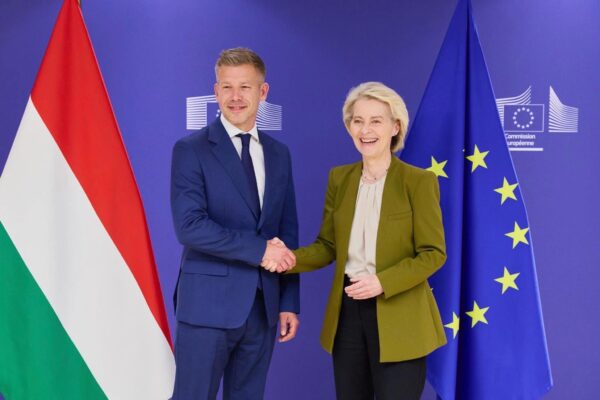
Magyar arrived in Brussels on Thursday for a two-day trip, where he is meeting first with Nato secretary-general Mark Rutte and Belgian prime minister Bart De Wever, and then on Friday with Ursula von der Leyen, president of the European Commission.
The main stake of the trip is whether the unfreezing of Hungarian EU funds will be announced.
Magyar was accompanied by finance minister András Kármán, foreign minister Anita Orbán and transport and investment minister Dávid Vitézy. They are already negotiating EU funds on Thursday; according to Magyar’s own X account, he will only go over the remaining outstanding questions with von der Leyen.
Magyar announced that he will shortly formally submit Hungary’s intention to join the European Public Prosecutor’s Office to the presidents of the European Commission and the European Council.
On the issue of EU funds, Ukraine did not come up once during the negotiations, Magyar said. According to him, the essence of the talks was the fight against corruption. There are some demands they will not meet, Magyar added without giving specifics, but in his view, this will not prevent Hungary from obtaining the money.
The European Commission also communicated this week that a few outstanding technical issues still need to be resolved in order to unblock the EU funds. If this is achieved, the Hungarian government can submit the revised version of its recovery plan. The stakes currently stand at €10.4bn, of which €6.5bn is non-repayable grants, while the remainder is concessional loans.
In recent days, Euronews reported that the remaining open questions may concern pension and tax reform. Magyar is unwilling to scrap certain special taxes whose abolition would simplify the tax system, but would at the same time mean a loss of revenue for the budget.
If an agreement is reached on Friday, that will not mean the immediate disbursement of the funds. The government will still have to meet the EU conditions, primarily the 27 super milestones, and it must draw down the available resources by 31 August so that they are not lost.
Poll of the week: Magyar is not the most popular Tisza politician
Although a frequent criticism of Tisza was that it functioned as Magyar’s one-man party, a new opinion poll suggests that voters do not see it that way.
According to a new survey by the Idea Institute, foreign minister Anita Orbán is the most popular politician in Hungary. Forty percent of the population find Orbán very likeable, a further 14 percent rather likeable, while 39 percent do not sympathise with her at all or rather do not.
The second most popular is István Kapitány, minister for economic affairs and energy: 35 percent find him very, and another 18 percent rather likeable, while 40 percent dislike him.
Transport and investment minister Vitézy is very likeable for 23 percent and rather likeable for another 23 percent, while 34 percent reject him.
Magyar is seen as very likeable by 36 percent, with a further 15 percent sympathetic towards him, and 42 percent rejecting him.
According to Idea, it is Vitézy, formerly a politician in the Budapest city administration, whose popularity has increased the most in recent weeks (by 6 percentage points). Among the Tisza politicians surveyed, the least popular is Zoltán Tarr, minister for social relations and culture. Even he is, however, more popular than any Fidesz politician.
Orbán’s rejection rate is quite high: 62 percent. At present, 29 percent of the population find him very, and another 5 percent rather likeable. Former foreign minister Péter Szijjártó’s rejection rate is similar, at 63 percent, and his popularity is slightly lower than Orbán’s: a total of 32 percent sympathise with him. The current Fidesz parliamentary group leader, Gergely Gulyás, has a popularity rating of 27 percent and a rejection rate of 66 percent. Sixty-seven percent reject former transport minister János Lázár, whose popularity stands at 28 percent.
The data were recorded between 8 and 11 May, based on an online questionnaire survey of 1,000 respondents.