


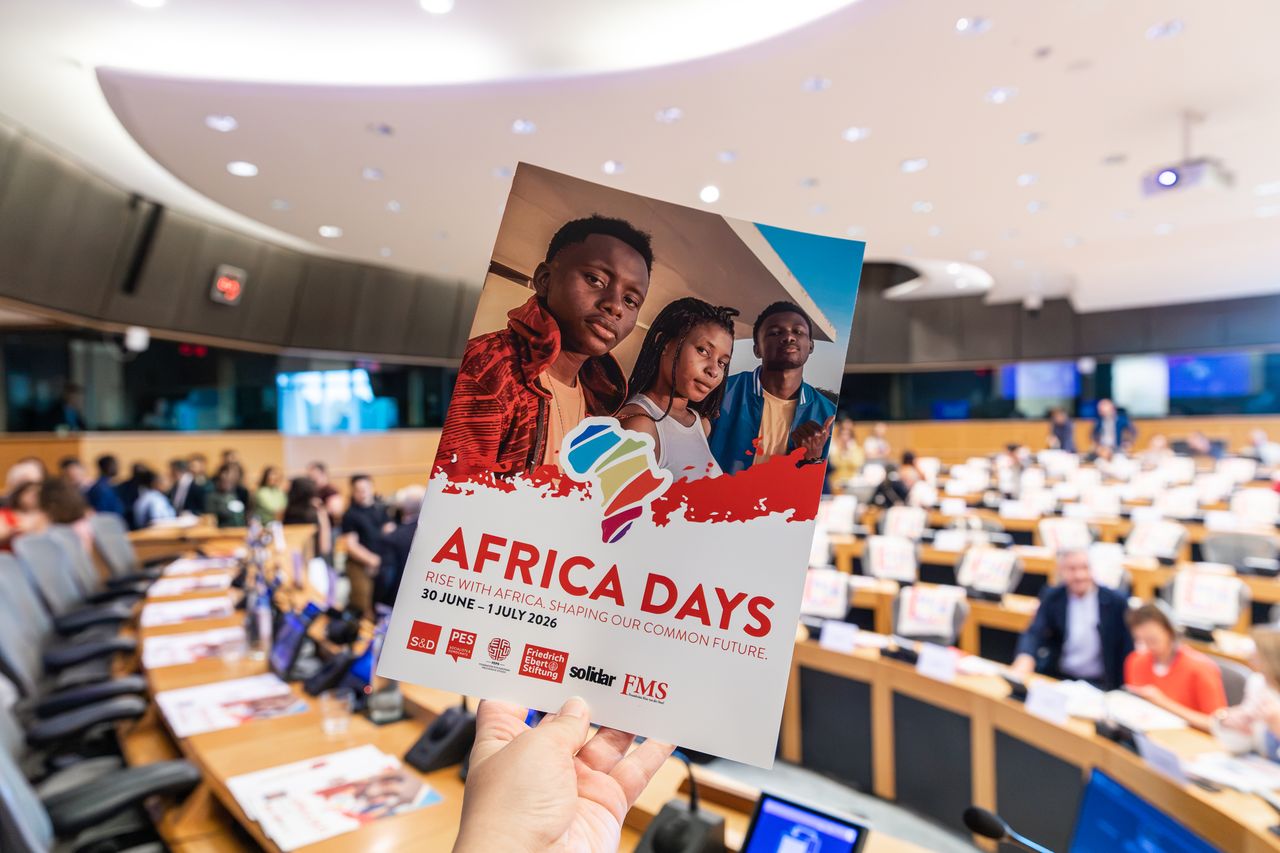
For the past two days, the Socialists & Democrats have held their “Africa Days”, a space for dialogue and co-creation between politicians, civil society, youth leaders, women’s movements, trade unions from both regions, and members of the diaspora.
 Socialists and Democrats



“If all I knew of Africa were of popular images – I too would think that Africa was a place of beautiful landscapes, beautiful animals, and incomprehensible people fighting senseless wars, dying of poverty and aids – unable to speak for themselves.”
These are the words of popular Nigerian writer Chimamanda Ngozi Adichie, whose book Americanah was one of the most widely read novels of the past decade.
It is a fact that, still today, many political forces continue to reduce Africa to security and migration issues, or to a territory for extractive investment opportunities.

We believe it is vital to get rid of any paternalistic view and listen to rising voices on the ground, echoing their demands and amplifying their perspectives to feed into the European political debates.
The recent European Union-African Union summit in Luanda (Angola) was a great step towards strengthening the relationship of the two regions.
However, the future of this partnership cannot be shaped exclusively in the corridors of institutions or traditional centres of power, ignoring the reality on the ground and the potential of its people.
Africa is the youngest continent, with over 12 million people about to enter the job market each year, and its population is projected to reach 2.5 billion by 2050. If we are interested in their raw materials, should we not be even more interested in joining forces with their human talent?
We are convinced that in a world of growing political tensions, it is more crucial than ever to keep the line open with those who get things moving.
This is why, for the past two days, the Socialists & Democrats have held their “Africa Days”, a space for dialogue and co-creation between politicians, civil society, youth leaders, women’s movements, trade unions from both regions, and members of the diaspora.
As a result of this event, we came up with a set of commitments that will not only drive our political and legislative work until the end of the mandate, but also aims to shape the Africa-Europe partnership for tomorrow.
A renewed partnership between equals
Last November, the president of the European Council, Antonio Costa, said: “War has returned to Europe and persists in several African countries. Disinformation and external interference are commonplace in our regions, global markets are experiencing unprecedented upheaval and global debt has reached unaffordable levels.”
Indeed, we share a common present and a common future.
In a world increasingly polarised and divided by nationalism, hard power and trade conflicts, we can no longer see Africa as a mere recipient of funds; but rather as a key player in the current global order, striving for our trust and engagement.
Any EU agreement with African countries must ensure that local communities participate and benefit from economic transformation, investment and the richness of their own natural resources.
In that sense, for instance, the adoption of the Clean Trade and Investment Partnership and the Memorandum of Understanding on a strategic partnership on sustainable minerals and metals value chains with South Africa, in November, showed the path to follow: a partnership of equals that creates stability in an uncertain world and prepares our economies and our people for the future.
These agreements represent a crucial opportunity for the EU and Africa’s largest economy to work more closely in the areas of sustainable development and minerals. They will create new trade and investment opportunities, help reduce strategic dependencies, and support decarbonisation and the just transition.
African agency must lead the way
A strong Europe-Africa partnership can only be built on respect for African ownership and leadership, and its future must be shaped first and foremost by its people’s aspirations, priorities, and solutions.
This is why Global Gateway – the EU’s flagship foreign investment programme mobilising €15bn to boost digital connectivity, transport infrastructure, and energy transition in Africa – is a useful tool, but its implementation must take into account human development, transparency and local ownership.
Investments must benefit the most socio-economically disadvantaged populations, including low-income households, women, and minorities, while ensuring that the distributional impact of interventions is properly measured.
Beyond that, they must be accompanied by robust support for key social infrastructures, such as basic education, healthcare and social protection.
Ensuring tax and climate justice
Today, many African countries continue to face limited fiscal space, debt pressure, unequal access to finance or the growing impact of climate change.
For this, we need Africa to have a stronger voice in global fora. The first G20 summit organised in South Africa in November 2025 was a great success and we commit to urging the EU to ensure that Africa has a permanent seat at the UN Security Council.
We will continue to fight for a fairer global economic and financial system, including effective taxation of multinational companies and stronger action against illicit financial flows.
Advancing global solidarity and social justice
Tackling inequality is a shared global effort. Alongside our commitment to social justice within Europe, we advocate for a fairer international economic system based on tax justice, responsible financial governance, and sustainable debt solutions.
We also believe that the benefits of growth and resource extraction must be shared more equitably, with African communities fully participating in, and benefiting from, the wealth generated on the continent.
For this, we will ensure that the partnership encompasses not only economic cooperation, but also infrastructure development, health systems, labour rights, and education.
The “avenue-concept”, for which we advocate, reflects a rejection of short-term profit motives, focusing instead on mutual interest in sustainable development and high social standards.
Africa’s future is being shaped every day by the power of its people – their creativity, resilience, and commitment to drive change across the continent.
From grassroots initiatives to youth-led movements, these voices are transforming societies, building new opportunities, and shaping the future.
This stakeholder article is paid for by a third party. All opinions in this article reflect the views of the author and not of EUobserver.