




From higher defence budgets to tighter control over social media, liberals are quietly backing a more muscular state they once resisted, arguing it is the price of keeping European freedoms alive.
 Petra Pavlovičová



Against a backdrop of geopolitical instability and mounting electoral setbacks, Europe’s liberals are redefining what it means to defend ‘liberal democracy’.
And increasingly, the language of rights, markets and European integration is being supplemented and at times overshadowed by a new political priority: security.
“Security and democracy are not separate – nor is democracy sequential to security,” Carolin Johnson head of policy at European Partnership for Democracy told EUobserver.
This shift comes at a moment of vulnerability for Europe’s liberal family.
Across the continent, centrist-liberal parties have suffered significant electoral setbacks over the past few years. In 2023, Spain’s Ciudadanos, once one of Europe’s fastest-rising centrist forces, effectively disappeared from national politics.
And Germany’s Free Democratic Party (FDP), after leaving chancellor Olaf Scholz’s three-way governing coalition, failed to make the five-percent threshold to return to the Bundestag in the 2025 federal election.
At the European level, the Renew Europe group lost 21 seats in the 2024 European elections, as voters increasingly turned either to conservative parties or the populist hard-right such as the Patriots for Europe or European Conservatives and Reformists Group.
Time for a rethink
Yet rather than retreating, Europe’s liberals appear to be attempting an ideological repositioning.
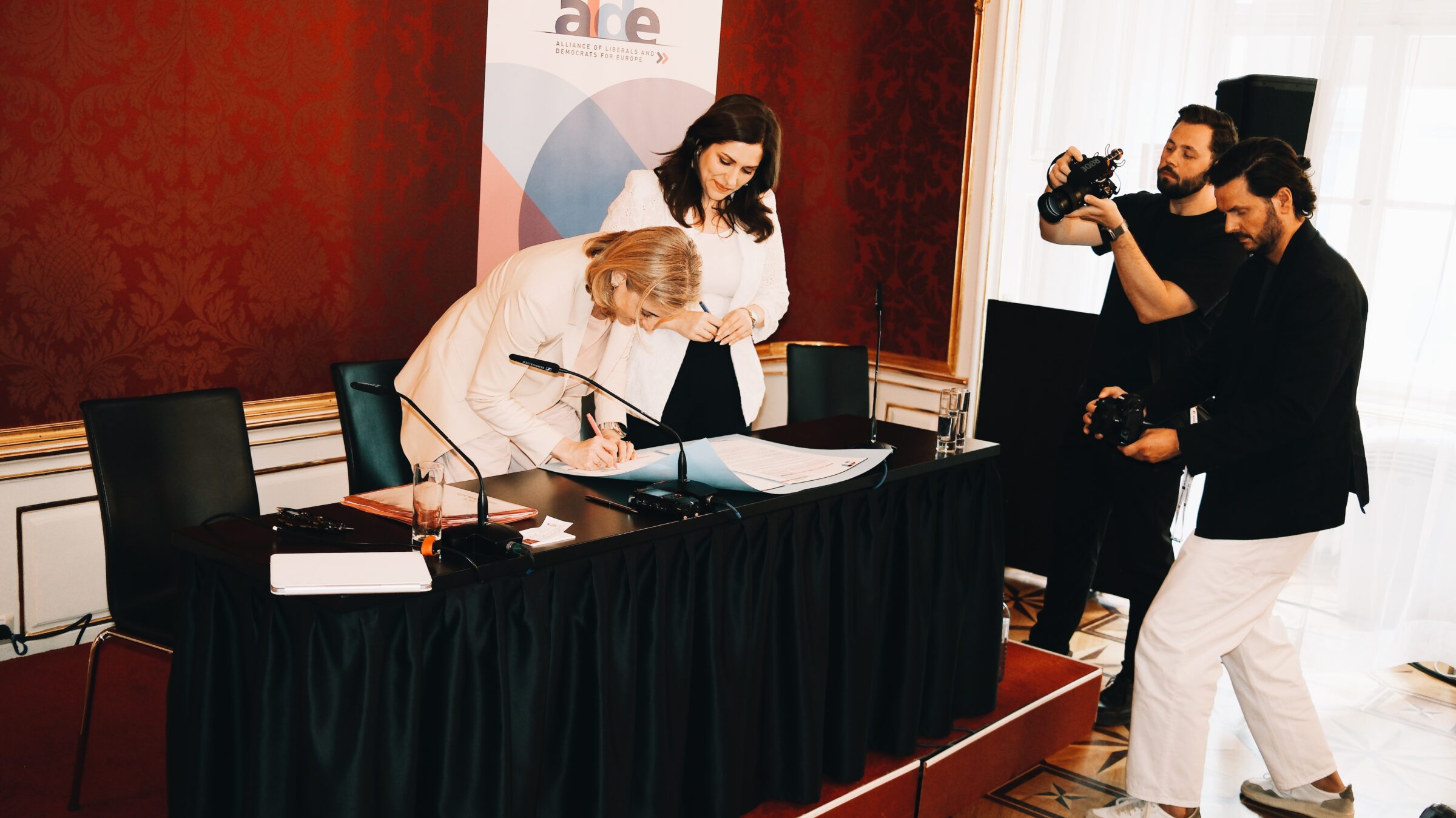
At the Alliance of Liberals and Democrats for Europe (ALDE) congress in Vienna in early July (3-4), speakers repeatedly returned to one message: Europe’s ‘openness’ can no longer be taken for granted. Security has become the condition upon which liberal values themselves depend.
“Europe is under attack,” Austrian foreign minister Beate Meinl-Reisinger said.
The leader of Austria’s liberal NEOS party, which recorded its strongest national result in 2024, has become one of Europe’s most outspoken supporters of Ukraine and advocates for countering foreign interference.
“Security is not optional,” Meinl-Reisinger added.
This statement, more than rhetorical, was a positioning. In May this year Austria expelled three Russian diplomats accused of espionage, with authorities pointing to an alleged ” forest of antennas” installed on diplomatic rooftops in Vienna. These antennas were capable of intercepting communications from international organisations and Austrian state institutions, reported the BBC.
A battlefield far from the frontline
Russia’s invasion of Ukraine remains the defining reason for “security coming to the forefront of political debate,” said Johnson. However, the topic of security extends well beyond the battlefield.
Hybrid threats, cyberattacks, economic coercion as well as foreign interference have fundamentally altered how liberal politicians describe the international environment.
“The state of security is multi-levelled,” Polish major general Karol Molenda told EUobserver.
The underlying assumption that peace, economic interdependence and democratic stability would reinforce one another is increasingly being questioned.
“Our saying is : once a victim, always a victim,” said Molenda.