

Residents of a Copenhagen housing estate, Mjølnerparken, are highly critical of plans to ‘upgrade’ it – arguing it was only the Danish government’s ‘Ghetto Law’ that turned it into a ‘parallel society’ in the first place.
 Bianca Blei



For years now, the Mjølnerparken social housing estate in the Danish capital has been a building site – politically as well as literally.
Construction hoardings, construction machinery and construction workers dominate the area around its apartment blocks in the city’s trendy Nørrebro district.
In 2018, then-prime minister Lars Løkke Rasmussen used it as the setting for the announcement of his ‘Ghetto Law’, which he said would crack down on so-called ‘parallel societies’ and finally provide a way of dealing with the failed integration of immigrants.
Under this law, social housing estates that meet certain criteria such as low educational attainment, high unemployment rates or high numbers of residents with criminal convictions have been listed as “vulnerable residential areas” and subjected to a range of measures aimed at upgrading them and breaking up the ‘ghettos’.
Over the years, however, the thresholds for these criteria have shifted, meaning that some estates remain on the list despite having improved.
The key criterion, however, is ethnic origin, since only estates where at least half the residents are non-Western immigrants and their descendants are designated as ‘ghettos’.
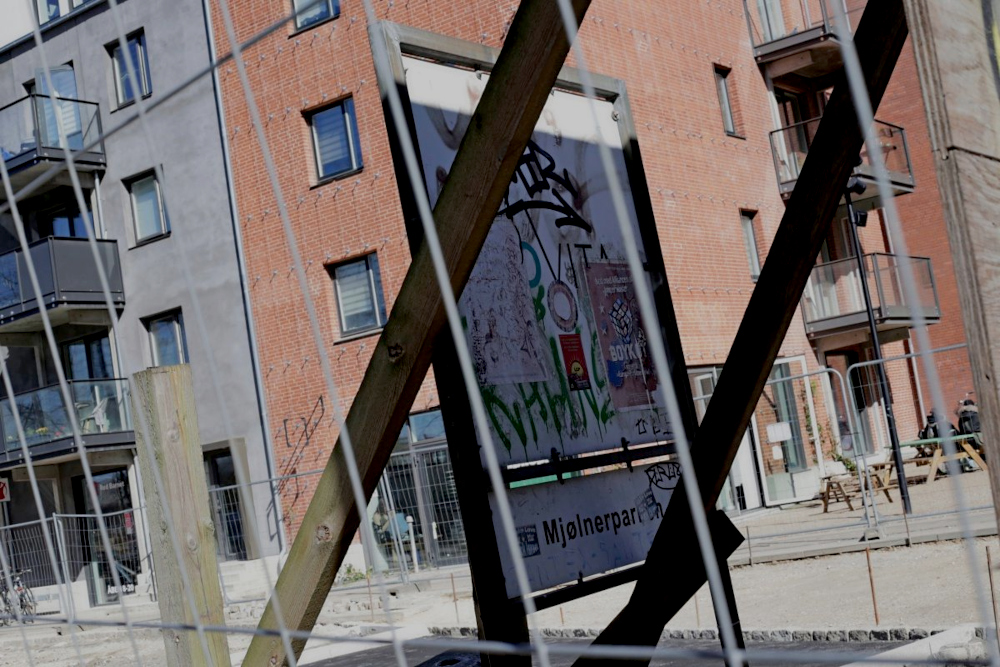 Mjølnerparken neighbourhood building site in Copenhagen. Source: Der Standard
Born a ghetto
In the office of the Residents’ Association, teacher Majken Felle, 52, said that Mjølnerparken was born on the ghetto list, so to speak. This is because measures are only supposed to be applied to so-called ‘hard ghettos’, defined as residential areas that have been classified as ‘ghettos’ for several years in succession.
Yet work to dismantle this estate with its red-brick buildings and white balconies began immediately.
“The law applied retroactively, so we were affected right from the start,” she says. While some areas were given time to improve their statistics and be removed from the list, an immediate plan to reduce the amount of social housing had to be created for Mjølnerparken.