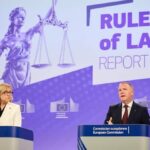

BRUSSELS – Today, the European Commission published its seventh annual Rule of Law Report, assessing the state of the rule of law across all EU Member States, as well as four candidate countries: Albania, Montenegro, North Macedonia, and Serbia. Since 2020, the European Commission has been publishing the Rule of
 EWB
EWB



BRUSSELS – Today, the European Commission published its seventh annual Rule of Law Report, assessing the state of the rule of law across all EU Member States, as well as four candidate countries: Albania, Montenegro, North Macedonia, and Serbia.
Since 2020, the European Commission has been publishing the Rule of Law Report as a part of the annual Rule of Law Cycle. In 2024, the four countries from region were included due to their most advanced status in negotiations, to put them on equal footing with Member States early on.
As it is stated by Commission, this support the reform efforts made by these countries to achieve progress on democracy and the rule of law ahead of accession, and to guarantee lasting high standards after accession.
Montenegro: Progress in judicial reform, attacks against prosecutorial authorities continue
According to the Rule of law Report for Montenegro, country continued implementing its Judicial Reform Strategy, adopting a new Action Plan and constitutional amendments aimed at strengthening the independence of the Judicial and Prosecutorial Council.
The Commission notes improvements in professional standards, evaluations of judges and prosecutors, and judicial efficiency.
“The Judicial and Prosecutorial Councils are effectively implementing the improved rules for the evaluation of judges and prosecutors, while the quality of the evaluation of judges can be further improved. While the Councils have an established reporting mechanism for instances of undue influence, criticisms and attacks against prosecutorial authorities and their decisions have continued, thereby raising concerns”, report said.
It is added that the effectiveness and coordination of law enforcement institutions in the area of corruption and the number of final rulings and convictions in cases of high-level corruption has increased.
When it comes to media landscape, European Commission states with new appointments the Councils of the Agency for Audiovisual Media Services and the Radio Television of Montenegro were restored to full composition.
It is added the appointment of the Director-General of the Council of the Radio Television of Montenegro continues to face legal challenges.
“Transparency of media ownership for audiovisual media services has improved but gaps remain for online media alongside increasing concerns about the influence of Serbian-owned media outlets. Transparency in the allocation of public funding for media has also improved, but the enforcement of obligations remains an issue”, report said.
It is added that the authorities continue to apply “a zero-tolerance policy to violence against journalists”, although isolated attacks still occur.
Albania: Media independence and political polarisation remain concerns
Albania continued implementing judicial reform and the Cross-Sector Justice Strategy, completing the vetting process for all judges and prosecutors after the appeal phase was finalised, further strengthening judicial independence, accountability and integrity.
However, the Commission notes that “attempts of undue influence on justice institutions, and personal attacks on magistrates continued”, while challenges remain in judicial evaluations and the full rollout of an integrated electronic case management system.
The institutional framework for corruption prevention has improved, but coordination with law enforcement remains weak.
SPAK continuing to deliver positive results in high-level corruption cases and building “a solid track record of investigations, prosecutions and convictions”. At the same time, corruption risks remain high in the police, public procurement and other high-risk sectors, while shortcomings persist in asset declaration verification.
The report also highlights persistent concerns over media independence, including the regulatory authority, the public broadcaster and media ownership concentration. Journalists continue to face “verbal and physical threats, smear campaign and strategic lawsuits against public participation (SLAPP)”.
It is stated that political polarisation continues to affect parliamentary work, while civil society organisations operate freely but still face discreditation, uneven consultation practices and financial sustainability challenges.
Serbia: Political pressure on judiciary increased, concerns over media freedom and civil society deepen
The European Commission says legal amendments adopted in Serbia weakened safeguards for prosecutorial autonomy and judicial independence, although subsequent measures addressed “a considerable part” of the Venice Commission’s recommendations.
Nevertheless, “concerns regarding prosecutorial autonomy remain”, while “political pressure on the judiciary and the prosecution increased significantly”, with limited response from judicial institutions.
The report notes that Serbia has yet to establish “a robust track record of investigations, indictments and final convictions in high-level corruption”.
It also raises concerns over the functioning of the Prosecutor’s Office for Organised Crime, widespread exemptions from public procurement rules, and continued weaknesses in asset declaration controls. The investigation into the Novi Sad railway station collapse remains ongoing.
The Commission describes the media environment as facing “serious challenges”, citing the lack of a functioning REM Council for most of the reporting period, persistent concerns over editorial autonomy and media pluralism, growing market concentration and political influence over the media.
It adds that “the safety of journalists has further deteriorated, with increased physical attacks and threats.”
The report also concludes that Parliament’s oversight role continues to be weakened by the lack of genuine political debate, while “the legal framework for public consultations and its enforcement has deteriorated.”
It further states that “civil society organisations have been subjected to increasing pressure and attacks.”
North Macedonia: Judicial independence undermined by political interference and weak anti-corruption record
The implementation of the anti-corruption strategy remained limited, while recent amendments to the Criminal Code introduced shortcomings compared with the previous framework.
Despite efforts to investigate corruption, “delays in court proceedings, infrequent final convictions and limited resources continue to impede the development of a strong track-record of high-level corruption cases.”
The report also notes continued concerns over the financial independence of the media regulator and the public broadcaster. Journalists continue to face pressure from political actors, increased online violence and SLAPP threats, while implementation of access to information legislation remains inconsistent.
The Commission adds that appointments were made to several independent institutions, but concerns remain over merit-based selection procedures. The Constitutional Court strengthened its role, while cooperation with civil society continued despite persistent funding challenges.