

Shopping local ensures a future for cultures and communities, says Caroline Weaver, creator of the Locavore Guide digital directory When I signed the lease for my new apartment in Brooklyn, the relief of having survived the brutal New York City real estate market was short-lived when my next task became
 Gaya Gupta




When I signed the lease for my new apartment in Brooklyn, the relief of having survived the brutal New York City real estate market was short-lived when my next task became clear: I needed to furnish the place.
My first instinct was to check everything off my list by shopping online. But the thought of waiting for deliveries and unboxing an endless mountain of packages seemed exhausting. And, I was moving to New York, where the streets are lined with a seemingly infinite number of stores.
The task was daunting. I knew where to shop for shoes or buy a nice candle for someone’s birthday, but I didn’t know where to find a set of drinking glasses, or Tupperware, or even an air conditioner without starting online at Target or Home Depot.
So I enlisted the help of Caroline Weaver, a shop owner in Manhattan who has spent the last decade convincing people like me that shopping locally isn’t hard – and it can actually be extremely fulfilling. Weaver has been operating local stores in the city since 2014 – her first, CW Pencil Enterprise, sold writing utensils and stationery.
Weaver created the Locavore Guide in 2023, a digital directory that helps New Yorkers shop locally, meet their neighbors and explore the city. And through her online video series, Caroline Finds It, she takes on challenges to find everything from nylon kites and hourglass timers at local stores. The Locavore Variety Store, which she opened in 2024, is also stocked with products from independent sellers manufactured in and around New York.
Weaver started the Locavore Guide because, in running her own small businesses, she found that her customers wanted to shop local but didn’t know where to start. TikTok also had a tendency to regurgitate the same 20 or so recommendations, she added, and she wanted to give New Yorkers a wider, unbiased range of stores they could frequent.
“A lot of people treat shops … as something nice to walk past, somewhere you go when you have to buy a gift,” Weaver said. “But really, those shops can’t exist if we’re not patronizing them and supporting them as neighbors and New Yorkers.”
On a perfectly temperate afternoon in early June, Weaver took me around downtown Manhattan to help me find a few essentials: dinnerware, cutlery, a kitchen prep table and an air conditioning unit that I ideally would not have to lug back myself.
We first met up on the Upper East Side’s S Feldman Housewares, a store that’s been in operation since 1929. The store has everything needed to service one of New York City’s most posh neighborhoods (they sold chandelier cleaner and silver polish), but they also have everyday items like food storage containers, cleaning supplies and drinking glasses. They even had a replacement bird-shaped whistle for a tea kettle Weaver had been looking for.
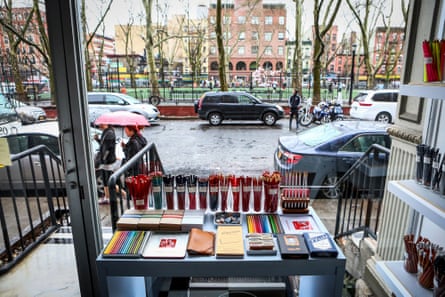
Some of the prices were slightly higher than what I saw online, but Weaver said that “it all evens out”, as other products are less expensive in person. She also pointed out that unlike Amazon, local stores don’t constantly adjust prices according to algorithms.
Local stores like Feldman’s also offer actual customer service that is impossible to get from most online retailers.
“You get an actual person who can help you,” she said. And if the store doesn’t have what you’re looking for, the shopkeeper may be able to order it in for you for free, she added.
Weaver and I then made our way downtown to hit several more local spots: at New York’s only 24-hour hardware store, Nuthouse, I picked up some kitchen tools and painter’s tape. And at Fishs Eddy, a home goods store, I bought two plates and a set of cutlery for my friend and I to eat the takeout we’d planned for that night. I also took far too much time picking out a martini glass so that I could have an inaugural drink at the new apartment.
Our last stop was Win Depot, a restaurant supply store in SoHo where I was hoping to find a stainless steelwork table for my kitchen. The table needed to be precisely sized to span 6 feet but was limited in its width to fit my long but narrow galley kitchen, which I knew would be a finicky task.
Over the course of several days, Cindy Loo, a manager at Win Depot, helped me customize my table, ensuring that it was the exact measurements. When the table arrived and I sent her photos of it fitting perfectly into my kitchen, I could feel her excitement, too.
In her decade of living in New York City and her time as a local shop owner, Weaver said she’s seen first-hand how many small businesses are struggling. Tariffs and rising rents have been a huge pain, but so have changing consumer preferences. Post-Covid, she said, online shopping has become the default for many people, and New Yorkers seem less inclined to venture out of their neighborhood for the things they need.
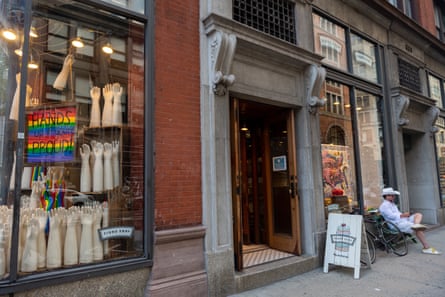
But things are changing. Boycotts of large online retailers have picked up steam in recent years as large corporations come under fire for low worker pay, suppressing union activity, rolling back DEI initiatives and boosting the pay of billionaires.
“If you have the means and the privilege to make the choice of where you buy your goods, I think that it is our social responsibility, it is our civic responsibility, to think about this from an ethics perspective,” said Weaver. “Shopping local, shopping independent, is a way to ensure a future for our culture, our communities.”
As Weaver and I traversed down the east side of Manhattan, hopping on and off the 6 train, chatting with shop owners and store patrons, I kept thinking about a new word I’d heard earlier in the year: “friction-maxxing”.
A columnist at the Cut declared 2026 her year of friction-maxxing, which is the practice of intentionally choosing inconvenience, even as it becomes easier to automate our lives, from using apps to order food directly to our doorstep to using artificial intelligence shortcuts to write texts and emails.
It certainly would’ve been easier to purchase everything I did during my day with Weaver online. I probably would’ve ended the day less sweaty and less hangry.
But I never would have gotten to meet Cindy, who I now know can help me find whatever else I need for my kitchen. And I would have lost out on a day exploring new shops and new neighborhoods in the city, which made me even more excited to return and call New York home once again.