
Five out of every six farms on Earth cover less than two hectares. Together, according to research published by the Food and Agriculture Organization (FAO), they produce roughly 35% of the world’s food while working just 12% of its farmland. That gap between land and output is the whole story
 May June Kyaw Win



Five out of every six farms on Earth cover less than two hectares. Together, according to research published by the Food and Agriculture Organization (FAO), they produce roughly 35% of the world’s food while working just 12% of its farmland.
That gap between land and output is the whole story of smallholder agriculture in one statistic – and it’s why the sector has quietly become one of the more interesting frontiers for European AgriTech founders.
For a long time, this wasn’t an investable problem. Smallholders in Africa, Asia and Latin America lacked the connectivity, capital and data infrastructure that made digital agriculture viable elsewhere. That has changed and is evidenced by the fact smartphone adoption across sub-Saharan Africa reached around 40% in 2023 and is projected to exceed 50% by the end of the decade, according to GSMA.
Meanwhile, satellite imagery has become affordable enough to query on demand, and cloud computing costs have fallen to the point where a founder in Berlin or Milan can build AI-powered agricultural tools that would have been commercially unthinkable a decade ago.
The question facing European startups is no longer whether AI belongs in smallholder agriculture, it is how to build solutions that remain effective long after the pilot stage.
Where the information gap actually is
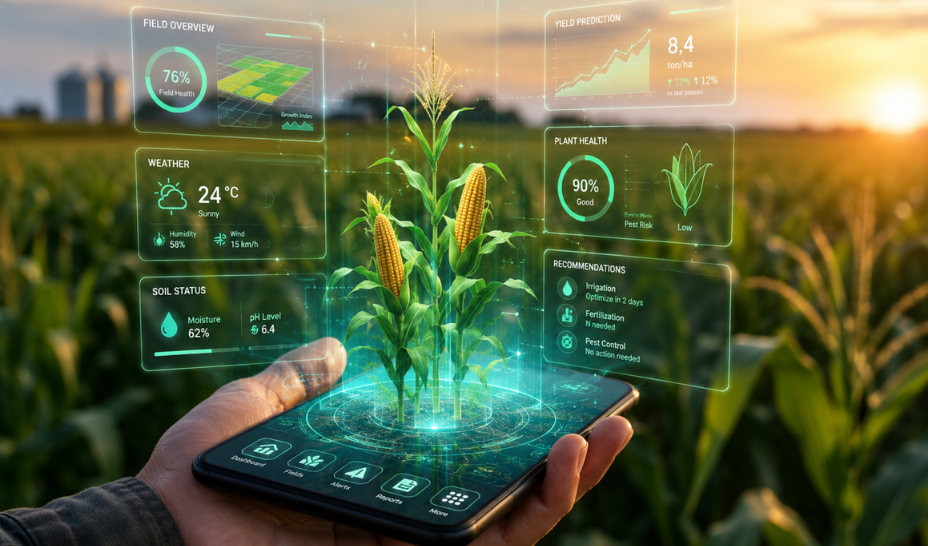
Most smallholder decisions – when to plant, how much to irrigate, what to spray – are still made on instinct, passed down rather than measured. Machine learning models trained on satellite imagery can now flag crop stress before it is visible to the eye. Computer vision lets a farmer photograph a diseased leaf and receive a diagnosis within seconds.
Berlin-based Plantix built exactly this: an application that identifies crop pests and diseases from a smartphone photo and is now used by millions of farmers while continuing to expand across Africa and Southeast Asia.
According to research by GMI, the global AI-in-agriculture market is valued at between €1.75 billion ($2 billion) and €4.38 billion ($5 billion) in 2024 and is expected to grow at approximately 20–26% annually through the early 2030s. This is now one of the fastest-growing segments within ClimateTech rather than a niche experiment.
There is a quiet commercial logic at play. Tools built for European precision farming such as soil sensors, yield forecasting, and irrigation scheduling often require surprisingly little re-engineering to work in emerging markets. What they need instead is a different distribution model: multilingual interfaces, offline-first functionality (Edge AI/TinyML) and partnerships with cooperatives rather than direct subscription sales.
Founders who treat this as a localisation exercise move faster and more efficiently than those starting from scratch.
The advisory layer is shifting too. Generative AI and large language models are beginning to deliver localised, agronomist-level advice through a WhatsApp message or voice call in a farmer’s own language, without requiring high processing power.
That represents a meaningful breakthrough in regions where the nearest agricultural extension officer may be a day’s journey away.
Circularity is what makes the economics work
AI alone solves an information problem; it does not solve a resource one. Many smallholder communities already practise informal circular farming through composting, integrating livestock and recycling crop residues into biochar – but these practices often exist outside digital systems, leaving their benefits unmeasured, under-financed and difficult to scale.
This is where the most promising startups are heading: building platforms that connect farm data, carbon measurement and regenerative practices into systems that financial institutions, input suppliers and corporate buyers can actually value. As European businesses adapt to regulations such as the Corporate Sustainability Reporting Directive (CSRD), AI-powered monitoring of circular farming practices can generate the Scope 3 emissions data that multinational supply chains increasingly require.
Denmark’s Agreena provides a compelling European example. The company expanded its verified soil-carbon programme from around two million to 4.5 million hectares in less than two years, creating measurable new income opportunities for farmers adopting regenerative practices. It is a model that could become increasingly relevant for smallholder agriculture as monitoring costs continue to fall.
Italy’s xFarm Technologies tells a similar story. Following its €36 million Series C funding round in 2024, the company now supports more than 450,000 farms across over 100 supply chains. By integrating geospatial AI, farm management and regenerative agriculture into a single platform, xFarm demonstrates that the future belongs to comprehensive ecosystems rather than standalone digital tools.
What this means for founders and investors
Several strategic patterns distinguish the startups that scale from those that remain pilot projects.
Artificial intelligence will not replace agronomic expertise, and circular farming alone will not solve global food security. Together, however, they address two longstanding barriers to smallholder agriculture: limited access to actionable information and limited financial returns from sustainable farming practices.
For European founders, this represents far more than an export opportunity. Many of the challenges faced by smallholder farmers including water scarcity, labour shortages, and climate uncertainty are becoming increasingly relevant within Europe itself.
The companies that learn to build for scarcity abroad may well discover that they have built more resilient products for markets everywhere.
For Europe’s next generation of AgriTech founders, the real opportunity lies not simply in exporting technology, but in creating scalable innovations that address global agricultural challenges while delivering lasting commercial and environmental value.
Those who succeed will not only help transform farming in emerging economies but also help shape the future of sustainable agriculture worldwide.