Intensive farming has all but destroyed England’s ancient woodlands and freshwater wetlands. On a farm in Lincolnshire a radical aristocrat hopes to show there’s money in protecting nature• The summer issue of the Long Read magazine is out now. Click here to orderIn the silent countryside south of Grantham, three
 Patrick Barkham



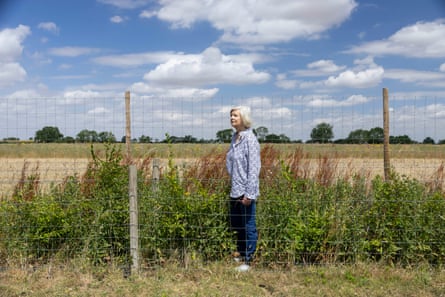
In the silent countryside south of Grantham, three vast steel barns rattled in the breeze. Gathered in a loose circle beside them were 15 landowners, land agents and a couple of young investors; all expensively dressed men, many with a sceptical mien. It was June 2022, and Sir Charles Raymond Burrell, 10th Baronet, was explaining how the purchase of 1,525 bleak acres (617 hectares) of prairie fields of wheat and beans could revolutionise farming and nature conservation, not just in South Lincolnshire but across Britain and beyond.
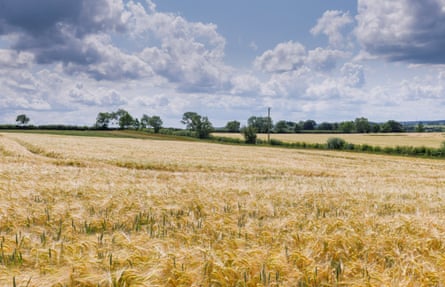
Burrell, known by everyone as Charlie, led the group on a walk from the barns beside the unlovable modern farmhouse, a red-brick behemoth with small windows like piggy eyes. We began by crossing a field of broad beans. Less than a century ago, it had been a patchwork of 10 fields. As we walked over the hard, cracked ground, we encountered not a single insect. Later, by a verge, a couple of butterflies flew. As for humans, we didn’t meet a single other person in our two-and-a-half-hour stroll across a range of footpaths and field edges. “This is a ruined landscape,” said one of the guests, the architectural historian Matthew Rice. “Not because of the soils. Because there are no people here. I’m sorry there are not enough stoats but I’d like there to be some children here, too.”
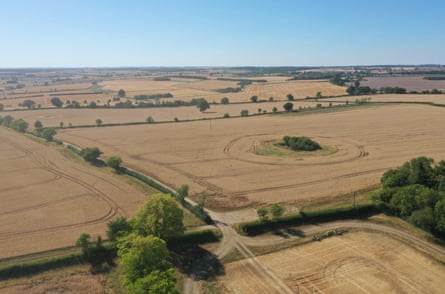
What is a farm? Most of us still picture a storybook image from childhood: cows, pigs, wheat, a pond, a farmer, a family. The farm that had, until recently, operated on this site was more typical of today’s “hard-arsed” farming, as Burrell put it. Boothby Lodge Farm had been a business owned by an absentee landlord. No one lived off the land, or on it. Tenants rented the farmhouse and worked elsewhere. More than 92% of the land was ploughed field. A contract farmer simply drove in with big machines several days each year to produce wheat and beans in relatively poor clay soils. Pheasants were released on the 3% of the farm that was woodland. For a few days each winter, men would pay to shoot them.
Boothby Lodge Farm made £250,000 profit each year but half of this came through the “basic payment”, a simple and generous subsidy for land owned that the government planned to halt by 2027. Beyond that date, thanks to reforms introduced by Michael Gove during his stint as environment secretary, farmers would only receive “public money for public goods” – that is, if their land provided clean water, or healthy soils, or wildlife-rich hedgerows, none of which Boothby appeared to be doing.
Hard-arsed farming has been the main driver of Britain’s contribution to the global extinction crisis. Over the past century, England and Wales have lost 98% of wildflower meadows. We have also destroyed half of Britain’s ancient woodland, half of lowland ponds, 90% of freshwater wetlands and 62% of all “farmland” wild birds.
As we walked, Burrell explained how we might reverse this, on this farm at least. In late 2021, the company he co-founded, Nattergal, had bought the farm for £13.8m. It intended to ditch 6,000 years of farming history on this land. No crops would be sown. No fertilisers or pesticides would be added to the fields. They planned to smash up the drains that had been painstakingly installed by generations of farmers to remove rainwater from their fields. The soils would spring up with weeds. Boothby Lodge Farm was to become Boothby Wildland.
The landowners listened intently to a prospectus that would horrify most farmers. They did so because Burrell, with his relaxed charm, sturdy good health and strong hands, looked and sounded like the pragmatic farmer he had once trained to be. This deceptively radical aristocrat also had a great success behind him. On his 3,500-acre estate of Knepp in West Sussex, he and his wife, Isabella Tree, had reversed farming history in 2000. Having been derided by neighbours for a decade and a half, the couple now presided over the poster child for British rewilding, a farm that had become a hotspot for rare nightingales, turtle doves, white storks and purple emperor butterflies; a hugely popular ecotourism destination that still produced free-range meat and vegetables and employed dozens more people than standard farms. Most pertinent to today’s audience, by rewilding his estate, Burrell had turned a loss-making business into a highly profitable one.
Emboldened by this transformation, Burrell hoped to expand the Knepp model. He intended to show that we could farm wildlife, and make a profit from doing so. Our environmental crises could not be tackled by governments or grassroots action alone. We must, he said, show financial markets that restoring nature is good for business. We must make nature profitable, because it is only by attracting vast investment from the private sector that we can reverse the catastrophic decline of the planet’s other species.
Burrell’s project in Lincolnshire was his pioneering attempt, and one of the largest and most dramatic examples of reversing conventional land management in the country. Abandoning farming in a county known as the bread basket of Britain was almost provocative. It was hard to imagine restoring nature in a landscape so devoid of life. But that is what Burrell set about doing. And so, for the past four years, I have followed what has unfolded in and around Boothby Wildland, to see whether it really could deliver on Burrell’s ambition and his unusual blend of idealism and business-minded realism. And over that time, some answers have hoved into view.
2022
The desolate feeling of Boothby never quite left me that first day. I had arrived late and missed the introductions so it took me several hours to work out who was who. A sharp-eyed northerner called Jim who sounded like a self-made businessman turned out to be William James Lowther, 9th Earl of Lonsdale, resident of Lowther Castle and the owner of 30,000 acres in Cumbria. A trendy young man represented several pop stars looking for an investment that came with the right optics.
Burrell was an affable guide. Assured without being cocky, he allowed his guests to speak and listened respectfully. His vision for Boothby was to stop farming its fields over the next three years. After five to seven years, he would bring in free-ranging herbivores. It could be cows, ponies, Tamworth pigs or even bison. Herbivores were crucial to rewilding projects, he explained, because their dung restored soil life and their grazing stopped the land becoming a dark woodland, which is unsuitable for a wide range of plants and invertebrates.
Burrell was on sure ecological ground but there were sharp questions about the sums. His company, Nattergal – Danish for nightingale – already had a slick website, which announced that its purpose was “to create serious focused investment into the restoration of terrestrial and marine ecosystems across the planet”. The company was backed by Peter Davies of Lansdowne Capital, an investment house in London; the multimillionaire Ben Goldsmith, who ran a green investment company; and Jeremy Leggett, a solar entrepreneur. The company promised to deliver at least a 4.5% return for investors. “We’re hoping to expand the idea throughout Europe. We’re thinking about a billion-dollar project,” said Burrell, casually. His funders tended to be those putting a tiny portion of their fortunes into “something nice,” said Burrell. “They feel safe because it’s land and if it goes pear-shaped they’ll sell the land and get their money back.”
Instead of flogging wheat for a modest profit, Boothby Wildland’s business model revolved around selling Biodiversity Net Gain (BNG) units. From 2024, the government would oblige housebuilders and infrastructure projects to create 10% more nature than was on their site before the development. If developers were unable to add nature to their building sites, they could buy credits that would guarantee that nature was restored elsewhere. Boothby would also sell carbon credits, for the carbon sequestered by stopping ploughing and allowing scrub and trees to regenerate. Like all farmers, Burrell still hoped to harvest some government subsidies but this time the grants would be for environmentally friendly land management, including payments for ecosystem services such as reducing flood risk by better managing the small river that ran through the farm. In the long term, his pitch was that the returning nature would create a sustainable ecotourism business, just as it had at Knepp.
“What about land decreasing in value when it’s rewilded?” asked one landowner.
“The old model of land value being linked to what you can grow on it is completely gone,” answered Burrell.
“Why not set aside 50 acres for a housing estate?” suggested another.
“Not interested,” said Burrell, firmly.
“So you’re not going to work the asset at all?”
“No.”
“Why would you do that?”
The value of land is not important when you aim to hold it in perpetuity, argued Burrell.
“There is no ‘in perpetuity’,” scoffed another landowner.
Burrell had endured two decades of hostility from his landowner fraternity over Knepp. “The principle is, this is about the recovery of nature to this land,” he said. “Then everything else follows.”
One lesson he had learned, he said, was to involve local people. Boothby appeared to be empty land but it was surrounded by three pretty villages, Boothby Pagnell, Ingoldsby and Bitchfield, and Burrell and Nattergal’s head of natural capital, Ivan de Klee, had wisely hosted village hall meetings before they revealed the purchase to the media. Compared with the bafflement that met his “rewilding” project in 2000, by 2022 there was enthusiasm for the idea, galvanised in Britain by writers such as George Monbiot, and Isabella Tree’s book and documentary, Wilding, which told the story of the Knepp revolution.
“Everyone said: ‘Don’t say rewilding. People in Lincolnshire hate it.’ I’m calling it rewilding,” said de Klee, a tall young man who shared Burrell’s knack of remaining unflustered when challenged. De Klee had attended the first village hall gathering with Burrell. “In the opening half hour there were two very loud, very angry people, talking about the loss of food production,” he said. “Then someone from the farming community stood up and said: ‘We might not all rewild but farming is going to change and we need innovation’ and half the room applauded quietly and it became much more of a conversation.”
It felt like there was an element of bloodymindedness in Nattergal’s purchase of Boothby. The land appeared to be completely emptied of wildlife, and yet so many locals were deeply attached to the intensive farming that had made it so. If Nattergal could make an ecological and financial success of rewilding here, it really could happen anywhere.
A few months later, the barns were still rattling when I joined an autumnal walk around Boothby to which locals had been invited. Thirty mostly retired people turned up, a good turnout for a sparsely populated area. The wildland had scored an early success, winning a bid to become one of the government’s first 22 Landscape Recovery Schemes in England, a new subsidy supporting nature restoration in prime wildlife areas, and Boothby had its first employee based at the farm, Lizzie Lemon, site and community coordinator, a friendly local woman who had once worked for the RSPB. Lemon was spending much of her time trying to alleviate local suspicion that Nattergal was a front for a solar farm. “Local people see these hedgefund guys coming in and think it’s all going to go wrong and then they will carpet it with solar panels,” she said. Locals viewed fields of solar as the unwelcome industrialisation of their landscape.
It did not help that Nattergal’s then chief executive, Neil Perry, who joined the walk, had a background in solar. Perry saw the emerging “natural capital” market as similar to solar. “No one was listening to pleas to invest in solar – and then suddenly in 2008-09 mainstream money poured in. All the manufacturing rapidly disappeared to China.” But now, he said, the UK could seize the opportunity to build a domestic industry around biodiversity and carbon credits.
“No solar farms?” asked a visitor.
“No, definitely not,” said Perry. “We’re not doing that here.”
A storm blew in and we sheltered under a tree. There were so many acorns beneath the oaks, it felt like walking on marbles. Some of these acorns would soon become the wildland’s first naturally regenerated trees. As we waited for the storm to subside, the walkers interrogated de Klee.
“All your weed seed is going to blow into our village,” said one woman.
“There will be weed drift,” said de Klee, not missing a beat. “We have a 50-metre buffer between us and our neighbours, as at Knepp. That won’t stop every seed drift but it will stop a large proportion of it. We have plenty of gardeners around Knepp and their gardens are all very clean and tidy.”
The locals were divided. A quarter were very enthusiastic (“like winning the lottery” said Clive and Sarah Carr; “Our little girl is five. To have it on your doorstep and grow up with it – it’s going to be amazing for her,” said Jo Elston-Moscrop). A quarter were implacably opposed. (“People think it’s a load of woke nonsense,” said one. “There’s a lot of romantic ideas,” said Jan Worts. “A lot of the young mothers with children in the village have this idea they will be skipping through the daisies.”)
To these sceptics, Perry quoted a fact from the Dimbleby report, an influential government paper that set out a national food strategy in 2021: take the least 20% productive farmland out of production and the calorific value of the food produced in the UK would fall by just 3%. Perry argued that cereal farms such as Boothby did not directly produce food for human consumption. The grain was fed to cows and chickens, while the beans ended up as fish meal for Norwegian salmon and came “back to our tables in M&S salmon packets. If biodiversity loss continues and all our pollinators disappear we’re going to have a much bigger food crisis globally in 10 years’ time.”
Roughly half of local people appeared to be on the fence. One man I met, Paddy Turner, described himself as “politely suspicious … I don’t like to see it going out of agricultural land but equally, I see the benefits,” he said. “People don’t like change, that’s the problem.”
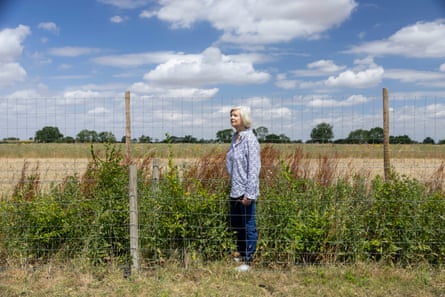
“I’ve forgotten more about this land than they are ever going to know, frankly,” declared Amanda Dixon, an elegant, white-haired woman. Dixon and her ex-husband used to own 1,000 acres of Boothby. She still lived on the fringes of the farm, in a converted cart shed, with 11 acres including a field of beloved sheep (hated by the rewilding movement). They had farmed the land well, she said: they innovated, raised yields and did what they could for nature. They planted 20,000 trees in small woods. On some of the better fields, they could grow four tonnes of wheat an acre, “which was then the holy grail of farming”. She felt the land’s productivity was being “talked down” by its new owners. “I do think it should be used for food because we’re going to have to feed ourselves.”
Still, she was persuadable. Thirty years ago, nightingales sang from the hedges of Boothby but they had vanished with the loss of bushy habitat. Dixon had told Burrell that she would forgive him for the loss of the farmland on one condition: he got the nightingales back.
2023
It was a wet autumnal evening in 2023 when I returned to Boothby. The barns were still rattling in the wind, bleakly. Two-thirds of the fields were now out of production; only 150 hectares would be sown with wheat for the final crop year, in 2024. The agronomist employed by the wildland to oversee its last crops had obtained yields of 9.2 tonnes of wheat a hectare (3.7 tonnes an acre) using 40% fewer “inputs” – ie, fertiliser – than the previous regime. “It turns out we’re quite good at farming this land,” said Lorienne Whittle, the new site manager based at Boothby.
The rewilders’ messaging had changed because locals had been angered by media portrayals (including my own) of this as nature-depleted but also rather rubbish farmland. “We have to be careful not to say this is bad land. This is resilient farming land,” said Whittle, although she also pointed out that they’d been lucky with the weather over the past two seasons, and the cereals had failed to make a profit in many recent years. (In 2024-25, British cereal farmers actually lost, on average, £27,400 on their crops; they only made profits because of subsidies and diversification – solar panels, barn rentals, farm shops.)
I met Boothby’s new ranger, Lloyd Park, at the door. Park was a passionate birder who had worked in traditional conservation for 14 years before switching to rewilding. “Ten years ago, I started thinking conservation has got to go in a different direction,” he said. He thought this could be it. Conservation tended to identify a special habitat, with a certain suite of species, and then micro-manage the land to preserve those species. Rewilding did not have a specific target, its mantra was to allow more natural processes to flourish, and celebrate abundance and whatever wildlife turned up.
As nice as that sounded, Boothby was also a pragmatic project. To earn income from BNG and other schemes, it had to deliver rising biodiversity as well as abundance, and so Park and the Boothby Wildland team were intervening to speed up restoration. Brash – dead tree branches – was being dumped in the middle of fields so birds perched there and their droppings sowed tree seeds. The riverbed would be filled in, so the stream would be forced out across its former floodplain, bringing water and life to the little valley. The team had also dug eight new ponds, funded in part by Network Rail, which was obliged to provide additional habitat for great-crested newts when its work damaged ponds elsewhere. Three PhDs were