Hague judges turned down a request for early release from Radislav Krstic, wartime commander of the Bosnian Serb Army’s Drina Corps, who is serving 35 years in prison for aiding and abetting the Srebrenica genocide.
 Lamija Grebo



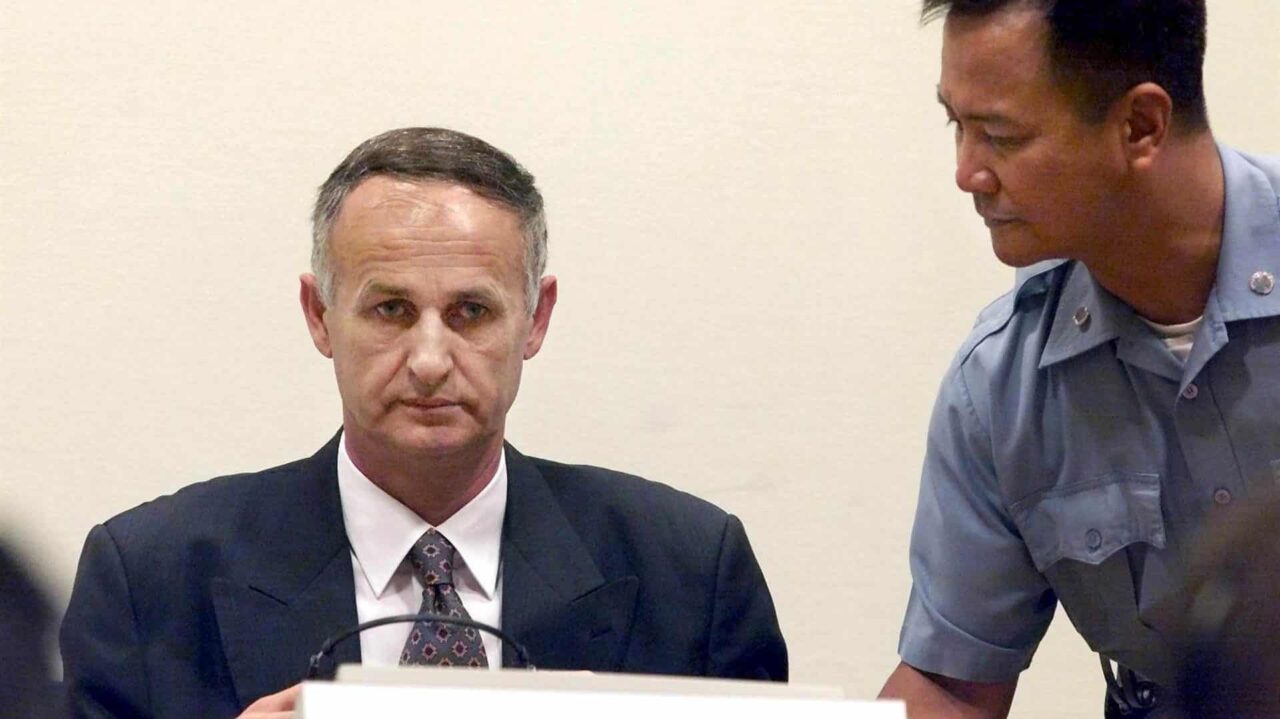
Radislav Krstic in the Hague Tribunal courtroom in October 2000. Photo: EPA PHOTO/REUTERS/POOL/FRED ERNST.
The International Residual Mechanism for Criminal Tribunals in The Hague has yet again rejected a request from Radislav Krstic to be freed from prison, citing his inadequate rehabilitation despite his public acknowledgement of his crimes.
“The high gravity of his crimes strongly militates against granting him early release and Krstic has not made a demonstration of rehabilitation commensurate with the gravity of his criminal conduct,” judge Graciela Gatti Santana, president of the International Residual Mechanism, stated in her decision.
Gatti Santana said she made the decision despite the fact that Krstic does meets the requirements to be considered for early release, having served two-thirds of his 35-year sentence.
She did however point to several important indicators of his progress towards achieving adequate standards of rehabilitation, including the fact that he publicly supported the adoption of a United Nations General Assembly resolution designating an International Day of Remembrance for the Srebrenica genocide.
Gatti Santana also pointed to the fact that Krstic has stuck to his admission of responsibility for the crimes for which he was convicted.
“I would encourage Krstic to continue reflecting on the events surrounding his convictions, his actions and inaction, as well as the impact of his conduct on the commission of the crimes, and to consider thoroughly whether there is any information that he could offer that would assist national criminal proceedings or the identification of the locations of missing remains,” the judge said.
Krstic’s letter to the court, in which he accepted responsibility for his crimes, acknowledged that he aided and abetted crimes against humanity through participation in a joint criminal enterprise to forcibly remove Bosniak civilians; that he participated in creating a humanitarian crisis that preceded the forcible transfer of women, children and elderly people from Srebrenica, knowing that civilians were being exposed to murder, rape and abuse.
“I accept the Tribunal’s verdicts from 2001 and 2004, which establish that the army forces to which I belonged committed genocide against Bosniaks in Srebrenica in July 1995, and that I aided and abetted the genocide by knowing that some members of the [Bosnian Serb Army’s] Main Staff intended to commit genocide,” Krstic said in the letter.
He also wrote that he would like to pay tribute the victims and “ask for forgiveness” if their families would allow it.
The Hague court has repeated has repeatedly rejected Krstic’s requests for early release, most recently in February 2025, citing inadequate progress towards rehabilitation.
In December last year, the Bosnian state prosecutor’s office also charged him with another offence – participating in an attack on the village of Novoseoci in the Sokolac area in September 1992, when he was commander of the Bosnian Serb Army’s 2nd Romanija Motorised Brigade.