Nearly 800 Russian logistics vehicles already knocked out and supply roads to Crimea and Donbas under constant drone attack. Some frontline units could run short of basic supplies by late summer.
 Tomáš Vasilko



Every day, the Ukraine Battlefield update newsletter offers a clear look at how the war is unfolding on the ground. Subscribe for free here to get the full text delivered to your inbox.
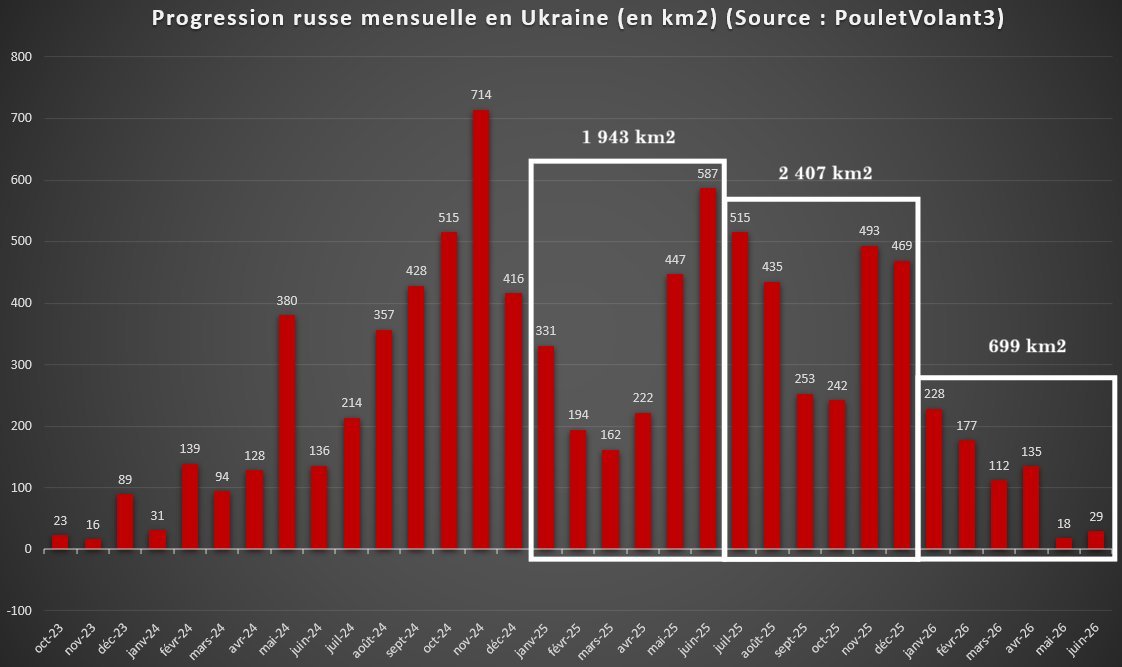
Ukrainians are trying to confirm a well‑known military proverb, as the number of successful attacks on trucks is rising. How Russia is trying to stop it, and why it is failing. Putin lives in an alternative reality and confused a Ukrainian river with a town in Russia. Ukrainians are attacking Russian space communication centres – what role they play. Map of the day: in the first half of 2026, Russia captured 70 percent less territory than last year. Videos of the day: sausages on the road after a Russian strike; a Russian truck driver runs away from a drone and another complains he has run out of fuel.
A well‑known military proverb says that battles are won by tanks, but wars are won by trucks. For example, the American general and later president Dwight Eisenhower wrote in his memoirs, that the five most important types of equipment for the US Army in the Second World War were the jeep, the armoured bulldozer, the 2.5‑ton truck, the amphibious car, and the C‑47 transport aircraft.
None of them was a combat vehicle.
It is precisely on trucks that Ukraine’s medium‑range drone campaign is focused on Ukrainian territory occupied by Russia. Although it has already lasted two months, Russia has not managed to stop it or even slow it down. On the contrary, it appears that Ukrainians are mounting successful attacks more and more frequently.
The French OSINT analyst Clément Molin focused on this topic. He recorded hits on 784 Russian military, cargo, tanker and other vehicles. He drew on videos filmed from drones and published by Ukrainian units. At present, they release on average three such compilations of footage per day.
The total number of Russian supply vehicles hit may be significantly higher than 800.
According to Molin, the tempo of Ukrainian attacks is increasing. While in May they published footage of seven vehicles hit per day, in June it was 19, and in the last ten days even 29.
“It shows that while the Russian army had enough time to adapt and implement defensive measures, it still lagged behind,” Molin wrote.
The Ukrainian military analyst Bohdan Myroshnykov also wrote that “the enemy is partially adapting”, but that Ukrainian units “continue to conduct effective attacks.”
Here is the video of the ~784 trucks and vehicles hit by the Ukrainians (mainly videos from the drones, since we can’t always tell the difference with ground footage).
Strikes target military trucks, fuel trucks, cargo trucks, cars, buses and trucks closer to the frontline. pic.twitter.com/SV3JSWp25v
— Clément Molin (@clement_molin) June 29, 2026
According to Molin, Russia is trying three ways to stop these attacks. Several videos have emerged showing that Russian forces send military vehicles with cannons along with trucks, intended to shoot down incoming drones. According to Molin, the strategy has proven ineffective. Many times Russian soldiers ran away from the scene of the attack, and when they did try to shoot down the drones, the drones were simply too fast for them.
The second method, which works partially, is the campaign of the Russian drone centre Rubikon, which tries to shoot down Ukrainian drones with interceptor drones. According to Molin, however, this is not enough and they can stop only a small proportion of attacks. The problem for Russia is that the area where the attacks take place is vast. Just one main road from the Russian border to Crimea is over 500 kms long.
The third measure is that Russia is trying to copy the attacks on Ukrainian logistics. However, it does not have similar medium‑range drones (above all the Hornet, although according to the Russian independent website Insider it uses a total of 14 types of drones), so it uses Gerans, which are expensive for such targets (they cost tens of thousands of dollars), and Russia does not have many of them. If they are used against such targets, there are not enough left to shell Ukrainian cities. This is one of the reasons why in June the number of such Russian attacks with Gerans decreased.
It is worth noting that according to the Russian think tank Conflict Intelligence Team, Russia is not trying to protect important roads with anti‑drone nets. Although these nets are far from one hundred percent effective and would still have to be constantly repaired, they provide a certain degree of protection. Ukrainians wanted to cover some 1,000 kms of roads up to 100 kms from the front in this way. Despite the ongoing attacks, Russia does not trust the nets.
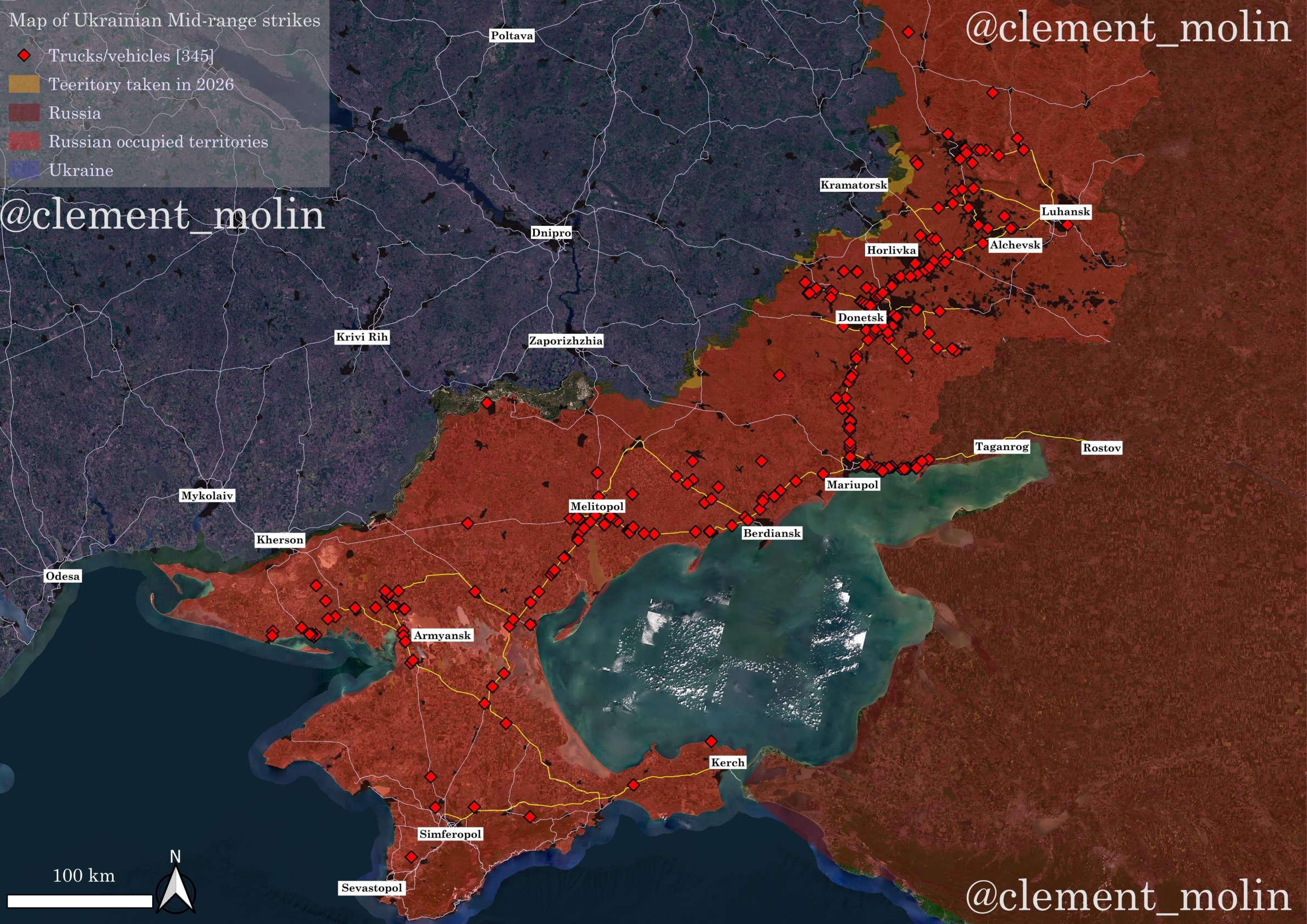
Where Ukrainians are attacking: Molin also published a map of 345 locations where attacks have occurred since the beginning of May. The main T‑280 road between Rostov‑on‑Don and Crimea remains the most frequent target. “There is no alternative road, and trucks and other vehicles continue to be targeted, especially around Melitopol and Mariupol. Alternate routes are also often targeted. Tanker trucks carrying fuel are the priority,” Molin wrote.
Source – Molin
Ukrainians are also attacking roads that serve to supply troops in Donbas. According to Molin, a total of 15 to 20 percent of the almost 800 vehicles hit were struck on these roads. He added that he examined only attacks carried out by medium‑range drones with a range above 20 kms; Ukrainians also attack closer to the front, where they are also hitting logistics.
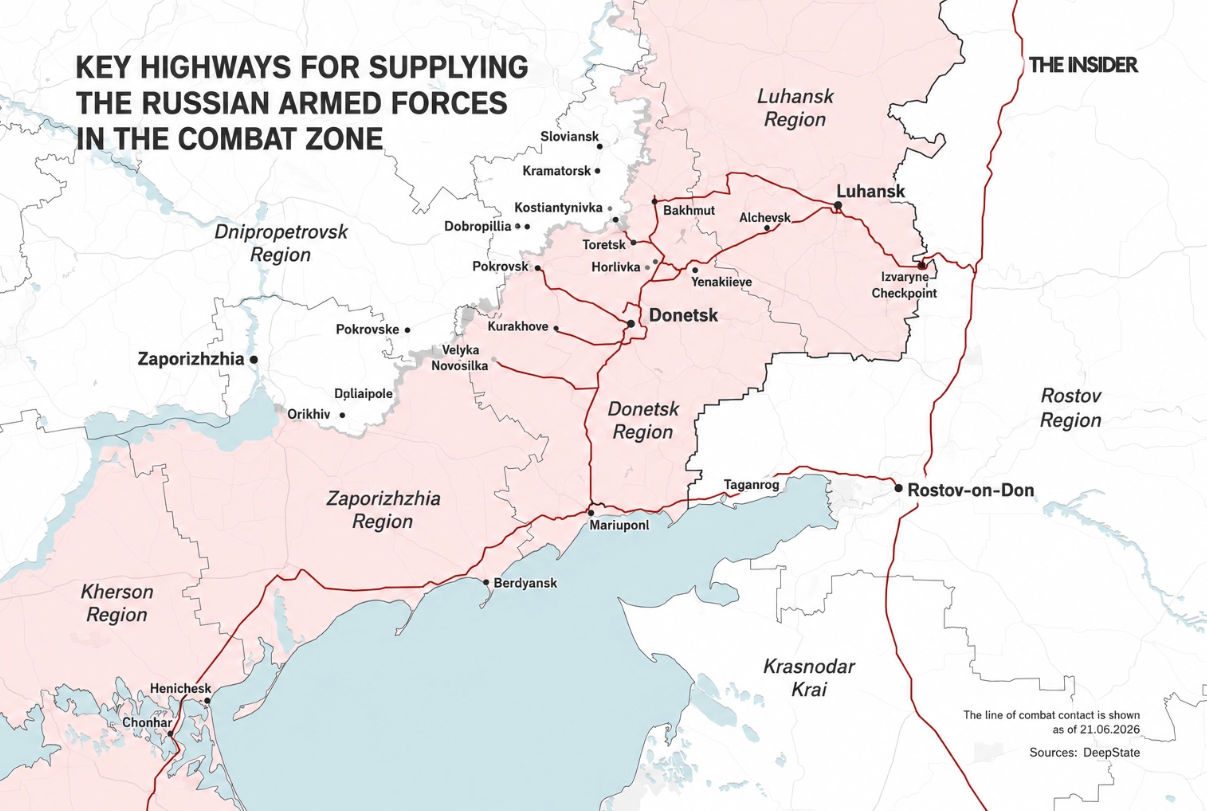
The Russian independent website Insider wrote that one of the most important logistics hubs for Russian forces remains the city of Luhansk. Supplies for troops attacking Kostyantynivka and in the direction of Sloviansk and Kramatorsk go out from there.
“For this reason, Ukrainian strikes on targets near the Izvaryne checkpoint, a border crossing located on the road from mainland Russia to the occupied city of Luhansk, had a significant impact on the fighting along the Lyman axis,” Insider wrote. An important supply route for the attack on Kostyantynivka leads through the towns of Yenakiieve and Horlivka.
Important Russian roads. Source – Indsider
How this will be reflected at the front: The question is how this will affect the supply of the Russian army. Clément Molin wrote that the first results of this strategy were already visible, as the southern front is essentially frozen for Russia. “The Russian offensive near Hulyaipole has slowed down and Russian units are gradually being pushed back along the entire front between the Dnipro river and Novopavlivka,” he wrote.
The Finnish analyst Joni Askola takes a somewhat more sceptical view. He wrote that it will take months before the “logistic lockdown”, as the Ukrainian defence minister called it, starts to manifest itself at the front.
“Kremlin still possesses an extensive logistic network that consists of thousands of trucks and railway trains. Russian units at the frontline can also draw from extensive stockpiles. Not even a perfectly executed campaign against logistics can magically empty these depots in a few weeks. When August or September comes, months of continuous pressure will likely cause some Russian units to struggle to secure basic supplies,” he wrote.
What impact this will have remains to be seen. For now, it can be said that Russia does not know how to stop these attacks.
Putin in an alternative world. Russian president Vladimir Putin again commented on the situation on the battlefield and, as many commentators noticed, he is somewhat detached from reality. The most amusing moment came when he confused the Oskil river (in Russian Oskol) with the Russian town of Stary Oskol.
In an interview for Vesti he commented on the situation on the left bank of the Oskil river near Kupiansk, where Ukrainians are indeed under Russian pressure and are in danger of having to withdraw to the other bank.
“On the left bank of the Stary Oskol river there is a mixed enemy grouping of about 5,000 troops, which our units have effectively blocked. It has been pushed back to the river,” Putin said, according to NV.
The problem is that the Stary Oskol river does not exist. What exists is the town of Stary Oskol – but it is located on the territory of the Russian Federation, far from the front. We are more used to this kind of geographical slip from the last two US presidents, but in Putin’s case it should also be added that he is of advanced age (he will turn 74 in October).
The problem is not so much one slip as other things that show that his generals are putting completely different maps on his desk than those used by independent analysts. Clément Molin checked Putin’s individual statements.
“Putin claimed that Russian forces were supposed to be 10 kms from Sumy (in reality they are 19 kms away). Allegedly, Ukrainian counter-attacks near Kupiansk failed (the town is predominantly under Ukrainian control). Most of Lyman was supposed to be under Russian control (the town is under Ukrainian control). Russian forces were supposed to be 8 kms from Sloviansk (in reality 14 kms). Russian forces had allegedly reached Dobropillia (they are 10 kms from the town) and there were supposed to be no defensive lines behind it (there are four). Russian forces were advancing on wide stretches of the front in Zaporizhzhia (in reality, they are advancing very slowly on small sections of the front, while Ukrainians have the initiative everywhere else in the south).”
A current example of embellished advances can be seen on the Dnipropetrovsk axis. According to the Russian channel Rybar, the Vostok group captured three villages in three days: Novoselivka, Pysantse and, on Monday, Bohodarivka. It then allegedly pushed close to the town of Pokrovske.
This is how it looks on Rybar’s map; the area in question is in the middle on the right.
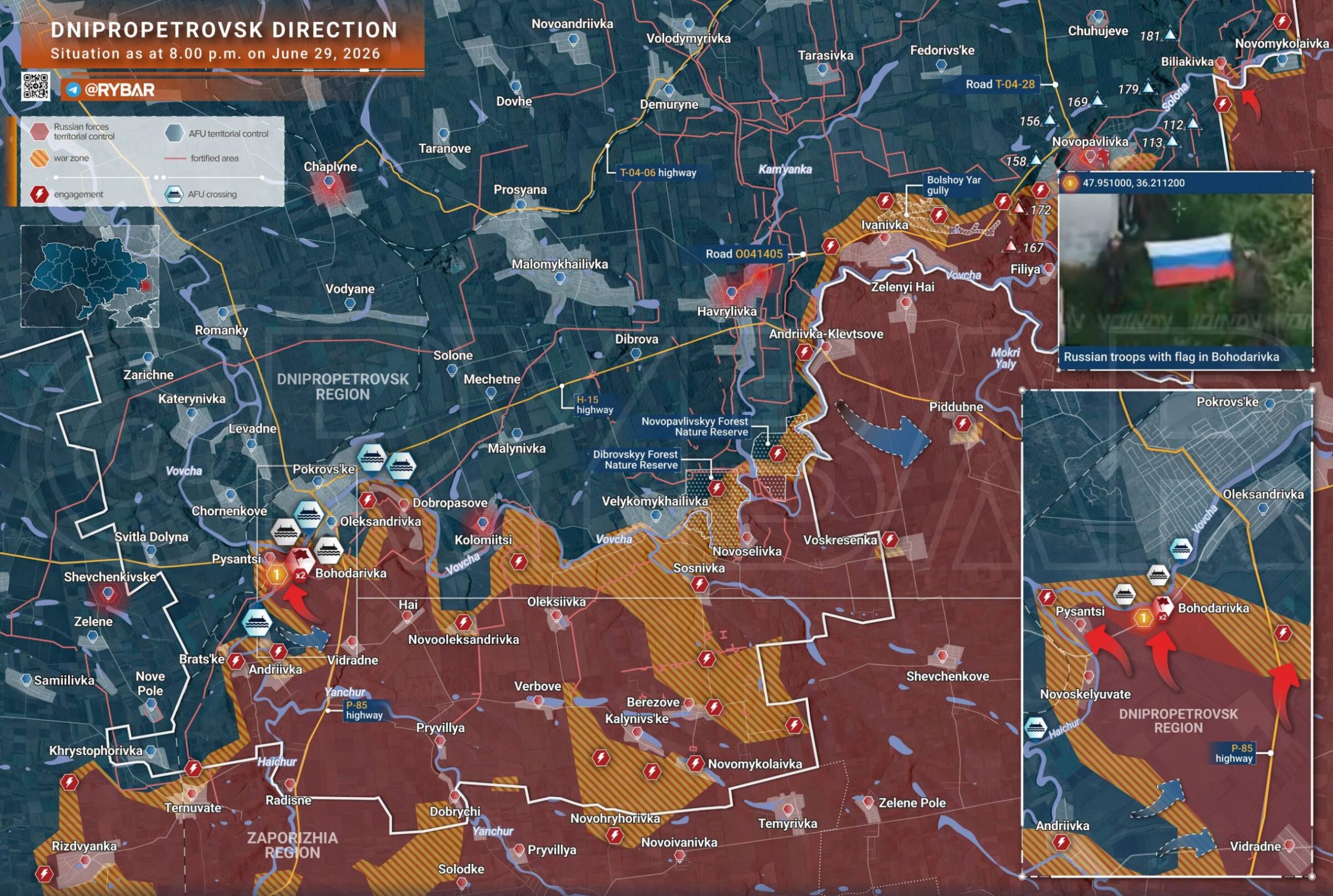
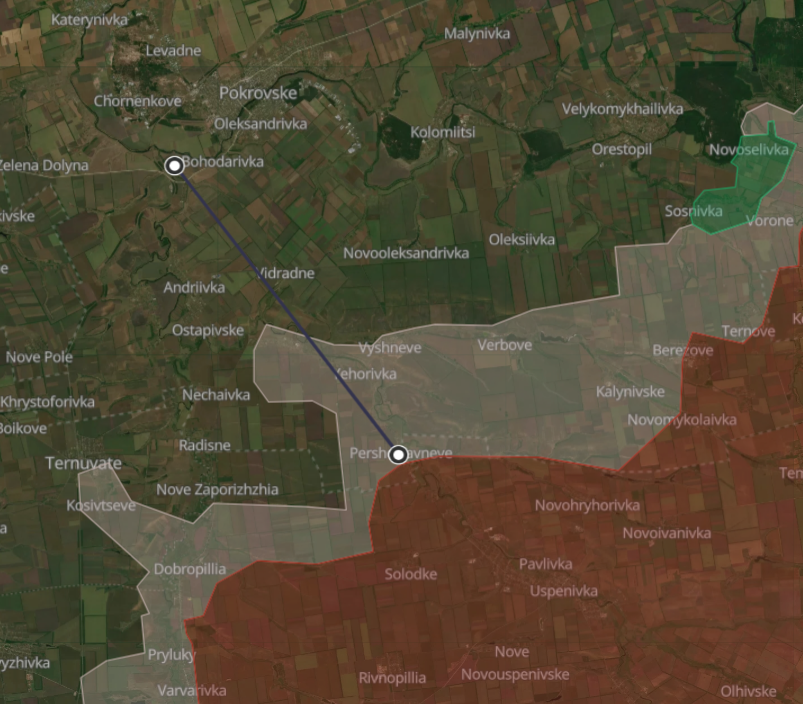
The problem, however, is that these maps are markedly different from those published by the Ukrainian account DeepState UA or the Finnish analytical group Black Bird Group. The difference is about 16 kms.
Source – DeepState UA
However, Putin needs good news to convince domestic audiences that Russia is still winning the war and to counterbalance reports of Ukrainian long‑range drone strikes on Russian cities.
Ukrainians are attacking Russian space centres whose task is to communicate with Russian satellites. In recent days they have repeatedly attacked the Vladimir centre and, most recently, Dubna, which is located north of Moscow.
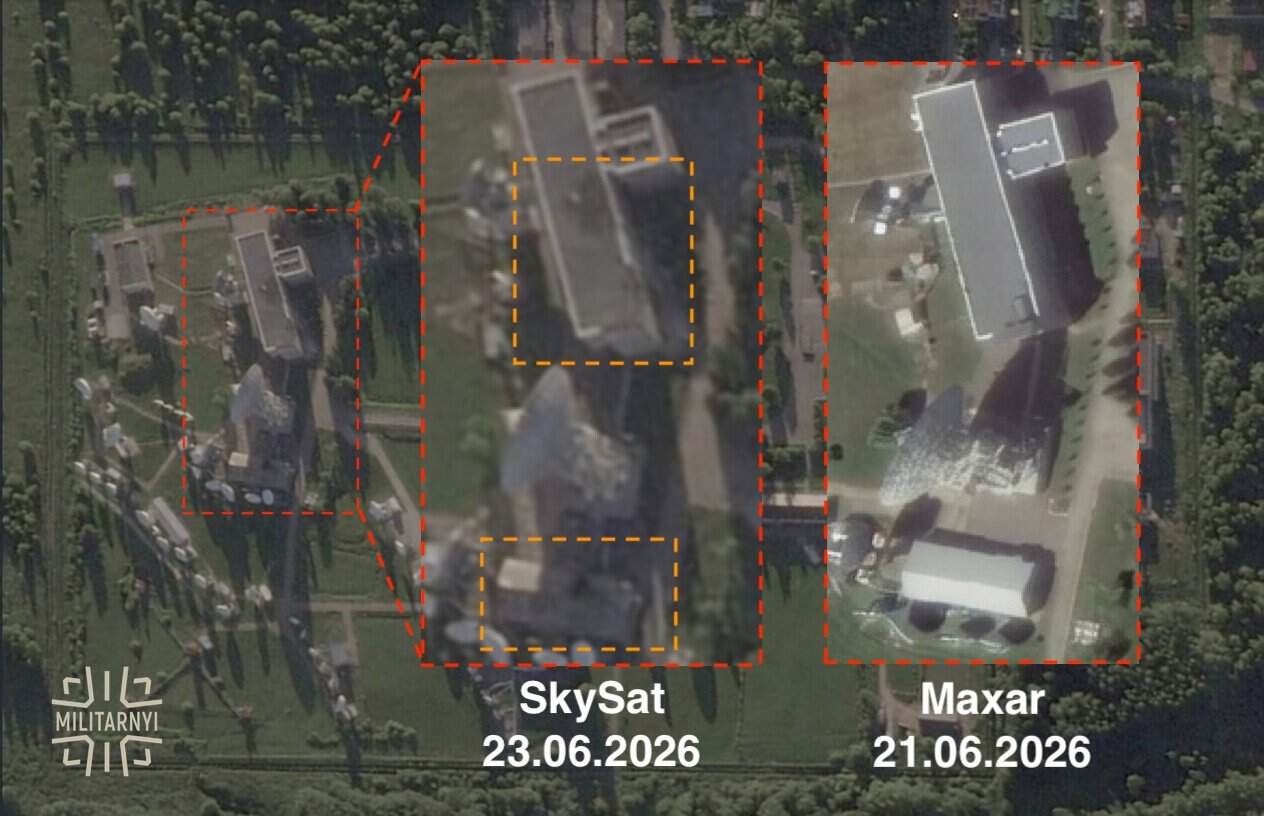
On Tuesday morning, they hit the Russian space communication centre Dubna for the third time. Smoke was seen rising from the area, which indicated a successful strike. Last week Ukrainians demonstrably damaged this centre when they hit the main building, where the control centre is located.
Satellites showed damage to the Dubna centre. Source – Militarnyj
Serhiy Beskrestnov, an adviser to the Ukrainian defence minister, commented on the role of these space communication hubs. Russia has a large number of satellites in low and high orbits: communication, reconnaissance and others. They serve both civilian and military purposes.
“However, all satellites need a communication channel with Earth. Some satellites require control, while others need a stable channel for data transmission to ground users. To perform these tasks, space communication hubs (centres) are deployed on the territory of the Russian Federation. There are five main centres,” he wrote.
The Dubna centre has existed since 1980 and, according to the website Militarnyj, it is one of the largest in Europe.
According to Beskrestnov, the hubs are equipped with large satellite dishes. “Some of the dishes are fixed and aimed at geostationary satellites, while some can rotate in order to communicate with satellites flying in low Earth orbit,” he wrote.
According to him, the attacks have partially achieved their goals. According to analysts at CIT, Ukraine’s aim may be to prevent Russia from launching its own space-based internet similar to Starlink.
Graph of the day
In the first half of 2026, Russia captured only 699 square kms of Ukrainian territory. This was reported by Clément Molin, who published these data one day before the last day of June. In June, according to him, Russia advanced by a net total of only 29 square kms.
As for the overall advance in 2026, it is 70 percent slower than in 2025 (2,407 square kms). This confirms that Russia is failing to get the front moving.
Source – Clément Molin/PouletVolant3
Videos of the day
We mentioned that Russia is also trying to restrict Ukrainian logistics. Here we can see how it hit a refrigerated truck that was transporting processed meat products. The road is strewn with sausages and other meat products.
Meanwhile, the Russians hit a Saltivskyi Meat Processing Plant truck on the Kharkiv-Sumy highway. The road is littered with sausages and other meat products. They said there were biological weapons in Ukraine. So is this it? pic.twitter.com/5F3qu0pGfq
— WarTranslated (@wartranslated) June 29, 2026
Truck and lorry drivers currently have one of the most dangerous jobs in Russia (after soldiers). This footage shows a drone strike; the driver manages to escape from the vehicle.
Here the driver is complaining that he has run out of fuel and had to park his truck on the roadside.
What the are losses
On Tuesday without an update
By Monday (29 June), Russia had demonstrably lost 23,703 pieces of heavy equipment (on Tuesday (23 June) it was 23,668). Of these, 18,686 (18,652) pieces were destroyed by Ukrainians, 988 (987) were damaged, 1,199 (1,199) were abandoned by their crews and 2,830 (2,830) were captured by the Ukrainian army. This includes 4,407 (4,404) tanks, of which 3,310 (3,307) were destroyed in combat. Ukraine has lost 11,629 (11,546) pieces of equipment, of which 9,068 (9,011) were destroyed, 687 (687) damaged, 683 (677) abandoned and 1,191 (1,189) captured. This includes 1,437 (1,433) tanks, of which 1,099 (1,097) were destroyed in combat.
Note: Neither side regularly reports its dead or destroyed equipment. Ukraine publishes daily the numbers of Russian casualties and destroyed equipment, but these cannot be independently verified. In this overview, we rely on data from the Oryx project which since the beginning of the war has compiled a list of equipment losses documented exclusively by photographic evidence.