Two sides agree to try to make bilateral relationship ‘more balanced’ after weeks of threatsThe EU and China have agreed to enter three months of talks to try to avoid a trade war over the bloc’s €360bn (£310bn) annual import/export imbalance.In their first joint statement in seven years, the two
 Lisa O’Carroll



The EU and China have agreed to enter three months of talks to try to avoid a trade war over the bloc’s €360bn (£310bn) annual import/export imbalance.
In their first joint statement in seven years, the two sides agreed in Brussels to open a formal trade consultation after weeks of threats and recriminations from China if the EU imposed any measures to stop the flood of goods and components into the bloc.
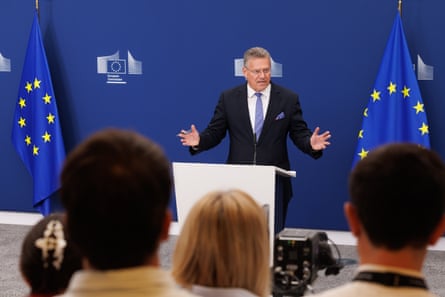
The EU’s trade commissioner, Maroš Šefčovič, said he hoped the “dialogue would bring tangible results” before the next meeting in Beijing in October.
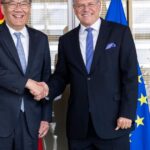
He met his Chinese counterpart, the commerce minister, Wang Wentao, for talks on Monday as part of a diplomatic offensive.
They said in a joint statement: “The EU and China as key trade partners, agree that the main objective of the TIC [trade and investment consultations] is to strengthen dialogue at ministerial level on trade and investment policies with the view to stabilise and make our bilateral relationship more balanced.”
EU leaders met two weeks ago to discuss concerns over what is now widely being described as China Shock 2.0 – a threat to European industries and jobs that extends far beyond electric vehicles and green energy.
Eurostat, the EU’s statistics agency, said on 15 June that Chinese exports to the EU outweighed imports from the bloc by €1bn a day.
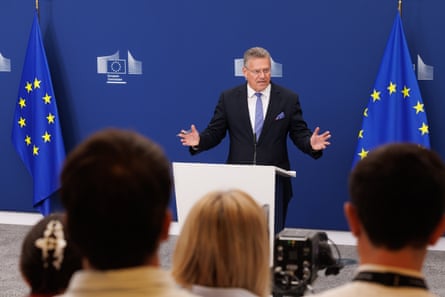
“We simply cannot afford to continue in the unsustainable growth of the trade deficit from the European perspective,” said Šefčovič. “We just didn’t want to wait too long. You hear it from European leaders, you heard it from the president of the European Commission, that what is very important for us is engagement, it’s dialogue. But it has to bring tangible results, and we believe that we can achieve them by October.”
Industry groups including the European Chambers of Commerce in China say the level of exports going to Europe is threatening to “cannibalise” EU factories heavily reliant on components from China.
The two sides have agreed to enter into consultation on four areas: the rebalancing of trade and investment; export controls including those on rare earths; intellectual property rights and World Trade Organization reforms.
They have also agreed to a joint monitoring mechanism going beyond the headline figures recorded by Eurostat and GACC, the Chinese customs database.
This will enable both sides to identify sudden surges in exports or imports with “political” discussions triggered should either side go into an “amber or red” danger zone, said Šefčovič.
It is understood the European Commission has been mapping in fine detail the imports and exports data for the past year, suggesting that the three months of talks will focus on political dialogue.
The EU has adopted a cautious approach after its 2024 imposition of tariffs failed to curb imports of EVs, with sources saying quotas on hybrids and chemicals could be mooted for the autumn.