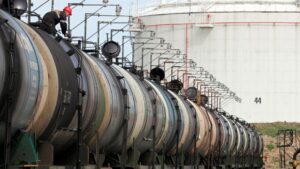
Ukrainian drones and missiles torch Russian oil depots and arms plants. Putin is scrambling to stop fuel queues snaking through Moscow.
 Roman Pataj



Every day, the Ukraine Battlefield update newsletter offers a clear look at how the war is unfolding on the ground. Subscribe for free here to get the full text delivered to your inbox.
Tanker trucks versus filling stations; systematic approach versus one-off strikes and the battle on the railways.
Putin admitted the problem of fuel shortages, promised a solution, but has failed to find one even in Moscow.
Russia is strengthening Moscow’s air defences. It is possible they are preparing for the deployment of Ukrainian ballistic missiles. Flamingo has again struck a Russian arms plant that also produces Iskander components, plus an explanation of how and where this missile attacks. New footage from Voronezh shows previously unknown damage and the near-total destruction of an entire factory. Ukraine lost two MiG-29 aircraft in a single day. Rai-Oleksandrivka has not been captured; fighting is still ongoing there, but Russian troops have already been to its west. Russia claims to have captured Novoselivka in the Zaporizhzhia sector; this is not true. Maps of the day – reinforcing Moscow’s air defences with S-400 systems; how the Flamingos attack; the battle for Rai-Oleksandrivka. Videos of the day – another refinery burned over the weekend; an air strike on a factory in Volgograd; an attack on a Ukrainian MiG-29 at an airfield; elimination of a Russian flag-raising operation in Novoselivka; a visualisation of the port and shipyards in Kerch in Crimea; a new tactic by Russian drone operators.
Tanker trucks versus filling stations; systematic approach versus one-off strikes, and the battle on the railways. While the Ukrainian army is decimating Russia’s vehicle fleet, focusing mainly on tanker trucks, and simultaneously attacking bridges in Russia’s rear, the Russians, in their attempt to respond, are choosing different targets. The aim, however, is the same: to deprive the Ukrainian army of fuel and logistics.
War is rarely a one-way affair, and in a long conflict like this one, the adversaries constantly try to respond to each other’s innovations.
Today’s Ukraine Battlefield update will first look more closely at what the Russians are doing differently, what they are trying to copy, and how successful they have been. A simple visual comparison is possible – while Russian cities are clogged with km-long queues for fuel, nothing like that is visible in Ukraine. That does not mean this is a final state of affairs.
While the Ukrainians are trying to achieve a situation in which Russian filling stations have nothing left to sell, the Russians have started working in frontline-adjacent areas to make sure the filling stations cease to exist. The Russian military channel Rybar, for instance, claimed that on Sunday alone Russian drones hit 10 filling stations.
The consequences tend to look like this one in Sumy region:
Or like this one in Dnipropetrovsk region:
“In response to our attacks on logistics facilities, the enemy has decided to destroy all our frontline filling stations,” wrote Serhiy Sternenko, an adviser to the Ukrainian defence minister. He said the Russians were using Gerans as well as smaller types in the attacks, deploying them in Dnipropetrovsk, Sumy and Kharkiv regions.
The Ukrainian army is largely independent of commercial stations, so according to Sternenko this is a potential problem for civilians.
“Will residents be left without petrol? Of course not. We are Ukrainians, after all – we will find a way to organise the logistics, distribution and sale of fuel, and how to refuel,” he reassured.
In addition, the Russians have stepped up attacks on Ukrainian railways. The following compilation shows attacks on locomotives in Zaporizhzhia and Kharkiv regions. Two of them tried to hide under a road bridge.
26/6/2026 – The operators of the “Geran-2 Sikher” UAVs launched strikes on the railway infrastructure, used in the interests of the Armed Forces of Ukraine.
💥 Destroyed
▪️ two locomotives, hidden under a road bridge in the city of Zaporizhia,
▪️ three locomotives, located on… pic.twitter.com/4JV8ExP4ta
— John Spectator (@johnspectator) June 27, 2026
“According to the defence ministry, another three trains were hit on one of the rail sections between the villages of Malynivka and Lozova, which is one of the main rail hubs for so-called Ukraine,” the Russian Rybar channel rejoiced (calling Ukraine “so‑called” is common among Russian accounts).
Aside from the increased number of attacks on the railway, it also welcomed the fact that the Russian defence ministry had started publishing “an ever-greater number of footage from objective control, which is a breath of fresh air, because previously the defence ministry generally only reported on the hitting of particular targets.”
At this link you can find more videos from the Russian defence ministry.
The railway, however, is also a target on the other side. This week, the Ukrainians destroyed a railway bridge between occupied Luhansk and Donetsk, and this map shows the locations of railway attacks in 2026 in this area alone.
Train attacks in 2026 highlighted with red train icons.
Green GPS icon is today’s attack.
Red Line is inoperable occupied Ukrainian rail line
Purple line is the front
Green lines are currently operational occupied Ukrainian rail
Black are other miscellaneous rail lines. pic.twitter.com/Q83DijDoe4
— Intelschizo (@Schizointel) June 29, 2026
Systematic attacks on bridges in southern Ukraine and in Crimea are making life very difficult for the Russians. They are trying to do the same, but as Rybar wrote, the results are dubious.
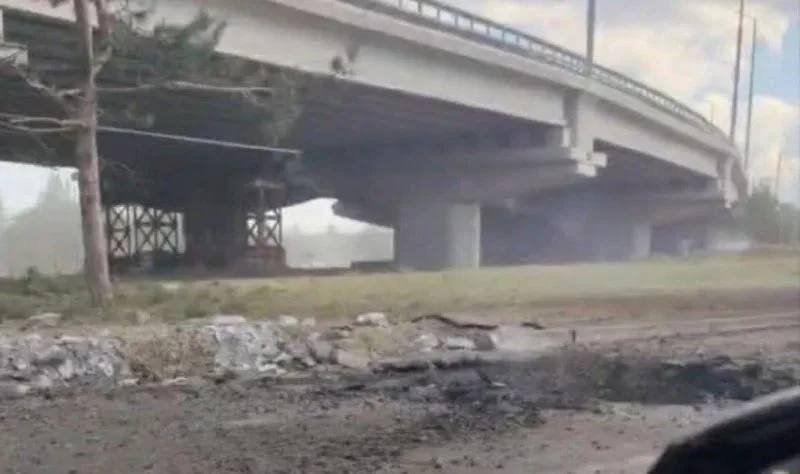
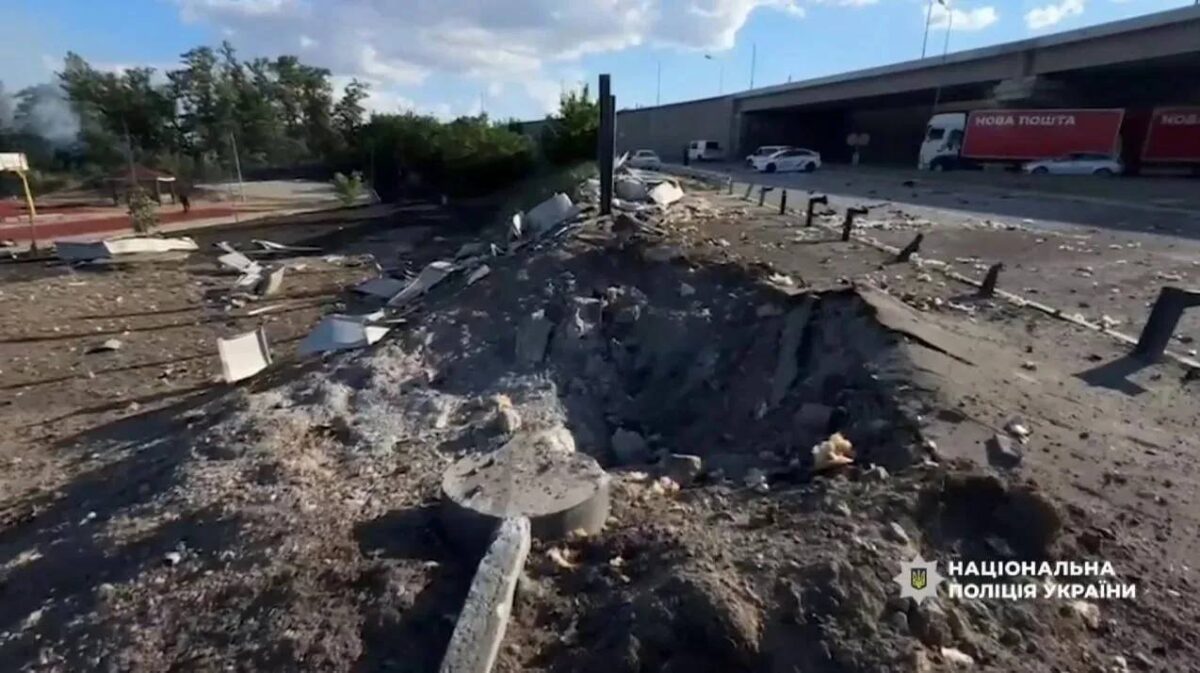
He looked at the bombing of one of the bridges in Zaporizhzhia, about 30 km from the front line. It took place on 20 June and, judging from satellite imagery and photographs from the scene, “not one of the five bombs hit the bridge directly, there was no serious damage, and the attacks have not been repeated since.” He contrasted this with repeated Ukrainian strikes against several bridges.
Rybar criticised that if the goal was to respond to the Ukrainian campaign in Crimea, the response was clearly inadequate. He illustrated this with two photographs showing the remarkable inaccuracy of Russian bombs, which missed the bridge by dozens of metres. This was very likely the result of effective electronic jamming:
Putin admitted the problem of fuel shortages, promised a solution, but has failed to find one even in Moscow. The fuel shortage in Russia “is not critical”, the Russian dictator declared in an interview on Sunday evening. It lasted just under half an hour and, according to the independent Russian website Meduza, president Vladimir Putin said that an important measure to overcome the current problems was to be “a rapid and substantial increase in the production of the most in-demand air-defence systems”.
It sounded like a rather desperate promise. First, Putin thereby admitted that the Russian army did not have enough air-defence systems, and second – their production would take far too long to have any impact on the current crisis. Moreover, each system needs a trained crew, which the Russians cannot conjure up overnight.
Naturally, the Ukrainians are making full informational use of Russia’s problems as well. On Friday evening, their army published an “advent calendar” of attacks against the Russian oil industry during June. Before the weekend there had been 27 of them. Over the weekend came another, highly successful one in the Russian town of Slavyansk in Krasnodar region. Footage can be found in the Videos of the day section.

In the meantime, an endless stream of videos continues to arrive from all over Russia, showing many-hour queues at petrol stations. This also applies to Moscow, which is crucial for the regime.
Jaroslav Trofimov, chief foreign correspondent of the WSJ and a Russia expert, noted on Monday morning: “I’m really surprised the Kremlin has been unable to fix the fuel crisis in Moscow. Yes, the fuel shortages are a consequence of Ukrainian attacks on refineries across the country. But politically, only Moscow matters, and yet Russian social media are full of frustrated Muscovites reporting on their long and often unsuccessful attempts to fill up. Putin personally promised yesterday to resolve the fuel crisis.”
The following video is not from Moscow but from Zabaykalsk, yet it shows that the problems have seriously affected freight transport as well, not just private cars.
Настоящий бензиновый апокалипсис в Забайкалье. На трассах в районе Шилки — гигантские километровые очереди из фур и легковых авто. Люди ночуют у АЗС и стоят по 6–8 часов ради 30 литров бензина. Власти региона уже ввели режим повышенной готовности из-за дефицита, но заправки… pic.twitter.com/XKiT92znRZ
— Политик по приколу (@NaSutkiOdessa) June 27, 2026
Russia is strengthening Moscow’s air defences. It is possible they are preparing for the deployment of Ukrainian ballistic missiles. Western sources reported that the Russian army was moving new S-400 air-defence systems to Moscow, and the Russian Telegram channel Military Correspondent commented on this.
Specifically, it commented on this satellite image, which marks five locations in the south-west and north-east of the capital where these weapons are being deployed:
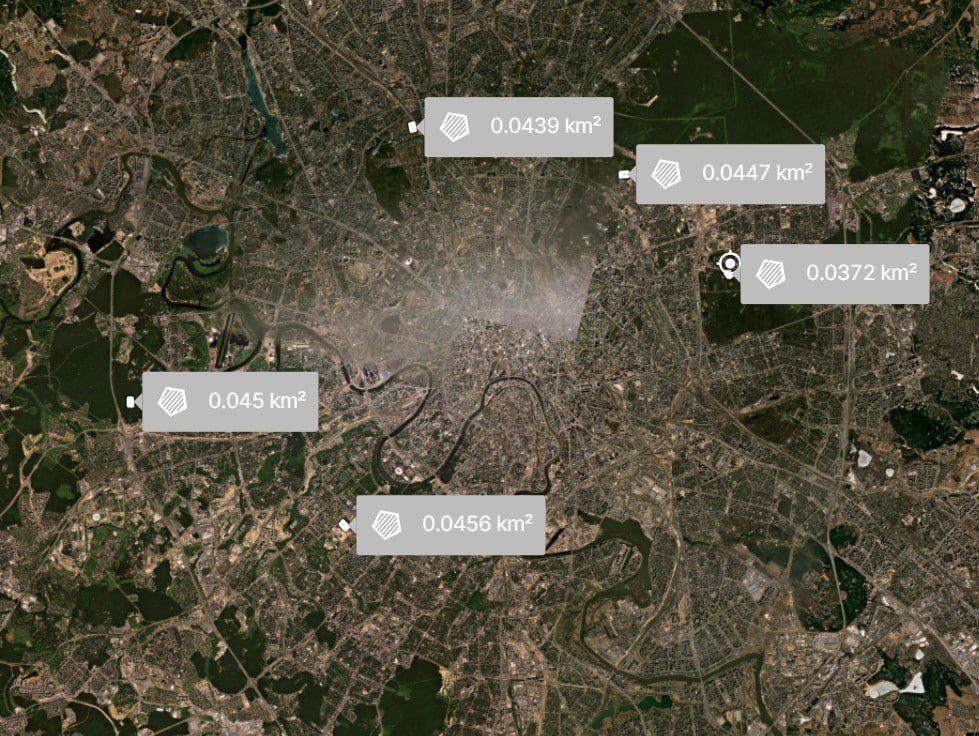
Military Correspondent wrote that in some of the images it was already possible to see vehicles that form part of this weapons system.
“The construction of new positions for these air-defence systems is probably driven by fears of possible future attacks by Ukrainian FP-9 ballistic missiles, which are currently undergoing tests,” the author added.
The Ukrainians are indeed speaking openly about the fact that this weapon is currently undergoing tests of its solid rocket fuel. “This month we will test the engine and expect the test flights to begin soon. As soon as the test flights show that everything is working correctly, the next flight will be directed at Moscow,” said Denys Shtilerman, co‑founder and designer at the company Fire Point.
The FP-9 has a range of 855 km and, at seven times the speed of sound, can carry an 800‑kg warhead with an expected circular error of 20 metres from the target. If the Ukrainian company really manages to get the missile into serial production and it meets the stated parameters, the Ukrainians will have independently acquired a weapon they badly lack, which in some respects will even surpass the American ATACMS missiles.
Flamingo has again struck a Russian arms plant that also produces Iskander components, plus an explanation of how and where this missile attacks. Until the Ukrainian army receives FP-9 missiles, its most powerful means of long‑range attack is the FP-5 Flamingo cruise missile.
Although it is an emergency solution, it is beginning to cause damage to the Russians, which may partly be due to the exhaustion of their air defences. Over the weekend, probably three of these missiles hit the Titan-Barikady arms plant in Volgograd. The next video is a clear example that the Flamingo’s one‑tonne warhead can, on impact, cause much more damage than drones with warheads of 50 to 200 kg. In the fourth second you can see a Flamingo coming in from the right, and in the sixth second the ensuing explosion.
Under the video there is a photograph showing the aftermath of the strike. It shows a destroyed factory hall. The plant is one of two that produce Iskander launchers.
On this occasion, the OSINT account Oko Hora compiled a map of known FP-5 uses. All of them lie in the immediate vicinity of the large rivers Volga and Kama, whose riverbeds the Flamingos use to fly at minimum altitude, allowing them to slip under air-defence radars.
🦩 If you plot all successful “Flamingo” strikes in 2026 on a map, an interesting pattern emerges.
All 7 targets were located along reservoirs and the rivers of the Volga and Kama.
River channels effectively provide a “free” way to avoid dealing with terrain elevation maps and… https://t.co/98b2m9UPaA pic.twitter.com/CzrCDj0uZ5
— Oko Gora (@oko_gora_tg) June 27, 2026
New footage from Voronezh shows previously unknown damage and the near-total destruction of the entire factory. The choice of the Volgograd plant was no coincidence, and it was no coincidence that it came shortly after the strike on the arms factory in Voronezh. Both produce components for Iskander missiles, which cause the greatest difficulties for Ukrainian air defences. It seems the Ukrainian army is trying at least partially to solve the problem by making it harder for Russia to manufacture new Iskanders.
In Voronezh this was done more effectively than it first appeared in the first half of last week. Part of the damage is revealed by new videos from local residents, which do show the building known to have been heavily damaged, but in more detailed shots it is clear that floors which appeared less damaged are also almost completely destroyed.
Shortly after the air raid there was already talk that the Storm Shadow missiles had probably hit not one but two buildings. Satellite images confirmed this. In the videos above there is a long, narrow building, which you can see in the top right of the photograph. In its centre there is a large hall that is not visible in the ground footage because it is hidden behind other structures. It was also hit by at least two, but more likely three, missiles. The damage inside the factory hall is certainly greater than the view from space suggests.
The strike on Voronezh is an illustration of the capabilities of precision-guided weapons. They hit their targets with perfect accuracy without causing damage to the surrounding civilian buildings.

Ukraine lost two MiG-29 aircraft in a single day. On Saturday, the Ukrainian air force suffered serious losses. First, it lost a MiG-29 in the air during a combat mission. The pilot ejected safely. It is not known whether this was due to a technical malfunction or whether the aircraft was shot down. The well-known Russian aviation channel Fighterbomber noted the loss, but did not write anything to suggest that the missing fighter had been shot down.
In addition, the Ukrainian air force lost another aircraft directly on the ground while it was being prepared for a combat sortie. The Russians destroyed it with a drone. MiG-29s perform both fighter and bomber missions. The footage is not of sufficient quality, but it appears that this particular aircraft was being prepared for a fighter mission. Under its wings it probably carried two medium-range R-27 missiles and four short-range R-73s. It is almost certainly one of the aircraft donated by Poland.
✈️🇺🇦🕯️ Nikolaevsky Vanek: It’s been a crappy morning for our Air Forces today.
One MiG went down, the reasons are unclear.
One MiG was lost because of their own incomprehensible, delayed decisions and reactions. And by the time they realized their mistake, it was already too… pic.twitter.com/6noYSWTQgm
— MAKS 26 🇺🇦👀 (@Maks_NAFO_FELLA) June 27, 2026
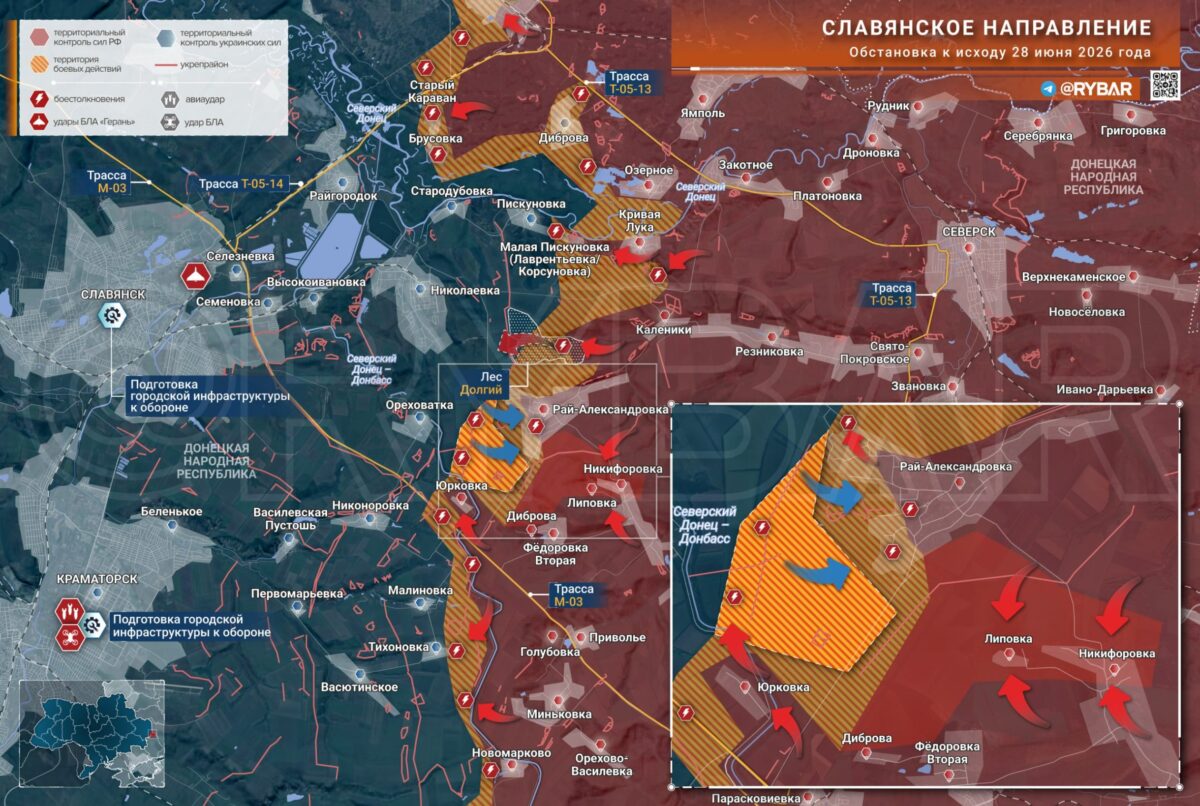
Rai-Oleksandrivka has not been captured; fighting is still ongoing there, but Russian troops have already been to its west. “Soldiers of the Russian armed forces are actively clearing the centre of the village of remnants of the Ukrainian armed forces,” the Russian Rybar channel wrote on Sunday evening, even though the Russian defence ministry and Z‑channels had reported last week that this important village on the Sloviansk axis had been captured.
However, Rybar also reported on fighting west of the village, and he was right. Ukrainian analyst Petrenko confirmed that a Russian soldier had been recorded just 8.35 km from Sloviansk. Videos from Russian sources prove it. On Petrenko’s map this location can be seen far to the west of Rai-Oleksandrivka, which is entirely in the grey zone.
The same author, however, also considers claims about an imminent assault on Sloviansk to be exaggerated: “In the era of mass drone use, no one will launch an offensive on a narrow section. If the situation at the front does not change, the battle for Sloviansk will not begin before mid‑2027.”
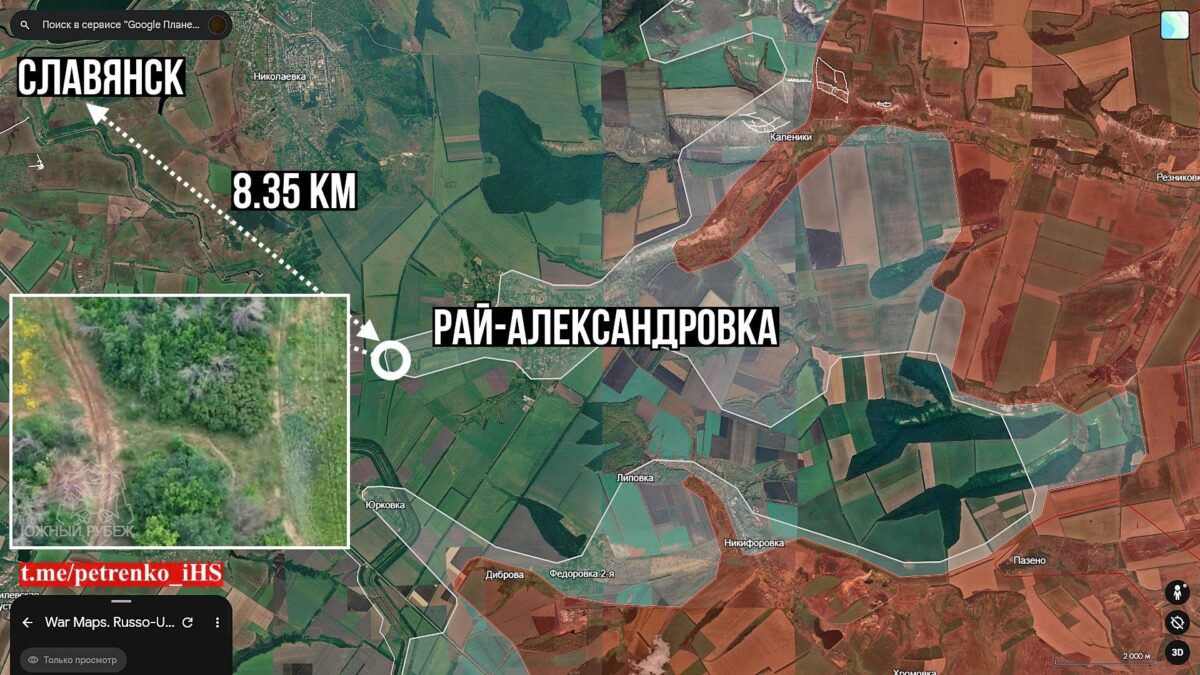
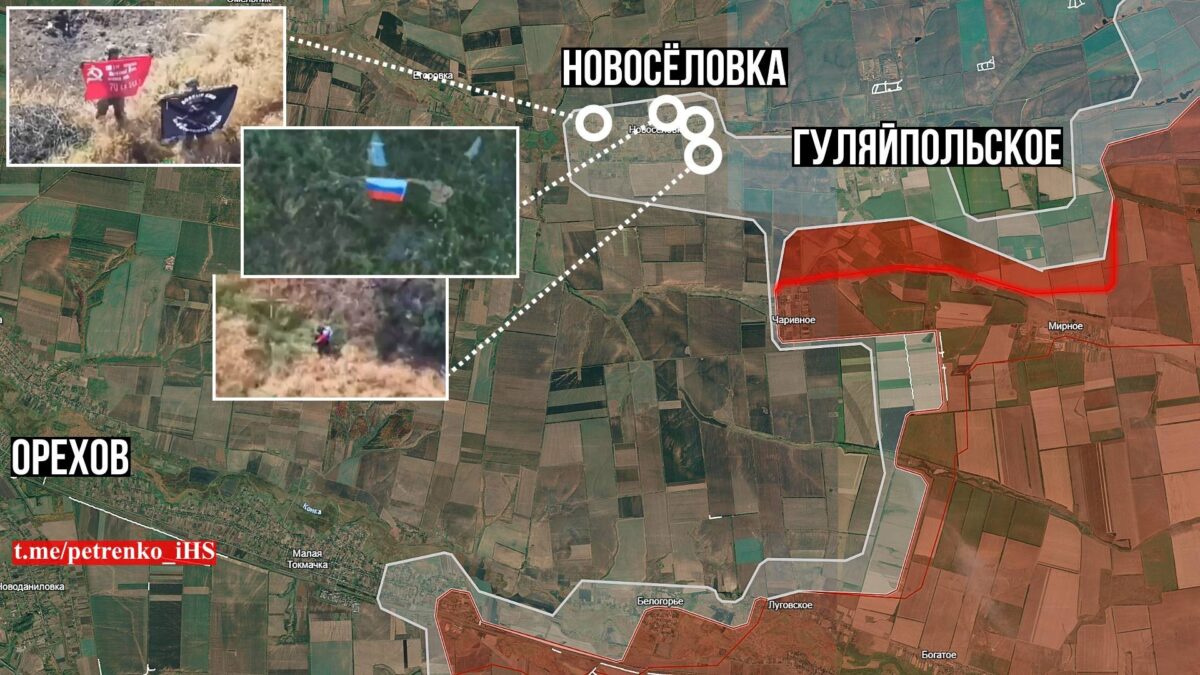
Russia claims it has captured Novoselivka in the Zaporizhzhia sector; this is not true. They base this on footage of their soldiers, filmed by drone as they display their flags. Ukrainian units then published footage showing these individuals being eliminated. Nevertheless, the Russians continue to claim they have captured Novoselivka. Warning! The footage in the following compilation is explicit.
Another example of why to never believe flags.
Most often than not they’re simple infiltrators that carry and show to the friendly drone their flags, and just like other infiltrators they’re often eliminated, wounded, forced to fall back or, as we see in… pic.twitter.com/cNC6u9yVQc
— Playfra (@Playfra0) June 29, 2026
The map is again by Ukrainian analyst Petrenko, who marked on it the locations where the Russians showed their flags.
Videos of the day
The refinery in Slavyansk after the weekend air raid.
An interesting visualisation of the port and shipyards in Kerch, Crimea. At the end you can notice a pair of ships in dry dock that were set on fire by drones over the weekend.
This 3D model of the Zaliv Shipyard in Kerch was generated automatically using our in-house software, which is currently in development (alpha version). The entire process took less than 30 minutes.
We won’t reveal all the details just yet, but we’re confident that the final… pic.twitter.com/YBYJLHCB2o
— Dnipro Osint (@GarbuzYe) June 29, 2026
The Russians are trying a new tactic. With an observation drone they carefully land on a Ukrainian supply vehicle, which then carries them to the unit waiting for it.
На деяких напрямках фронту противник почав застосовувати нову тактику: саджає фпв-ждун в нрк СОУ, їде на ньому до точки призначення або повернення і відпрацьовує по бійцям, які зустрічають. pic.twitter.com/m0ZZiaoyWv
— CorvaxСlever®⚡️ (@CorvaxAncien) June 26, 2026
What are the losses
By Monday (29 June), Russia had demonstrably lost 23 703 pieces of heavy equipment (on Tuesday (23 June) it was 23 668). Of these, 18 686 (18 652) pieces were destroyed by the Ukrainians, 988 (987) were damaged, 1 199 (1 199) were abandoned by their crews, and 2 830 (2 830) were captured by the Ukrainian army. This includes 4 407 (4 404) tanks, of which 3 310 (3 307) were destroyed in combat.
Ukraine has lost 11 629 (11 546) pieces of equipment, of which 9 068 (9 011) were destroyed, 687