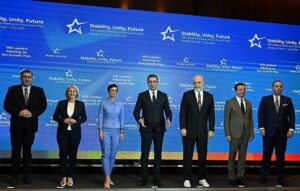



The scheme would offer candidate countries EU perks before membership — without the political rights that doomed earlier proposals.
 Gabriel Gavin, Nicholas Vinocur



Unlike earlier ideas for “reverse enlargement,” which would have granted countries political rights before completing the accession process (the plan was rejected by EU capitals), gradual integration would offer membership-style economic benefits without bringing countries into the EU before they are deemed ready.
The proposal already has more political momentum than earlier plans. France and Germany — the EU’s two heavyweights — have previously backed similar “membership-lite” ideas for countries facing lengthy accession timelines, and officials are optimistic the approach will prove more palatable to capitals than previous schemes.
“There must be some parallel, but necessary economic integration,” said Petras Auštrevičius, the Lithuanian MEP who drafted the European Parliament’s enlargement strategy. “The more-for-more principle is well tested and should be embraced as supporting those candidates who progress better than others.”
The Commission will seek backing from EU capitals for the initiative, with officials hoping leaders will endorse work on a broader framework at a European Council in either October or December.
Under the plans, access to benefits would be granted on a case-by-case basis depending on how far each country has aligned with EU rules and how many reforms they have implemented, one official said. That would mark a significant departure from the current system, under which most benefits are reserved for full members.
The proposals come as governments broadly agree that enlargement needs to move faster, particularly in light of Russia’s war against Ukraine, but remain wary of admitting countries before they are fully prepared. Brussels is therefore trying to accelerate the process while building in stronger safeguards to reassure skeptical capitals.