Tea with Putin in Sochi, Peskov in New York, oligarch sponsors in Dubai, and other ways the Russian elite captured the global chess circuit – an insider’s guide by Peter Heine Nielsen, the coach of chess champion Magnus Carlsen.
 Andrew Rettman



Tea with Putin in Sochi in 2014, Peskov pops into New York in 2016, oligarch sponsors in Dubai, and other ways the Russian elite captured the global chess circuit – an insider’s guide by Peter Heine Nielsen, the Danish coach of Norwegian chess champion Magnus Carlsen.
[EUobserver] Why are you in Hong Kong today [16 June]?
[Heine Nielsen] I’m Magnus’ coach and he’s playing [in the World Rapid and Blitz tournament] here, so … Also, we had [Russian FIDE president Arkady] Dvorkovich do the official opening press conference today, with Magnus and other team members. Everybody on the chess circuit is here.
What does Dvorkovich normally do at FIDE events?
In principle, he’s in charge of the tournament, but, of course, FIDE has other people who deal with organisation. Dvorkovich walks around a bit and mingles with players. He’s quite approachable and I’ve spoken to him. But he’ll also be meeting local VIPs and politicians, some might say to campaign [for his re-election as FIDE head in September], or to exercise Russian soft power. He’d say it was just part of his job.
Do Carlsen and Dvorkovich chat?
Not much, a bit, of course. Mr. Carlsen doesn’t chat much with anybody. He also tries to stay out of chess politics. As for me, I’m more outspoken, but my political views are entirely my own. I don’t speak for him. As his coach, I also have to respect professional confidentiality.
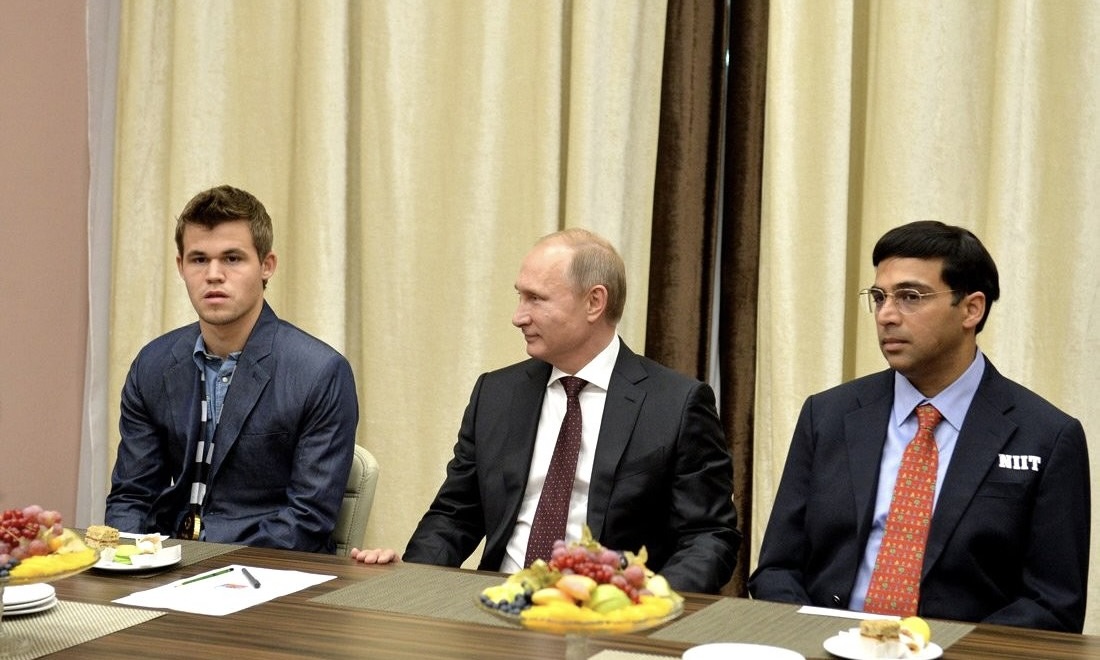 Carlsen (l) with Putin (c) in 2014 (Source: Kremlin)
Did you also meet Russian president Vladimir Putin when he posed for photos with Carlsen in Sochi (Russia) in 2014?
It was the World Championship match and Dvorkovich was the main organiser. This photo was from the closing ceremony. I was already Magnus’ coach, but I wasn’t there, as I’d recently become a father, so I rushed home after the last match had ended the day before. Putin used to invite chess players for tea. It might sound like a joke these days, but it shows how highly Russian society values chess.
I’ve seen a lot of elite Russian politicians at FIDE championships. In 2016 at the World Championship in New York, for instance, when Magnus was defending his title against a Russian challenger, [Sergey] Karjakin, who is now a senator in [Russian-occupied] Crimea [in Ukraine], [Putin’s spokesman Dmitry] Peskov turned up for the match. I had no clue who Peskov was until my wife told me, but there he was, just a few metres away from us, rooting for Karjakin, who lost in the end. I later read in the Mueller Report [on Russian election interference] that the Kremlin had used the World Championship games to try to establish a back-channel to [now US president Donald] Trump.
In the World Championship in Dubai in 2021, [Andrey] Guryev [a Russian fertiliser billionaire] gave out the trophy. I think [Andrey] Simanovsky [a Russian retail baron] also sponsored the event, while [Sergei] Sobyanin [the mayor of Moscow] and [Natalia] Komarova [a Russian governor] were invited as VIPs, introduced to Dvorkovich, and made first moves in games. You see a lot of high-profile Russians at FIDE championships, who come with their whole entourages of various employees.

Would Carlsen play in Russia or against a Russian player?
He hasn’t played in Russia since 2022 [Putin’s full invasion of Ukraine], that I’m certain of. Very few players have.
He has played against Russian opponents though. If you refused to play Russians, you’d struggle to find major tournaments to compete in. Magnus has won a number of World Rapid and Blitz and Freestyle titles, for example, but it’s FIDE who controls who can enter these events. And even though the IOC [International Olympic Committee], at least until 2023, didn’t allow Russians to compete in the Olympics, even as neutrals, FIDE was letting them do it from day one [after Putin’s full invasion of Ukraine].
You wouldn’t have seen the Russian flag flying at FIDE events, but chess is covered on TV and online, so it also depends which flag Russian media put on your screen.
Since the war began, there have been a few incidents of players refusing to shake a Russian opponent’s hand.
As for Magnus, he’s normally quite apolitical, but there was one exception. At the FIDE general assembly [in Budapest] in 2024, when there was a big debate going on about letting back in Russian teams, Dvorkovich was giving Magnus a ‘greatest player of all time’ award, and, in his acceptance speech, Magnus said [Russian former chess champion, now dissident, Garry] Kasparov probably deserved it. Then he added: “And in Kasparov’s honour, I’d like to say the same thing he’d have said: Please don’t let the Russian teams back in”. So, that was a rare moment of political activism.
Unlike me, Magnus doesn’t have to shout.
Given his huge name in the chess world, did Carlsen’s remarks influence views on Russia?
It got a lot of publicity at the time and drew the attention of the outside world. But if the chess bubble existed in a vacuum, with no outside pressure, then FIDE delegations would probably have voted to let Russian teams back. Many delegations have long connections to the Russian Chess Federation and friendly relations with Russian players.
Dvorkovich is quite popular and the Russian Chess Federation is very influential, so we need outside pressure, like EU sanctions, IOC decisions, and CAS [the Court of Arbitration for Sport] verdicts.
Dvorkovich is an adept politician and he’s been careful not to make too many controversial statements on the Ukraine war since 2022.
In his FIDE election campaign [that same year], he publicly promised that if the EU sanctioned him, he would resign from his post. He’s repeated this. But then again, he also introduced two-term limits, then overturned them for himself, which shows his attitude. So, we’ll only know if he’d keep his resignation promise when or if the EU sanctions become real.
Could he still do his FIDE job if 27 EU states put him under a visa-ban and asset-freeze?
It might create some difficulties for FIDE’s bank accounts in Europe, but there’s nothing to legally prevent him from staying in his post.
The EU is 27 countries, but that still leaves a lot of other places in the world, where you can travel for tournaments, or whose chess federations can help you win FIDE elections. We can’t rule out that if EU states sanctioned him, 20 other FIDE federations would suddenly come out and proclaim: ‘You’re such a brilliant leader Mr Dvorkovich, please reconsider your promise to resign’. For Europeans, it might seem like he couldn’t function under an EU visa-ban, but he probably could.
At the same time, there’s no particular evidence against him. When I spoke to Dvorkovich, I asked him: ‘Why did you leave the FIDE congress in 2024 [in Budapest] to speak with Mr [Péter] Szijjártó [the former Hungarian foreign minister]?’. Dvorkovich replied: ‘I talk to a lot of politicians, what’s wrong with that?’. ‘Maybe to meet a sports minister, but what does a FIDE president have to talk about with Hungary’s foreign minister?’, I said.
We later learned of the wiretapped phone calls between Szijjártó and [Russian foreign minister Sergei] Lavrov, but that didn’t concern Dvorkovich directly.
Russia aside, Israel has also divided the sports and cultural arenas – have you seen that in FIDE?
Basically not, no.
I think there was one boycott incident in Spain, but FIDE reacted quickly. The Iranian Chess Federation also got fined because they refused to play Israel in the 2024 chess Olympiad.
Under Dvorkovich, FIDE has organised events in Jerusalem, which is under occupation, but this caused no major fuss.
If one goes back to his original 2018 [FIDE] election, there was a leaked letter in The Guardian newspaper at the time from the Israeli foreign minister, which said Putin had asked [Israeli prime minister Benjamin] Netanyahu for Israel to back Dvorkovich, in what may have involved a quid pro quo.
But if I’m asked, why does the chess world care more about Russia than it does about Israel, for me, it’s self-evident: Because the Russian Chess Federation and, of course, the FIDE president, are so obviously linked to the Kremlin.
The Russian Chess Federation has been systematically organising tournaments in occupied parts of Ukraine, as the CAS court verdict showed, and there’s just nothing on a comparable scale going on in chess terms with regard to the Israel-Palestine conflict.
Our politicians often think the chess world is small and doesn’t matter, but it matters tremendously to the Kremlin. So, by listing Dvorkovich, EU leaders could cause Putin quite some pain for very little cost.
As Malcolm Payne [a chess writer for The Telegraph newspaper in the UK] once said, in the West we see chess as being very niche, but the Russian elite really don’t.
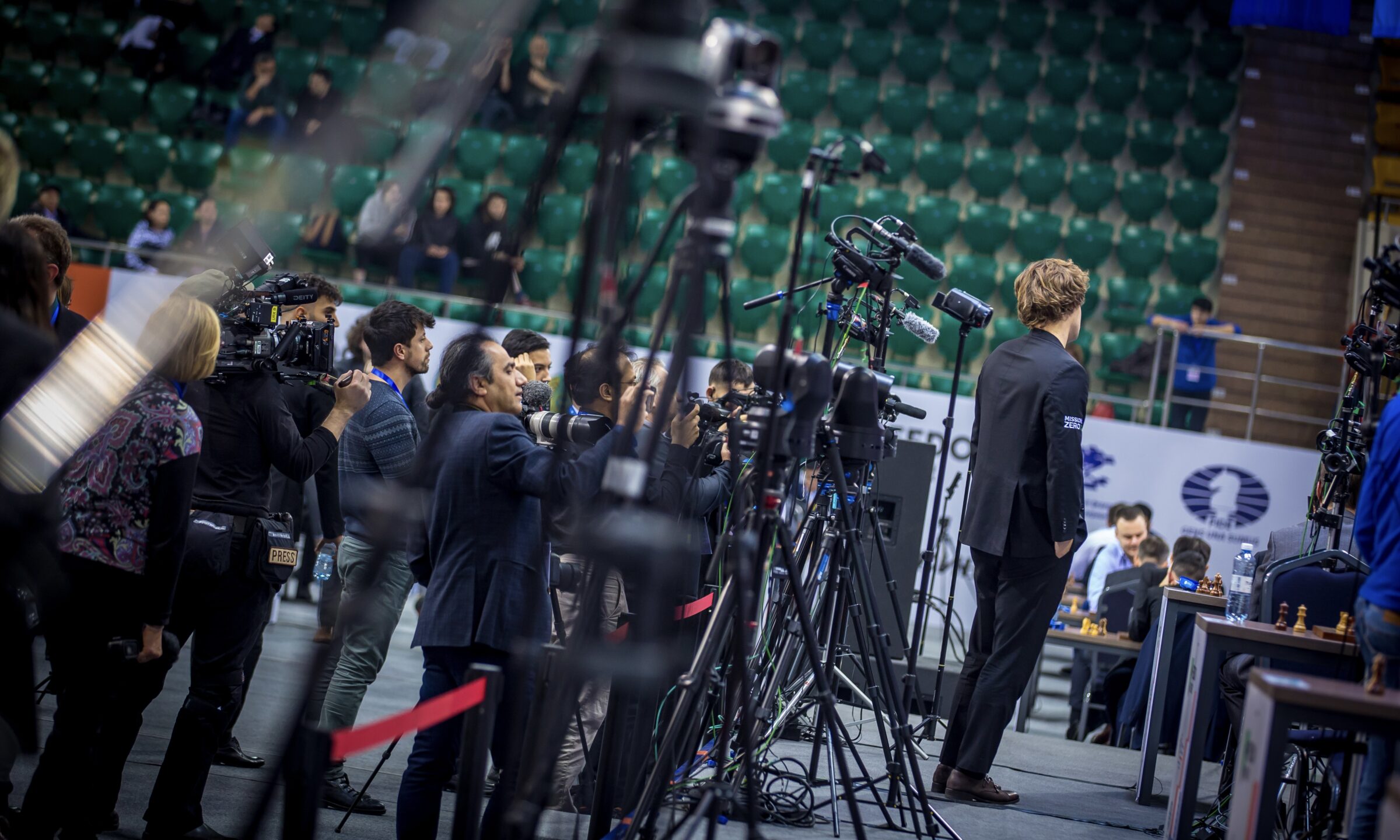 Carlsen in Almaty in 2022 (Source: FIDE)