Fuel limits have been introduced at all petrol stations from the border of Russian-occupied Donetsk all the way to the Russian city of Rostov‑on‑Don after drone strikes.
 Roman Pataj



Every day, the Ukraine Battlefield update newsletter offers a clear look at how the war is unfolding on the ground. Subscribe for free here to get the full text delivered to your inbox.
Testimonies from Z‑channels and residents of affected areas about the fuel crisis – a heavily hit area roughly 200 km wide. It is not over: drones hit more bridges, black rain fell from the sky. In Kyiv, after a Russian air raid, one of the most important Orthodox churches in the world was on fire + an overview of where Russia bombed Ukraine. Former Slovak MiGs in Ukraine are still fighting, the 114th Brigade released new photos. Russia is pushing towards Kupiansk from the east. Ukrainians are advancing on the border of Dnipropetrovsk and Donetsk regions. Maps of the day – major Russian air raid on Ukraine; attacks on bridges to Crimea; Russian advance on Kupiansk; Ukrainian gains in the south. Videos of the day – fire at the Kyiv Pechersk Lavra; black rain falling in Russia; strike on a car park near Dzhankoi; Russia sent 43 FPV drones against a bridge before destroying it.
Testimonies from Z‑channels and residents of affected areas about the fuel crisis – a heavily hit area roughly 200 km wide. “There is no petrol in Donetsk and across the so‑called DPR (the puppet Donetsk People’s Republic, editor’s note),” wrote over the weekend the pro‑war Russian blogger and volunteer Vladimir Romanov, author of the Romanov Lajt channel.
He claimed that along the entire route between occupied Donetsk and the Russian village of Avilo‑Uspenka on the Ukrainian‑Russian border he had not found a single petrol station with fuel. The same applied to Donetsk, more than 70 km away, as the crow flies.
From a logistical point of view, this is an almost apocalyptic picture. It is the same distance as from the centre of Bratislava to Břeclav in the Czech Republic.
The Ukrainian account Petrenko continued with a grim description, from which it followed that the crisis had already spilled over from the occupied territories directly into Russia. Fuel limits have been introduced at all petrol stations from the border of Donetsk region all the way to the Russian city of Rostov‑on‑Don. From the aforementioned Avilo‑Uspenivka it is 58 km as the crow flies, and significantly more by road. Acute fuel shortages thus affect a strip roughly 200 km wide.
“The seriousness of the situation lies in the fact that even soldiers operating on the front line have no fuel,” Romanov complained. He described how soldiers of an unnamed unit decided to buy fuel supplies at their own expense. They therefore went as far as Rostov region, that is already on Russian territory, but since there is a blanket ban on selling fuel into barrels and jerrycans and quantity limits are in place, they failed. “At all petrol stations in Rostov region, they refused to pump fuel into barrels for soldiers who are advancing at the front,” Romanov said.
One of the Russian Z‑channels even described a situation in which residents were shouting abuse at other soldiers in another location.
The Russian war correspondent Pavel Kots tried to write something more optimistic, but with dubious results. He described how along the entire route from Starobilsk, through Luhansk to Donetsk he counted only four burned‑out fuel tankers. In Luhansk region it was possible to refuel without queues (“only 20 litres, but at least at every station”). In Donetsk, however, fuel is available only at some petrol stations, in some places only in the morning, elsewhere until ten in the evening, and people wait in queues for two to three hours.
“But in a city where water runs once every three days, this does not make you want to tear out the remaining hair while screaming ‘Everything is lost!’. Will that help? It will not,” Kots concluded his post, in which he admitted that, although the situation in Luhansk region was somewhat better, Russia faced serious fuel problems across all of Ukraine.
The most serious situation remained in Crimea. Another war correspondent, Roman Saponkov, published two testimonies from residents of Crimea. The first sounded somewhat more optimistic. Its author described that there was fuel in the ATAN network (we reported this on Friday as well), but the problem was that too little was being delivered and “by far not everyone gets some. One such station is just near me. Cars are already parked there. Drivers have simply left them there so that tomorrow they will be in the queue.”
As the witness admitted, “prices have shot up to the heavens, but people no longer look at the price, only at availability.” In other words, the black market in fuel is booming in Crimea. Yet the author still claimed that conditions were bearable and that “in the ‘new territories’ the fuel problems are even worse.” What worried him much more was that Ukrainian drones were flying completely unimpeded and it seemed to him that nobody was fighting them.
A note on Russian terminology – a Russian from occupied and stolen Crimea speaks about other occupied territories in Ukraine as “new territories”.
The second testimony published by Saponkov is from the perspective of a resident who does not live in Sevastopol. Fuel is mostly available via a QR code, but even getting that is difficult. “Many write about this as if it were some kind of salvation for Crimea. Nonsense,” the second account began.
Its author lives on the western coast of the peninsula, 300 km from Kerch and the Crimea Bridge and 20 km from the town of Chornomorske. She cannot go to Russia to refuel because she does not have the fuel for that, and since 30 May she had not managed to fill up at home even once.
“Today (on Sunday) diesel was on open sale, but I need 95. Yes, sometimes they sell it with a limit of 20 litres, but people wait in queues for 12 to 24 hours,” the anonymous author continued, adding that travelling further away for petrol was not worth it, because on the way there she would use up a large part of her fuel, and if she did not manage to fill up, she would have no way to get back home.
“I am already willing to buy petrol at double or triple the price, just so that it is without waiting in queues – but there is no such option. Public transport does not run to us. Tourists are massively cancelling reservations. For now I am somehow coping, but patience is already running out.”
It is not over: drones hit more bridges, black rain fell from the sky. In the meantime, the drone offensive did not let up. The targets again included bridges to Crimea, which had to be temporarily closed, further worsening an already bad situation.
❗️Russian-installed Kherson governor Vladimir Saldo said overnight drone strikes damaged two key transport links in occupied Kherson region: the Chonhar bridge and the bridge connecting Henichesk with the Arabat Spit. Traffic on both crossings has been halted. #Ukraine pic.twitter.com/mjde8HB9Qz
— NOELREPORTS 🇪🇺 🇺🇦 (@NOELreports) June 15, 2026
Ukrainians are also systematically destroying oil and fuel storage facilities, spreading the crisis to other regions. One such place is Rybinsk, 260 km north‑east of Moscow. Ukrainian Liutyi drones repeatedly struck the facilities there.
Ukrainian long-range drones have severely struck the oil depot of Rybinsk, Yaroslavl, in Russia. The drones just keep on coming. pic.twitter.com/uM8fsmKwG8
— (((Tendar))) (@Tendar) June 14, 2026
The result was, among other things, an environmental disaster. An oily rain fell on the city.
Oil also reached the local river.
In Kyiv, after a Russian air raid, one of the most important Orthodox sites in the world was on fire. The grounds of the Kyiv Pechersk Lavra were hit. Footage showed that at least the roof was burning. There is no doubt that this was the result of the massive Russian air raid from Sunday to Monday. The direct cause, however, is not known.
According to the Ukrainian website NV, the fire affected 800 square metres of the church roof. After the attack, religious relics and museum exhibits were evacuated from the cathedral. The shelling caused a fire in the roof of the Assumption of the Blessed Virgin Mary. During the firefighting, relics and works of art were taken out of the building. While rescue work was under way, the National Cultural, Arts and Museum Complex was also hit.
Russia bombed the Kyiv Lavra — the holiest Orthodox site in Eastern Europe — and, among other targets, Ukraine’s main cinema studio. After his long conversation with Trump yesterday, Putin was confident he can launch a war of extermination on Ukrainian culture and national… pic.twitter.com/dFc8Y6TQ65
— Yaroslav Trofimov (@yarotrof) June 15, 2026
“This is not just another attack on Kyiv. It is a blow to one of the most sacred sites of world Christianity. It is a blow to the Lavra, which is on the Unesco World Heritage List. It is a place that Russia has tried for decades to appropriate as ‘its spiritual heritage’. This is the answer to all their talk about ‘defending Orthodoxy’. They do not protect holy sites. They destroy them,” NV quoted the Ukrainian historian Oleksandr Alfiorov as saying.
The bells of the Lavra rang out across Kyiv after Russia’s massive attack on the capital.
A sound of faith, resilience, and survival above a city that endured another night of terror. pic.twitter.com/hnjv3VWYNt
— Saint Javelin (@saintjavelin) June 15, 2026
The Kyiv Pechersk Lavra is indeed a sacred place for Russians as well. Throughout the war they have been spreading nonsense about how it was taken over by satanists and the like. Now they claim that it was hit by debris from a Ukrainian air‑defence missile. They put out this claim virtually immediately after information about the fire appeared. It cannot be ruled out that the Lavra was indeed ignited by remnants of some Ukrainian weapon, but it is highly unlikely that Russia could have known that so quickly.
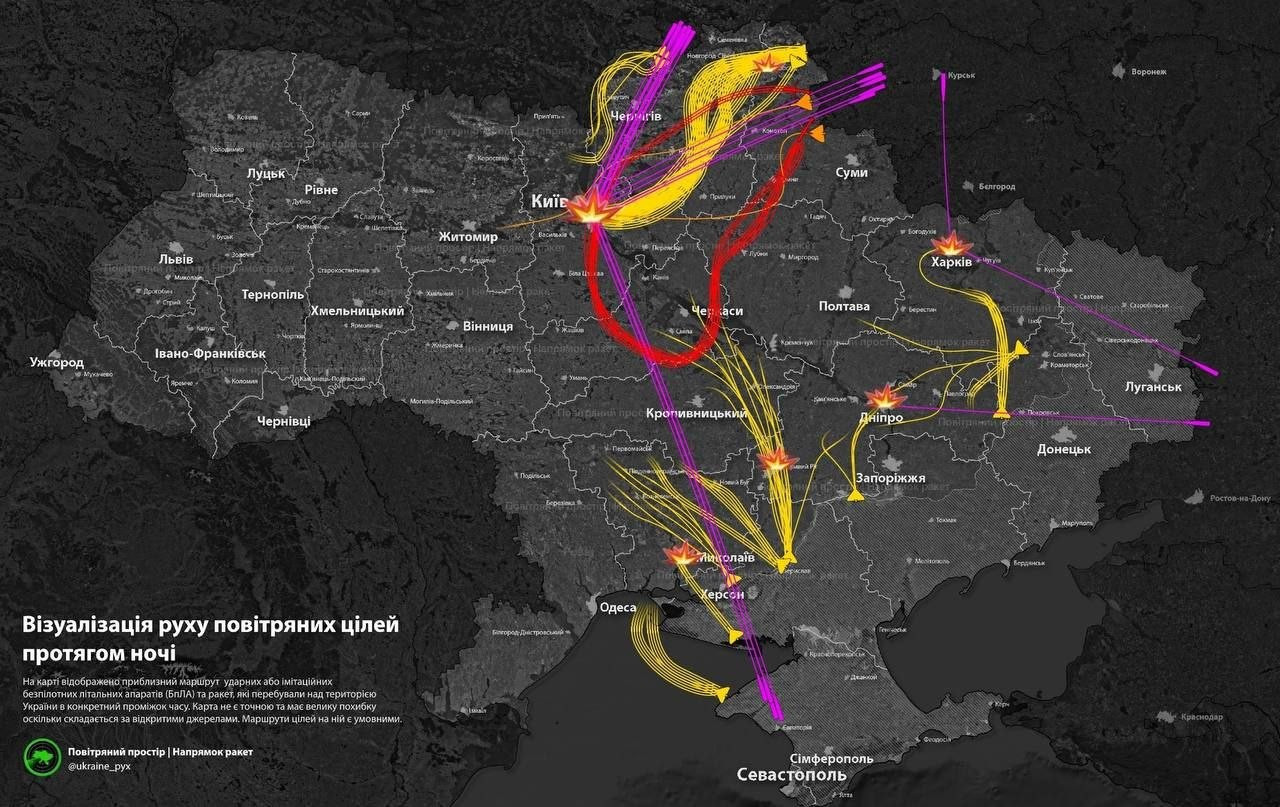
Otherwise, they are very pleased with the air raid. They claimed that in Kyiv they hit seven factories producing long‑range drones or their components. In addition, they hit the central warehouse of Nova Poshta, a delivery company they accuse of supplying the Ukrainian army. Other targets included Dnipro, Kharkiv, Odesa and additional cities.
In total, 681 missiles, cruise missiles and drones were launched towards Ukraine. The Ukrainian army said it managed to shoot down 632 targets, but 20 ballistic missiles and 27 drones got through and hit 42 different targets. Debris struck another 12 locations. By the time this text was published, five fatalities were known.
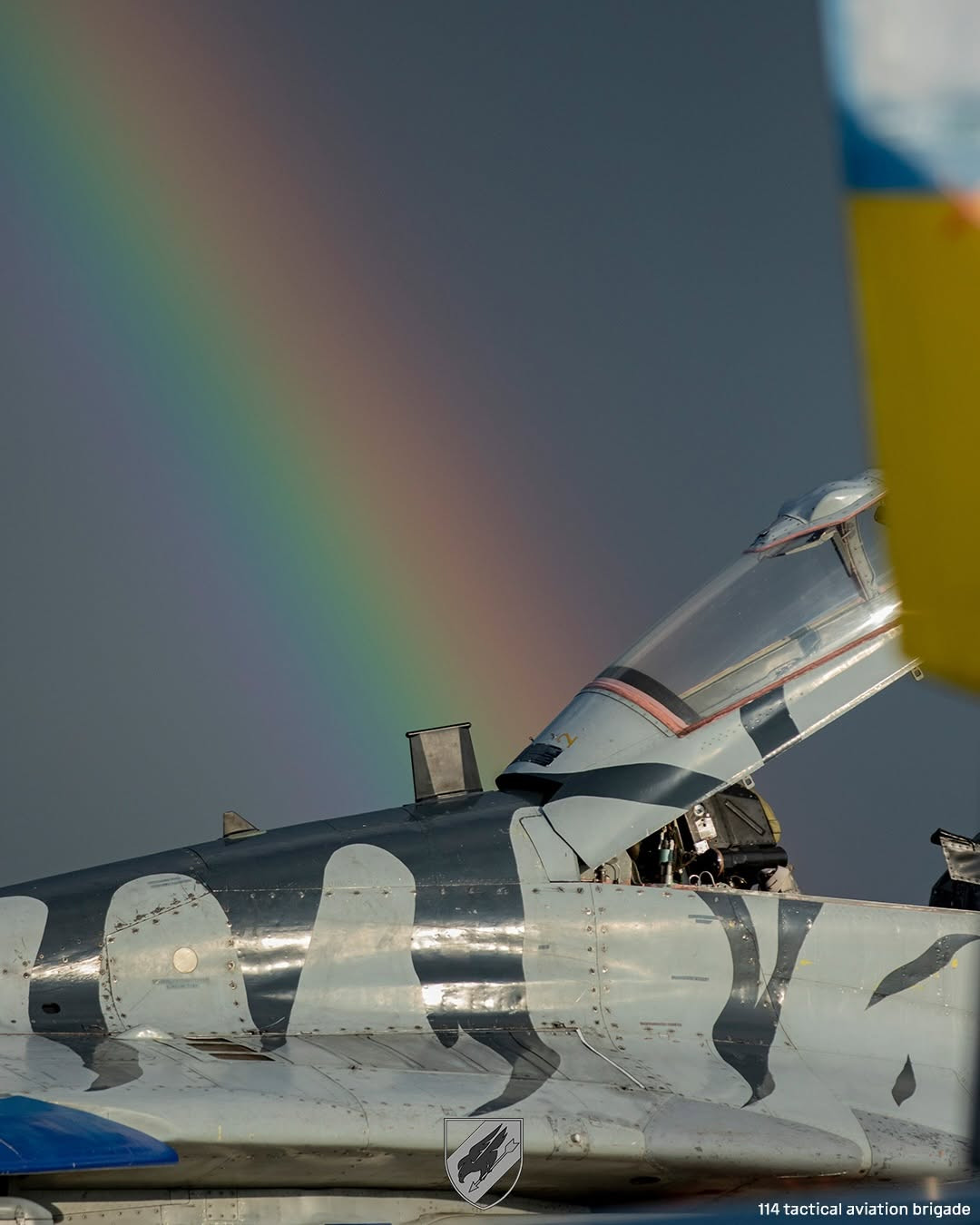
Former Slovak MiGs in Ukraine are still fighting, the 114th Brigade released new photos. It has been more than three years since March 2023, when Slovakia donated its MiG‑29 aircraft to the Ukrainian army. There were 13 of them, of which only a smaller number actually flew in. The rest were moved by land because of their poor technical condition. Since then, Russia has carried out dozens of air raids on Ukrainian air force bases, while the Ukrainian air force has flown thousands of combat missions in the same period.
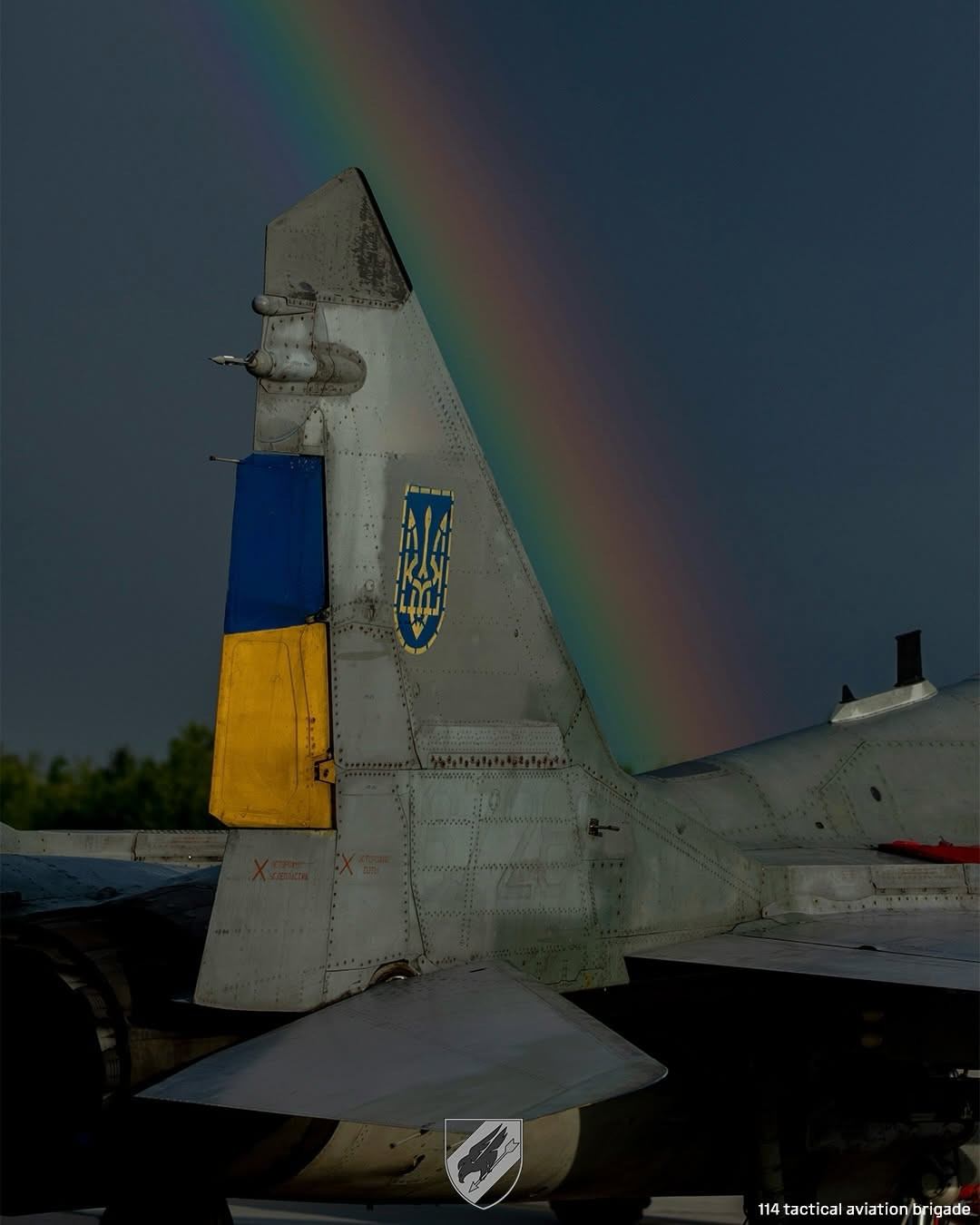
Today, thanks to a new series of photographs published by the 114th Tactical Aviation Brigade, we know that at least two former Slovak MiG‑29s are still flying in Ukraine.
It can be said with certainty that the legendary two‑seater “tiger”, which carried the number 1303 in our air force, is still flying, as well as the single‑seater that flew here with the number 6728.
The first is unmistakable thanks to its two‑tone grey camouflage imitating a tiger pattern. The fact that it is an aircraft from Slovakia is also evidenced by the distinctive antenna behind the cockpit, installed after modernisation. Only Slovak and Polish aircraft carried them.
The second MiG‑29 originating from Slovakia has the same antenna. Identification is in this case also easy and unambiguous. This MiG has a two‑tone grey‑green camouflage pattern that neither Ukrainian nor Polish aircraft used. In addition, on the vertical tail surface under the Ukrainian trident, which has covered the original Slovak roundel, the original number 6728 clearly shows through the new paint.
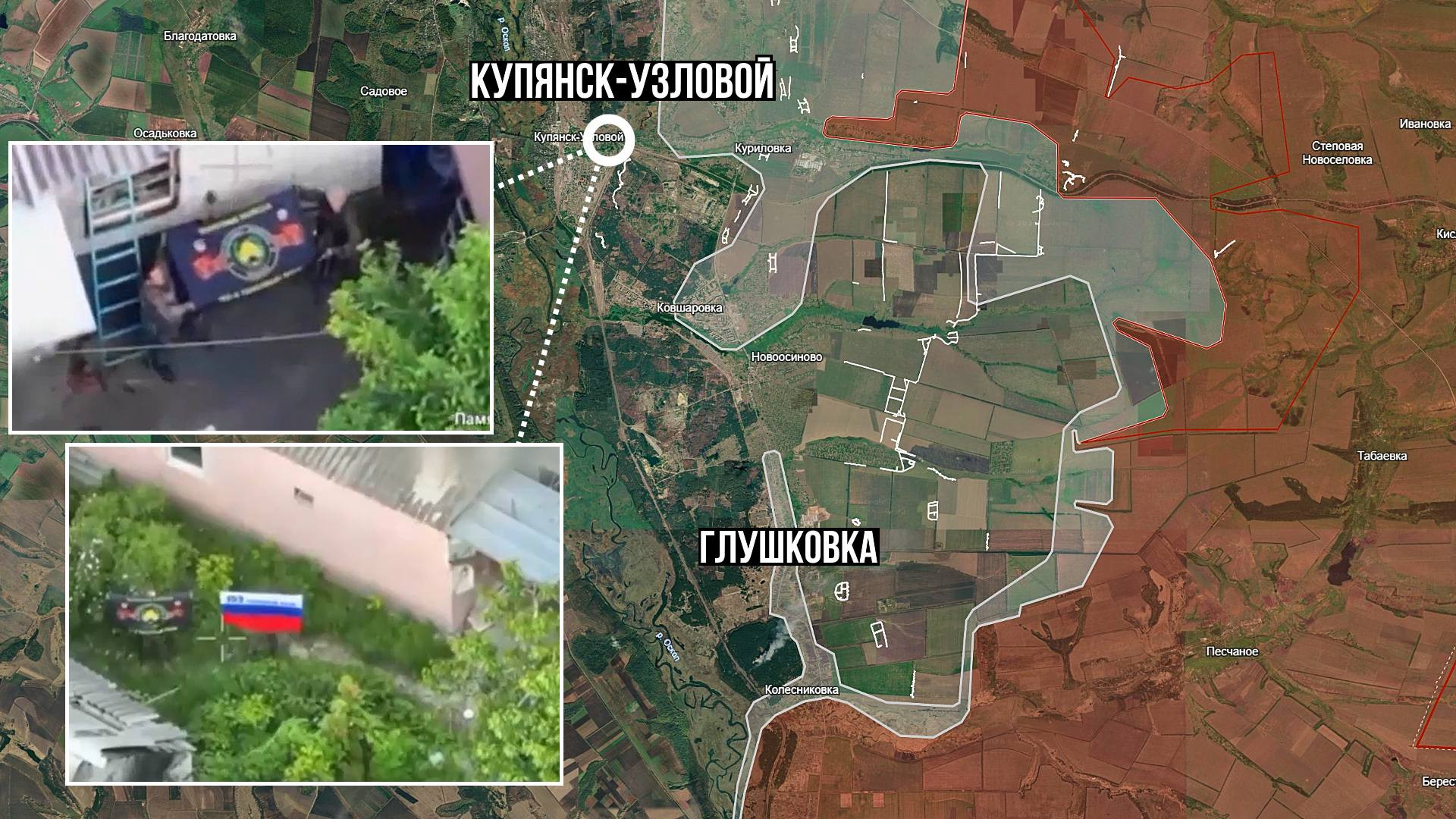
Russia is pushing towards Kupiansk from the east. Specifically through Kupiansk‑Vuzlovyi, where they raised their flags in the eastern part of the settlement. This does not mean that the village is lost. It often happens that it is only a short‑lived infiltration and the soldiers seen in the footage are quickly eliminated, but as the Ukrainian analyst Petrenko pointed out, the very penetration into the interior of the settlement is proof that Russia has advanced.
They also showed flags in nearby Hlushkivka. A look at Petrenko’s map makes it clear this does not mean anything good. If Russia’s advance is not stopped here, there is a risk that defenders further east will be cut off and could end up trapped in an encirclement.
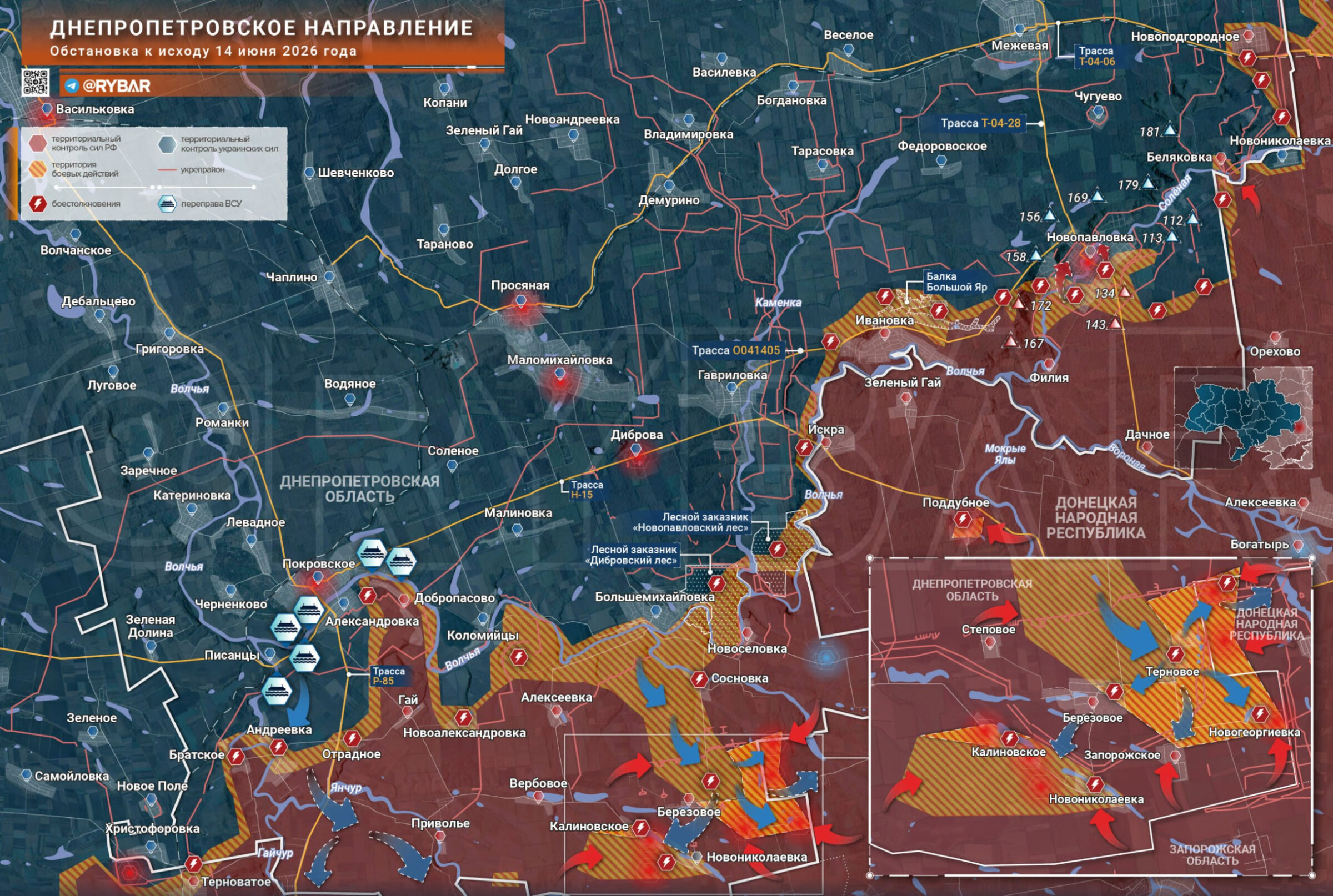
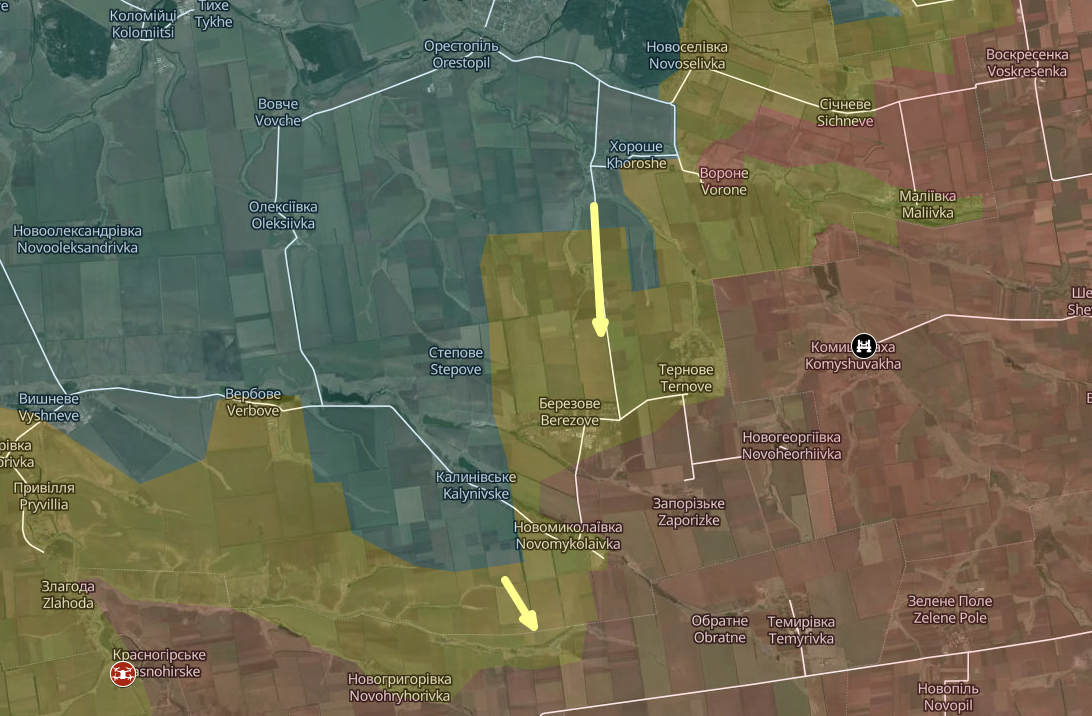
Ukrainians are advancing on the border of Dnipropetrovsk and Donetsk regions. This is confirmed by both Ukrainian and Russian sources. First, we will show a map by the Russian Rybar. It depicts the area to the east/north‑east of the village of Ternuvate, where the Ukrainian army took the initiative in February.
Rybar shows a deep Ukrainian penetration towards the village of Berezove. His map attracted a lot of attention over the weekend, but it repeats the pattern familiar from Rybar’s maps in sectors of the front where Ukrainians are doing well – it lags behind reality (and often jumps ahead in favour of Russia).
For comparison, here is approximately the same area from independent analyst Andrew Perpetua. Places that Rybar marks in red as securely controlled by the Russian army are, on this map, at best in a grey zone and at worst (for Russia) under Ukrainian control. Perpetua also marked a Ukrainian attack here.
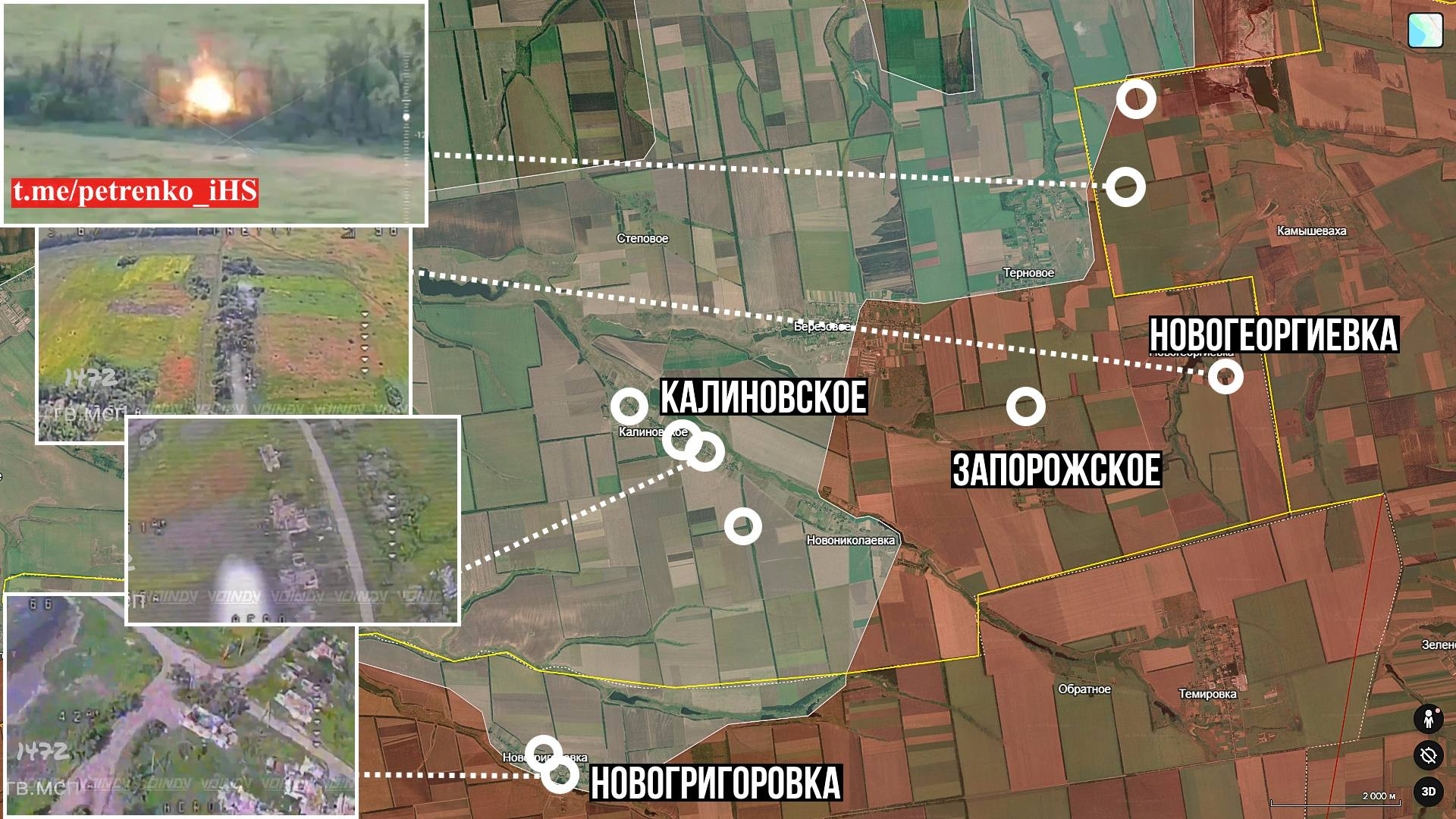
Rybar did not report on a place that worried Russia even more. It lies a little further to the east.
“Russian forces were pushed out of several positions near the border with Donetsk region. Fighting continues in the areas of Kalynivske, Novomykolayivka, Novohryhorivka, Zaporizke, Novoheorhiivka and Ternove,” the Ukrainian account Petrenko wrote. In addition, according to several sources, Ukrainians advanced as far as the village of Piddubne.
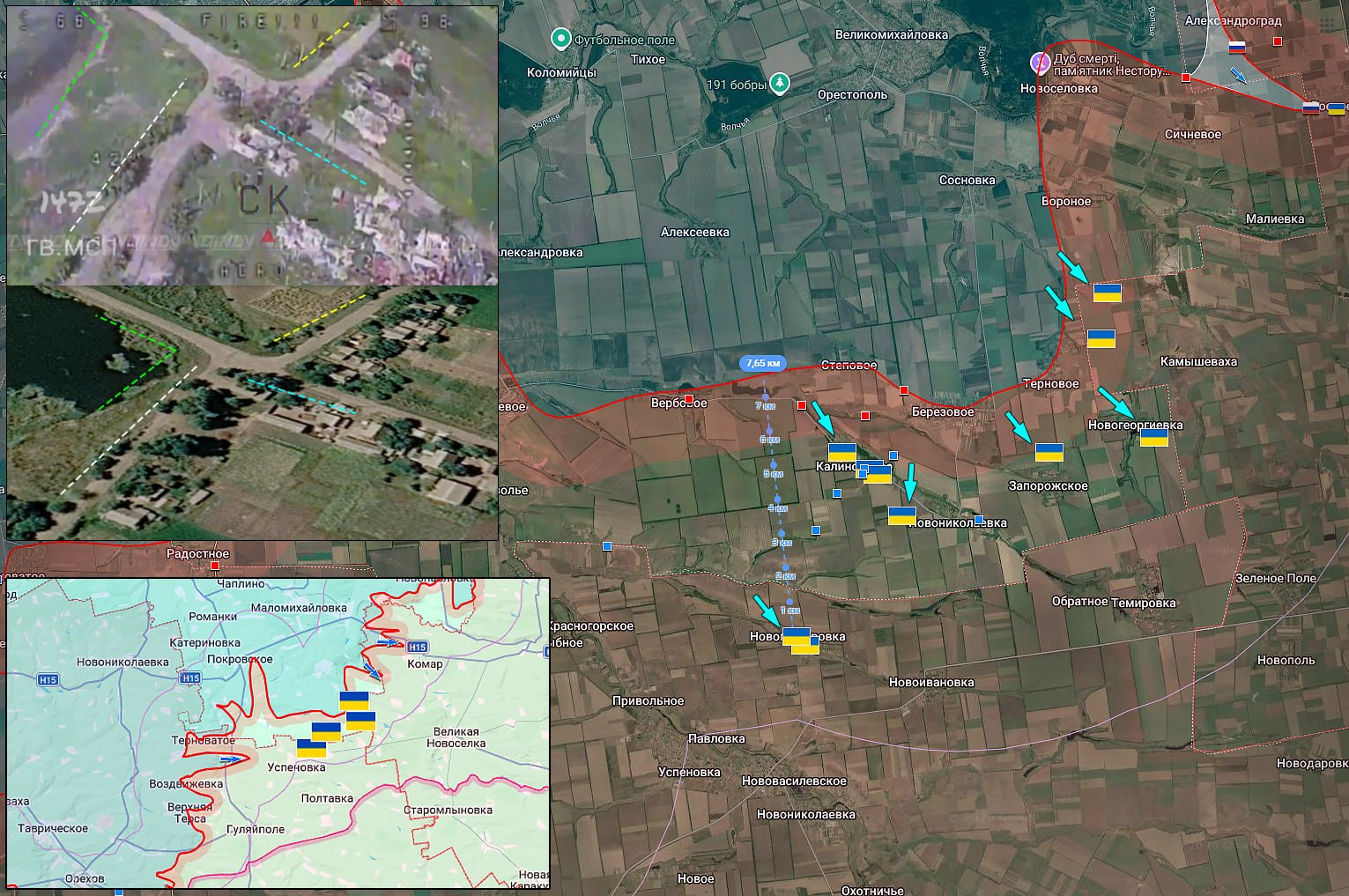
The Russian mapmaker writing under the name Slivochnyi Kapriz drew the most dramatic picture of all. According to him, Ukrainians penetrated between the villages of Verbove and Stepove to a depth of eight kms. On Rybar’s map, this Verbove lies safely in Russia’s rear.
Videos of the day
Drones set fuel tanks on fire in Rybinsk, Russia.
Ukrainian long-range drones have severely struck the oil depot of Rybinsk, Yaroslavl, in Russia. The drones just keep on coming. pic.twitter.com/uM8fsmKwG8
— (((Tendar))) (@Tendar) June 14, 2026
Russia used 43 small FPV drones to destroy the supports of a road bridge. The Ukrainian army had used it to supply units in the Lyman sector.
The Russians employing 43 FPV drones to crush concrete support columns of a road bridge on the Nitrius river in Ukraine’s Kharkiv Oblast.
Ultimately, the bridge collapsed. pic.twitter.com/Apz4Yu25Ed
— Status-6 (War & Military News) (@Archer83Able) June 12, 2026
The car park near Dzhankoi is not safe. Given that, it was surprisingly full.
What are the losses
Last updated on Monday (6 June).
By Monday (6 June) Russia had demonstrably lost 23 593 pieces of heavy equipment (on Monday (1 June) it was 23 556). Of these, 18 585 (18 551) pieces were destroyed by Ukrainians, 982 (979) were damaged, 1 199 (1 199) were abandoned by their crews and 2 827 (2 827) were captured by the Ukrainian army. This includes 4 397 (4 394) tanks, of which 3 300 (3 293) were destroyed in combat.
Ukraine lost 11 425 (11 397) pieces of equipment, of which 8 888 (8 863) were destroyed, 680 (678) damaged, 670 (669) abandoned and 1 187 (1 187) captured. This includes 1 426 (1 424) tanks, of which 1 091 (1 089) were destroyed in combat.
Note: Neither side regularly reports on its dead or destroyed equipment. Ukraine publishes daily figures on Russian casualties and destroyed equipment, which cannot be independently verified. In this overview we use data from the Oryx project, which since the beginning of the war has been compiling a list of equipment losses documented exclusively by photographic evidence.