Life in Ukraine and Kyiv goes on. But there are islands of hurt, destruction, loss, scattered across the landscape, hidden behind polite smiles, encoded in the language
 Wester van Gaal



Three hours west of Kyiv, the air raid alerts on my phone start bleeping.
“Attention, air raid alert, proceed to the nearest shelter. Don’t be careless. Your overconfidence is your weakness,” the voice blares.
It takes me a while to realise the voice belongs to Mark Hamill, the actor who plays Luke Skywalker in Star Wars.
He lent his voice to the English-language version of Air Alert, an app many people in Ukraine use to monitor drone and missile attacks.
Hamill starts yelling if a drone is spotted in your region. Movement and activity of Russian warplanes and missile launch sites are also monitored closely. If a launch is suspected, or a fighter plane is readied, the entire country is put on alert.
Because strikes can happen anywhere. The day before our team arrived in the western city of Lviv, Russia launched one of the heaviest attacks on civilian infrastructure since the beginning of the war. Our fixer, arriving from Kyiv on an eight-hour drive, hadn’t slept.
Most of the 600 drones and 90 missiles, including 36 ballistic missiles, struck the capital, and the sound of near-constant explosions made sleep impossible.
But Kyiv wasn’t the only target. Attacks were reported across the country, including an Oreshnik strike on a town south of the capital, not far from our route, against which Ukraine’s air defences are ineffective.
As we drive, into the outer boroughs of Kyiv, Hamill starts again: “Attention, the air alert is over. May the force be with you.” Outside, a soldier gets out of a car and throws down his pack. A young woman jumps into his arms, legs wrapped around his waist.
The war manifests itself in these vignettes. Life in much of Ukraine and Kyiv goes on. But there are islands of hurt, destruction, loss, scattered across the landscape, hidden behind polite smiles, encoded in the language.
Heroes. Not soldiers. Cat memes shared on TikTok as a nationwide mental health fix.
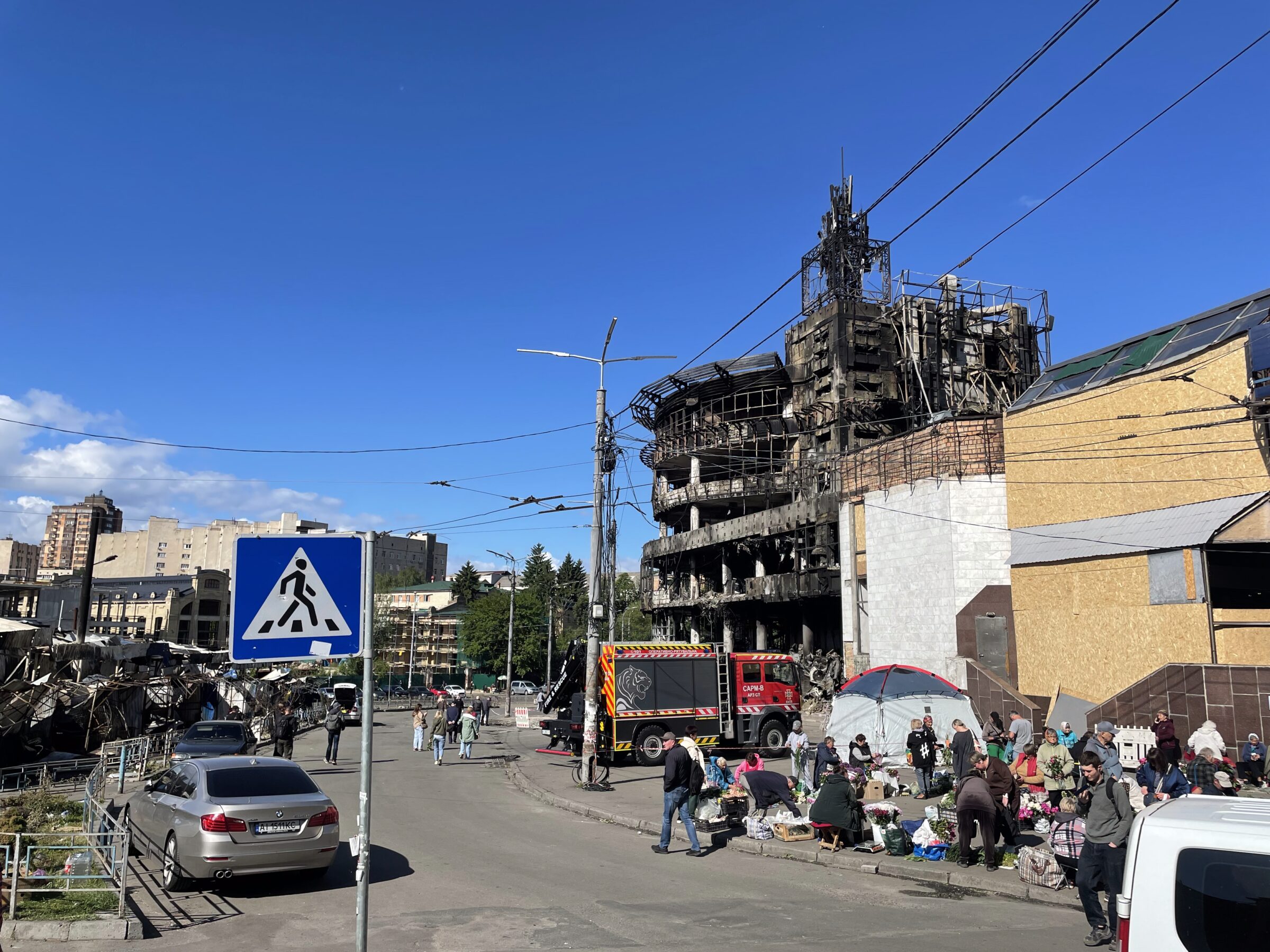
In Kyiv, the next day, a group of about two dozen older women, lovingly called Babushka’s, are selling flowers on the street. Behind them stands the charred husk of what used to be the Kvadrat shopping mall.
A Russian missile bored directly into the roof in an overnight attack on 24 May. Firefighters are still clearing the burned-out remains. The women used to sell flowers inside. Now they sell them on the street. “We have to. We don’t have money to stop,” one of them says.
Across the street, a man who opened a coffee shop just before the strike and lost it the next day gives away coffee for free with the equipment he managed to save, grateful for those who showed up to offer their support.
In a historical irony that is hard to miss, the Soviets built Kyiv’s metro to withstand nuclear attack in the sixties. Many people sleep in them during raids. Others prefer to stay at home.
A young man says he ignores air raid alarms because there’s “nothing you can do anyway.”
A young mother waits until her husband and baby are safely in the shelter, then takes her coffee to the balcony “in proper porcelain”. During the worst raids, she pretends the exploding drones and missiles are fireworks. “It calms my mind, I need it now,” she says. What is ‘it,’ I wonder.
She starts laughing. As she turns away, she shows me a TikTok of a cat holding its nose over a map of Ukraine covered in bombs.