Most will see the maritime bill as legal codification of regional assertiveness, but it’s also a lot more: A way of legitimising Turkey’s geopolitical revisionism.
 admin
admin



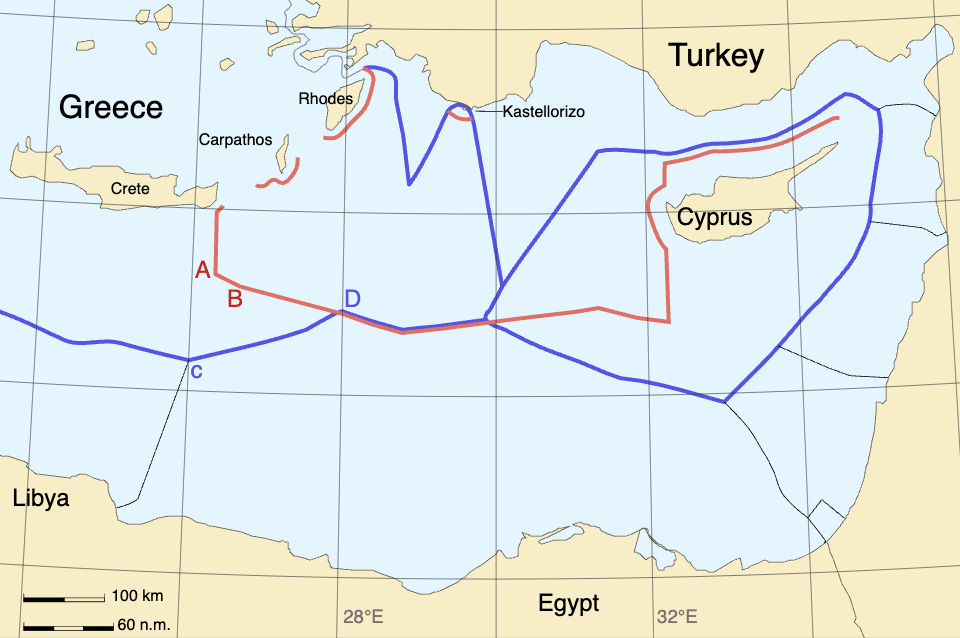
Turkey’s denial of past demographic violence in the region underpins its territorial fiction of an uncontested Anatolian and maritime continuity, while its emerging ‘Blue Homeland’ doctrine extracts contemporary entitlement from that fiction.
These are not parallel state projects. They are the same project, operating in different registers — and one of them is about to become law.
In the coming weeks, the Turkish parliament is expected to take up the Maritime Jurisdiction Areas Law — the legislation that codifies Turkey’s Blue Homeland doctrine.
Presented in May by Ankara University’s National Center for the Sea and Maritime Law (DEHUKAM) and senior figures from the Presidency’s Board of Security and Foreign Policies, the 14-article draft would write into domestic legislation Turkey’s positions on territorial waters, continental shelf, and exclusive economic zone (EEZ) — including the claim that islands do not generate continental shelves on equal terms with mainland territory.
Most observers will read it as the legal codification of an increasingly assertive maritime doctrine. It is also something more consequential: the legislative output of a longer state project that helps constitute the legitimacy environment within which such revisionism becomes governable, teachable, and legally codifiable.
That environment extends well beyond naval strategy. For decades, Turkish state institutions, academic networks and public diplomacy platforms have worked to normalise a version of history in which the demographic violence of 1914–1923 in Turkey either disappears or is recast as a defensive national struggle.
The Turkish foreign ministry’s annual 19 May statement — issued on the day Greece commemorates the genocide of the Pontic Greeks — dismisses Greek commemorations as “baseless,” demands recognition of atrocities against Turks and other ethnic groups from the 1821 Tripolitsa massacre to Western Anatolia after 1919, and calls on Athens to stop “exploiting history for political motives.”
This is not diplomatic noise. It is regular maintenance of a normative frame.
Geopolitical revisionism
The link between this memory infrastructure and the maritime bill is operational. Both rest on the same revisionist premise: a state-centred historical narrative in which Turkey appears as perpetually wronged, and therefore entitled to revise outcomes it considers unjust.
Historical and geopolitical revisionism are not separate agendas. They are the same agenda articulated across different instruments.
DEHUKAM itself illustrates the overlap. The institution that presented the bill does not merely study maritime law; it produces the maps supporting Turkish jurisdictional claims and operates in close coordination with presidential advisory structures.
The bill’s public unveiling was led by the acting chair of the Presidency’s Board of Security and Foreign Policies, Çağrı Erhan, a foreign policy adviser to Turkish president Recep Tayyip Erdoğan. The historical-legal-maritime ecosystem is integrated by design.
So is the language that surrounds it.
Turkish official discourse describes 1919–1922 as a “War of Independence” against foreign “invasion,” the Lausanne Treaty as a recurring source of unjust constraint, and the Mediterranean as a “Blue Homeland.”
These terms appear across ministerial statements, school textbooks, English-language think tank output, and now legislative drafting.
The repetition is not a rhetorical habit. It is a doctrine articulated consistently enough that, by the time a bill is introduced, the terms feel natural rather than contested.
European response?
The standard European response treats memory questions as historical specialists’ business and maritime questions as matters for international law.
This compartmentalisation is precisely what allows the integrated Turkish project to operate uncontested. International law assumes that maritime claims rest on legal arguments; it has fewer instruments for engaging claims that rest on historical premises that themselves remain unchallenged in mainstream discourse.
One objection writes itself: revisiting 1914–1923 in 2026 is historical grievance, not contemporary policy. The objection misreads what is happening. Ankara does not treat these questions as historical. It restates its position annually, codifies adjacent claims legislatively, and invests continuously in the international diffusion of its narrative.
The Greek side of this asymmetry deserves honest acknowledgement. Athens commands a smaller state apparatus and fewer instruments of international narrative projection; some of the deficit is structural. But not all of it.
Greece holds substantial assets it does not coordinate — a sizeable diaspora, archival holdings in third countries, natural alignments with Armenian and Assyrian memory movements, and existing research infrastructures without strategic direction. The problem is partly capacity, more substantially allocation.
What follows for European policy is straightforward. Treating the Blue Homeland legislation as a purely maritime question — to be answered in maritime terms — concedes the analytical frame before the negotiation begins. Responding only at the legal layer leaves the underlying infrastructure untouched, and therefore available for the next legislative iteration.
In international politics, narrative infrastructures are not soft power. They are legitimacy infrastructure. The maritime bill will be debated as law. It should also be read as evidence of how memory becomes statecraft.